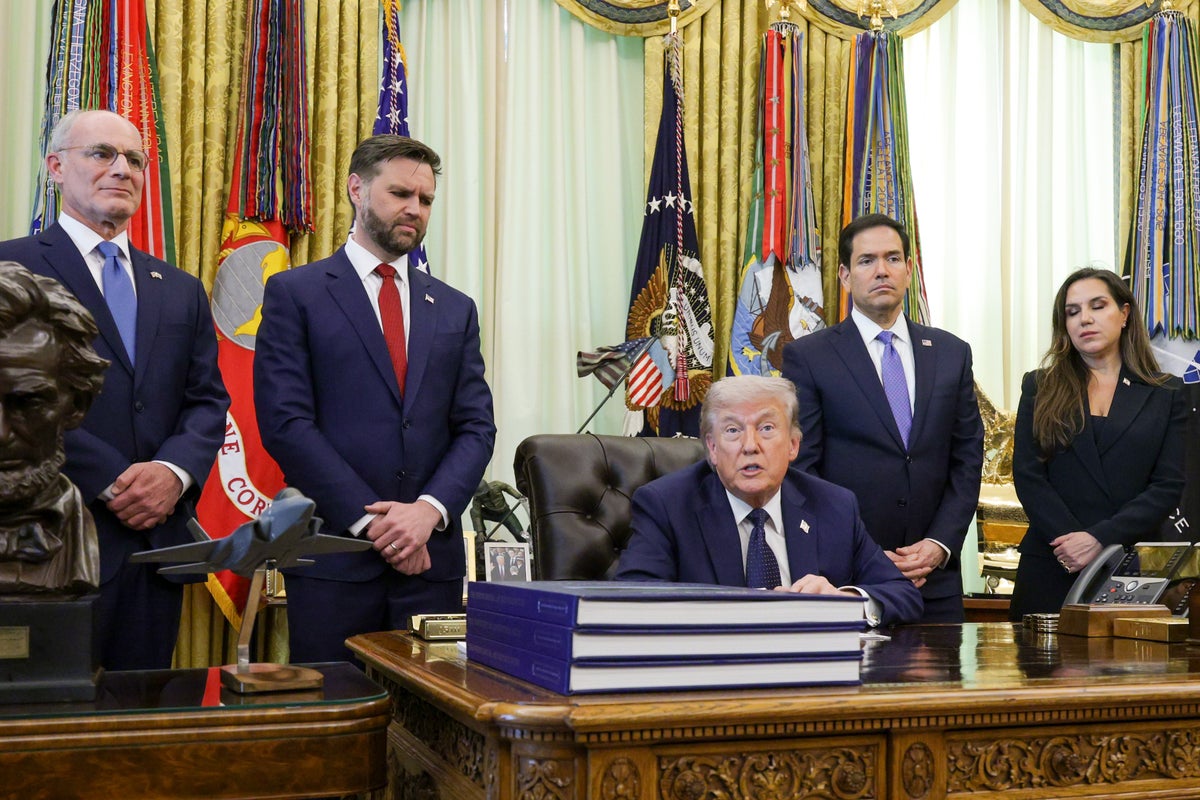
The current discourse surrounding the political survival of high-tier cabinet members and potential successors within the MAGA movement centers on a fundamental misunderstanding of power dynamics. Observers often categorize the tension between Donald Trump and figures like JD Vance or Marco Rubio as a personality conflict or a psychological quirk. This is a category error. The phenomenon described by critics as Trump "eating his young" is actually a rational, albeit aggressive, mechanism for maintaining a mono-polar power structure. By deconstructing the incentive structures of the executive branch and the specific mechanics of the "loyalty-utility" trade-off, we can quantify the risks facing any subordinate positioned as a "successor."
The Zero-Sum Framework of Political Branding
In a traditional political hierarchy, a leader cultivates a successor to ensure the longevity of a platform or party ideology. However, the MAGA movement operates on a personalized branding model rather than an institutional one. This creates a Zero-Sum Brand Utility.
Every ounce of political capital acquired by JD Vance or Marco Rubio is capital that is not explicitly anchored to Trump himself. In a personalized movement, "succession" is synonymous with "supplantation." If a Vice President becomes too effective at articulating the movement’s goals, they become an alternative center of gravity. To maintain total control, the primary leader must periodically devalue the brand of the subordinate to ensure they remain a derivative asset rather than a standalone entity.
The Mechanism of Public Humiliation as a Control Variable
The public critiques or "tests" of loyalty often observed are not random outbursts. They serve as a Calibration of Subordination. By forcing a high-level surrogate to defend a controversial or contradictory position, the leader achieves two strategic outcomes:
- Sunk Cost Reinforcement: The subordinate burns bridges with moderate or independent blocks, making them entirely dependent on the leader’s base for survival.
- Brand Dilution: The subordinate’s individual identity is erased, replaced by a persona that exists only in relation to the leader’s current whim.
This creates a high-attrition environment. The "cost" of being a successor is the systematic destruction of one's independent credibility.
The Three Pillars of Internal Cannibalization
To understand why figures like Anthony Scaramucci predict the political demise of Rubio and Vance, we must look at the structural pressures that force a dominant leader to undermine their own deputies.
1. The Threat of the Post-Trump Era
For Donald Trump, the "Post-Trump" conversation is a threat to his current leverage. If the GOP donor class and voter base begin to view Vance or Rubio as the viable future, Trump’s "lame duck" status accelerates. To prevent this, the leader must ensure the future remains murky. By "eating his young"—undermining their standing or pitting them against one another—Trump ensures that he remains the only indispensable component of the machine.
2. The Feedback Loop of Narrative Dominance
In a news cycle driven by dominance, a leader must always be the protagonist. A Vice President who performs too well in a debate or a Secretary of State who secures a major diplomatic win risks stealing the spotlight. In the logic of high-stakes political branding, "good news" that doesn't feature the leader at the center is "bad news." The leader corrects this by introducing friction, often through social media or leaked internal dissatisfaction, to refocus the narrative on their own authority.
3. The Institutional vs. Personalist Conflict
Marco Rubio represents the institutional wing of the party that has integrated into the MAGA framework. JD Vance represents the ideological conversion wing. Both are vulnerable because they have "prior versions" of themselves. This history is used as a lever. A leader can "forgive" past opposition, but that forgiveness is a debt that can be called in at any time. The moment a deputy asserts independence, the leader can weaponize that deputy’s own history against them, effectively neutralizing them.
Quantifying the Successor’s Dilemma
The probability of political survival for a Trump-adjacent successor can be viewed through an Incentive Alignment Matrix.
- Scenario A: High Performance, High Visibility. (The "Star" Deputy)
- Result: Immediate friction. The leader views the deputy as a rival. High likelihood of public "correction" or dismissal.
- Scenario B: Low Performance, Low Visibility. (The "Placeholder")
- Result: Irrelevance. The deputy provides no value to the movement and is eventually replaced by a more aggressive loyalist.
- Scenario C: High Performance, Low Visibility. (The "Ghost")
- Result: Sustainable in the short term, but provides no path to succession. The deputy does the work but receives no credit, making them a non-factor in a future leadership race.
The narrow corridor for survival requires a deputy to be effective enough to be useful, but humble enough to never appear as a replacement. This is a nearly impossible equilibrium to maintain over a four-year term.
The Structural Incompatibility of Rubio and Vance
The inclusion of both Marco Rubio and JD Vance in the inner circle creates a Dual-Track Bottleneck. By having two high-profile potential heirs, the leader creates a competitive market for his favor.
This "Gladiator" model of management ensures that Vance and Rubio will spend as much energy neutralizing each other as they do executing policy. From a strategic standpoint, this is a masterclass in internal containment. If Rubio gains ground with the donor class, Vance can be used to attack him from the populist right. If Vance gains too much momentum with the base, Rubio can be bolstered as the "adult in the room." The leader sits above the fray, acting as the ultimate arbiter, while the two "young" politicians exhaust their political capital in a battle for a second-place position.
The Impact on Policy Execution
The primary casualty of this dynamic is long-term policy stability. When the primary goal of a cabinet member is to avoid being "eaten," they prioritize signaling over substance.
- Policy Stalling: Subordinates fear taking initiative on complex issues (like trade or immigration reform) because any failure will be blamed on them, while any success will be claimed by the top.
- Intellectual Atrophy: To avoid contradicting the leader, subordinates stop providing honest data or divergent viewpoints. This creates a "Yes-Man" feedback loop that increases the risk of catastrophic strategic errors.
The Cost of Loyalty in a Volatile System
We must distinguish between Institutional Loyalty (to the office) and Personalist Loyalty (to the individual). In the current administration's logic, these are often at odds. Rubio’s challenge is his long-standing relationship with the Senate and the intelligence community—institutions that have frequently been at odds with the Trump executive. His survival depends on his ability to betray his institutional roots whenever they conflict with personalist demands.
Vance faces a different hurdle: the "convert’s zeal." As someone who pivoted from a "Never-Trump" stance to a core surrogate, his position is built entirely on the continued approval of the leader. He lacks an independent base. If that approval is withdrawn, he has no "home" to return to within the party. This makes him more pliable, but also more disposable.
Predicting the Breaking Point
The collapse of these relationships typically follows a predictable decay curve. It begins with "The Leak"—a report that the leader is "unhappy" with a specific performance. This is followed by a public "Testing of the Waters," where the leader mentions the deputy's name in a neutral or slightly negative context during a rally or interview. The final stage is the "Ultimatum," where the deputy is forced to choose between a humiliating public reversal on a core belief or a departure from the inner circle.
For Rubio and Vance, the clock starts on day one. The bottleneck of the 2028 election makes their destruction almost inevitable under the current power logic. A leader who views his movement as an extension of his personhood cannot, by definition, allow a successor to flourish while he still holds the stage.
The strategic play for any actor in this environment is not to seek the spotlight, but to build a "Shadow Infrastructure." This involves cultivating deep-tier donor networks and grassroots ties that are independent of the leader's direct communication channels. However, even this is high-risk; in a surveillance-heavy political environment, the discovery of a "Shadow Infrastructure" is treated as an act of treason.
The most probable outcome is not the rise of a "New Guard," but the systematic exhaustion of the party's top talent. As the leader "eats his young," the pool of viable, experienced successors shrinks, leaving the movement in a state of permanent transition with no clear exit strategy. The destruction of Rubio and Vance wouldn't be a byproduct of the system; it is a core functional requirement for the maintenance of the current hierarchy.
The only variable that changes this trajectory is a shift from a personalized movement back to a platform-based institution—a shift that current data suggests is unlikely in the near term. Therefore, the "cannibalization" of the GOP's rising stars should be viewed as a fixed cost of doing business in the current era. Successors do not emerge from this system; they are consumed by it to fuel the primary engine. Moves made by Vance or Rubio to distinguish themselves must be viewed through this lens of survival: any attempt to lead is an invitation to be hunted. Any attempt to follow is a slow march toward obsolescence. The path to power in this framework is a narrow, diminishing return. High-level consultants and strategists must advise their clients to recognize that in this structure, the "inner circle" is actually a centrifugal machine designed to spin talent out the moment it gains enough mass to exert its own gravity.