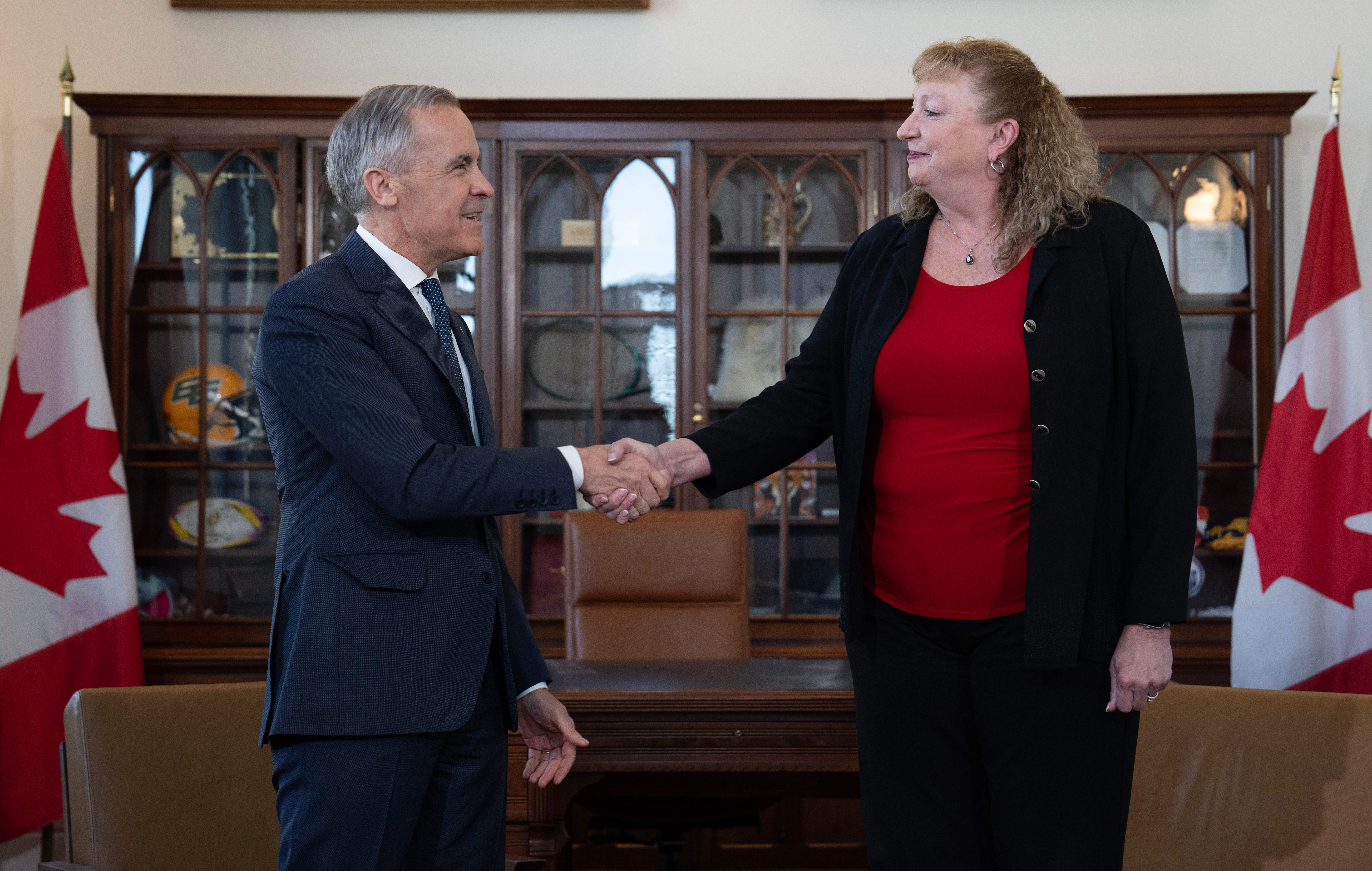
The internal machinery of Canadian federal politics is currently grinding through a high-stakes friction point that has little to do with policy and everything to do with the looming shadow of an election. Mark Carney, the former central banker turned Liberal advisor, has taken a sharp, public aim at Conservative MP Marilyn Gladu, claiming she is poised to break ranks with her party’s official stance on reproductive rights. This isn't just a minor disagreement between a backbencher and a high-profile consultant. It is a calculated opening salvo in a broader strategy to define the Conservative Party of Canada as a movement hiding a socially conservative agenda behind an affordability mask.
Carney’s assertion that Gladu would "vote with the Liberals" on abortion issues is a deliberate attempt to wedge the opposition. By singling out Gladu—a veteran MP known for her occasional willingness to speak on conscience issues—Carney is attempting to force Pierre Poilievre into a defensive posture. The strategy is transparent. If Poilievre suppresses Gladu, he looks like a dictator; if he lets her speak, the Liberals will use her words to frighten moderate urban voters.
The Mechanics of the Political Wedge
In the world of political strategy, a wedge issue is designed to split the opponent's coalition. For years, the Liberal Party has used reproductive rights as the ultimate tool for this purpose. It works because the Conservative caucus is a "big tent" that includes both fiscal libertarians and social conservatives. When Mark Carney enters the fray, he isn't speaking as a banker. He is speaking as a partisan operative trying to find the cracks in that tent.
Marilyn Gladu represents Sarnia-Lambton, a riding that demands a balance of industrial pragmatism and traditional values. She has navigated these waters before. However, the current climate is different. The Liberals are trailing in the polls, and their traditional economic arguments are failing to resonate with a public frustrated by housing costs and inflation. When the economy fails as a talking point, parties retreat to "values" issues.
Carney’s specific claim—that Gladu would align with Liberal voting patterns on this file—serves a dual purpose. First, it attempts to legitimize the Liberal position as the "default" Canadian value. Second, it suggests that the Conservative leadership is out of step even with its own members. It is a classic move from the playbook of political agitation.
Why Marilyn Gladu is the Target
Gladu is not a random choice for this narrative. She has a history of being vocal, sometimes to the chagrin of her party’s leadership. In the past, she has advocated for the protection of conscience rights for healthcare workers, a position that is often conflated by opponents with a desire to roll back abortion access. This nuance is usually lost in the heat of a thirty-second news cycle.
By focusing on Gladu, Carney is targeting a specific demographic of the Conservative caucus. He is looking for the "Red Tories" and the social conservatives who feel sidelined by Poilievre’s laser focus on the "Axe the Tax" campaign. If Carney can provoke a response from Gladu that emphasizes her personal beliefs, the Liberal war room gets the footage they need for the next election's attack ads.
The reality of parliamentary voting is far more rigid than Carney’s comments suggest. In the Canadian system, party discipline is the iron rule. While "votes of conscience" are technically allowed on certain moral issues, the political cost of breaking with the leader on a high-profile topic is career suicide. Gladu knows this. Poilievre knows this. Carney certainly knows this. This makes the claim less about how Gladu will actually vote and more about the "vibe" of the Conservative Party.
The Carney Factor and the Liberal Succession
We must also look at Mark Carney’s own trajectory. His transition from the "Governor of Everything" to a Liberal partisan has been long-gestating and fraught with speculation. By taking a hardline, aggressive stance against a Conservative MP, Carney is "washing the gray off." He is proving to the Liberal base that he is not just a technocrat, but a fighter willing to engage in the mud-slinging of identity politics.
For a man often criticized as being "too elite" or "too globalist" for the average Canadian voter, leaning into a social issue like abortion rights is a way to build rapport with the progressive wing of the party. It is a signal that he is ready for the leadership, should Justin Trudeau step aside. He is adopting the party’s most successful rhetorical weapon.
However, this move carries significant risk. If Carney is seen as a person who misrepresents the positions of female MPs to score points, he risks alienating the very swing voters he needs to win. The "banker" persona relied on a reputation for cold, hard facts. The "politician" persona is already being accused of playing fast and loose with the truth regarding Gladu’s intentions.
The Conservative Response and the Silence of Poilievre
Pierre Poilievre has managed to keep his caucus remarkably disciplined for the better part of two years. He has pivoted almost every question back to the economy. When the Liberal-NDP coalition tries to bring up social issues, the Conservative leader typically gives a short, scripted answer affirming the status quo and moves back to the price of gas.
Mark Carney is trying to break that discipline. By naming a specific MP, he creates a localized fire that Poilievre might have to put out. If the Conservative leader stays silent, he allows Carney’s narrative to take root in the media. If he speaks out, he enters a debate he has spent months trying to avoid.
Gladu herself finds herself in a precarious position. If she denies Carney’s claim too aggressively, she might alienate her own pro-life constituents. If she confirms a willingness to vote with the Liberals, she loses her standing within her party. It is a sophisticated trap.
Beyond the Rhetoric of Reproductive Rights
The underlying tension here isn't actually about the legality of abortion in Canada. No major party has expressed a formal desire to change the existing legal framework. Instead, the conflict is about institutional trust. Carney is arguing that the Conservatives cannot be trusted to uphold the status quo. The Conservatives are arguing that the Liberals are using "ghost stories" to distract from a failing economy.
This is the "how" of modern Canadian governance: a perpetual state of distraction. While the public debates a hypothetical vote by a single MP, larger issues like the productivity gap, the housing shortage, and the stability of the healthcare system are pushed to the periphery. Carney’s intervention ensures that the next few weeks of political discourse will be dominated by social friction rather than fiscal scrutiny.
The Role of the Media in Amplifying the Wedge
The media’s role in this saga cannot be overlooked. Headlines that frame the story as "MP to vote with Liberals" provide a sense of internal chaos that may not actually exist. It is a narrative of "rebellion" that attracts clicks and viewers. For the Liberal party, this media oxygen is vital. They need the public to see the Conservatives as a party at war with itself.
Investigative scrutiny reveals that many of these "split" narratives are manufactured. A deep dive into Gladu’s voting record shows a consistent adherence to party lines on major files. The idea that she would suddenly become a Liberal ally on a core identity issue is a stretch of the imagination, yet it serves as a powerful fiction for a campaign in trouble.
The High Cost of Partisan Branding
When a figure of Carney’s stature engages in this type of targeting, it changes the nature of the conversation. It moves from a debate about ideas to a debate about people. It turns an MP into a proxy for a national ideological battle. This is the "why" behind the specific naming of Marilyn Gladu. It makes the threat feel personal and immediate.
The strategy assumes that the Canadian voter is more motivated by fear of social change than by the reality of economic hardship. It is a gamble that the Liberals have won in the past, most notably in the 2019 and 2021 elections. But as interest rates stay high and the cost of living dominates every kitchen table conversation, the efficacy of the "Gladu-style" wedge issue may be reaching its expiration date.
The tactical error Carney might be making is underestimating the public's exhaustion. Voters are increasingly skeptical of "boogeyman" politics. When a former central banker—someone who should be talking about capital flows and GDP—starts talking about how a backbencher from Sarnia might vote on a social issue, it smells like desperation.
The Pivot to Personal Credibility
The ultimate victim in this exchange might be the credibility of the institutions themselves. When policy advisors and potential leadership candidates use their platforms to speculate on the future actions of their opponents, the line between analysis and propaganda thins. Mark Carney is no longer an objective observer of the Canadian economy; he is a player in the game of narrative construction.
Marilyn Gladu, for her part, remains a symbol of the friction inherent in the Conservative coalition. Whether she speaks or remains silent, her name has been effectively "weaponized" by the Liberal machinery. This is the brutal reality of the pre-election cycle. No one is a bystander. Every MP is a potential target, and every past comment is a potential liability.
The outcome of this specific skirmish will likely be a stalemate. Gladu will likely issue a clarifying statement that satisfies no one, and Poilievre will keep his eyes on the inflationary data. But the precedent is set. Mark Carney has signaled that he is willing to go into the trenches. He is no longer the man in the ivory tower; he is in the arena, and the rules of the arena are messy, personal, and often disconnected from the truth of the ballot box.
The focus on Gladu is a symptom of a government that has run out of economic road. When you cannot fix the present, you sell a terrifying version of the future. Whether Carney can make that sale depends entirely on whether Canadians are still willing to prioritize social anxiety over their empty wallets.
The political landscape is shifting away from the polite disagreements of the past toward a model of targeted character assassination. By using a single MP as a lightning rod, Carney has demonstrated exactly how the next election will be fought. It won't be fought on the floor of the House of Commons or in the pages of an economic report. It will be fought in the margins of personal belief and the deliberate mischaracterization of an opponent’s intent.
The strategy is clear. The targets are selected. The only question remains whether the public will see through the theater or succumb to the distraction.


