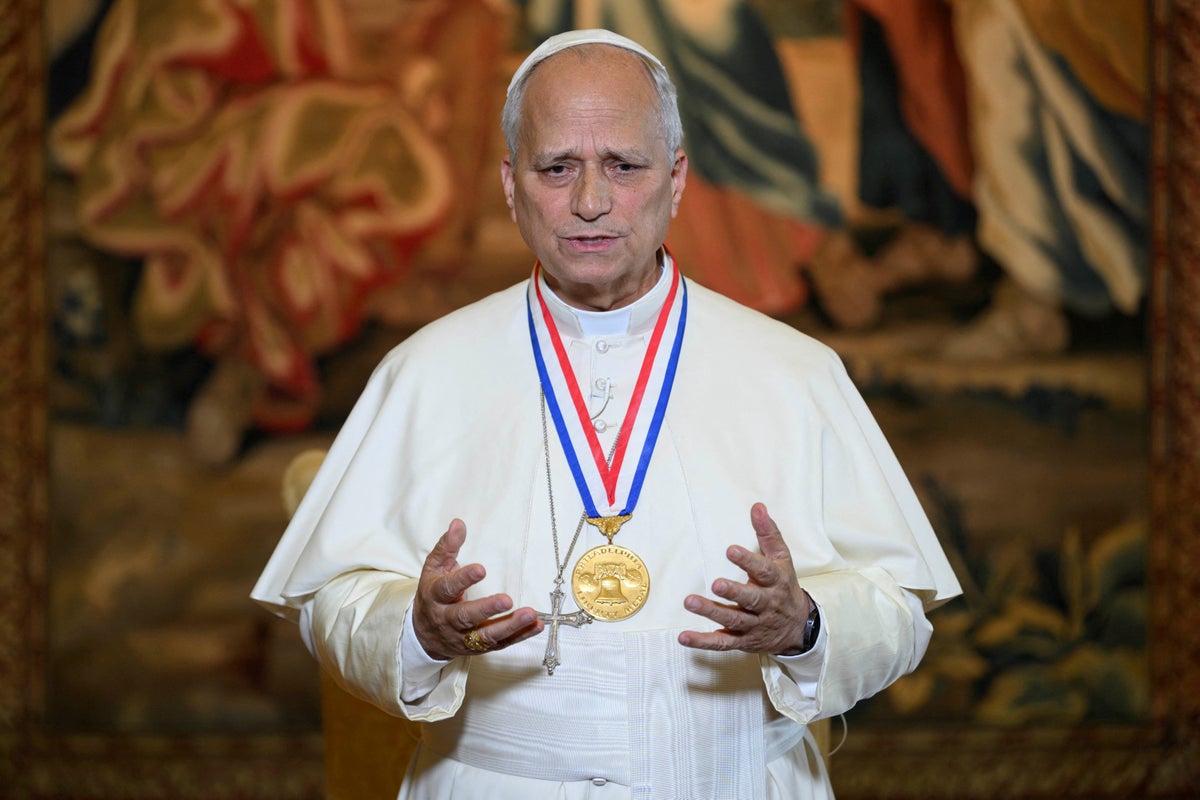
The recent address by the Vatican calling on the United States to recommit to its founding ideals ahead of Independence Day is a masterclass in historical amnesia. It plays perfectly into a lazy narrative. For decades, commentators have treated the American founding and Catholic social teaching as if they were long-lost siblings destined for a happy reunion.
They are not. They are fundamentally incompatible.
When a religious authority urges a modern superpower to return to its 18th-century roots, it ignores a brutal reality. The philosophical foundations of the American experiment were explicitly designed to reject the very framework the Vatican represents. Wrapping the cross in the Stars and Stripes might make for comforting holiday rhetoric, but it falls apart under the slightest intellectual scrutiny.
The Myth of the Shared Foundation
The common consensus insists that the Enlightenment ideals of the American founding naturally align with universal moral truths. This is a profound misunderstanding of political philosophy.
The American founding was built on the back of John Locke’s liberalism. Locke’s framework prioritizes individual autonomy, negative liberty, and a social contract rooted in self-interest. It posits that government exists primarily to protect property and individual rights.
Catholic political philosophy, rooted in Thomas Aquinas and developed through centuries of papal encyclicals, argues the exact opposite. It states that society is an organic whole. It posits that freedom is not the right to do what you want, but the power to do what you ought. The state has a positive duty to promote the common good, not just referee individual competition.
To tell Americans to fix their current cultural fracturing by returning to Locke is like telling a driver to fix a broken engine by pressing harder on the gas pedal. The hyper-individualism fracturing modern American society is not a deviation from the founding ideals. It is the logical conclusion of them.
Comparing the Core Doctrines
| Concept | American Founding Liberalism | Catholic Social Teaching |
|---|---|---|
| Primary Unit of Society | The individual | The family and community |
| Definition of Liberty | Freedom from constraint (Negative) | Freedom to pursue virtue (Positive) |
| Purpose of the State | Protect property and rights | Promote the common good |
| Economic Driving Force | Self-interest and market forces | Subsidiarity and solidarity |
The Problem with Selective Nostalgia
We see this cycle every July. Public figures look at modern political polarization, economic inequality, and cultural decay, and they prescribe a heavy dose of nostalgia. They point to 1776 as a golden baseline.
I have watched political analysts and religious leaders waste decades deploying this strategy. It fails because it treats the founding documents as infallible scripture rather than compromise-driven political texts.
When you tell a population to return to founding ideals without defining which ones, you invite ideological chaos. Are we returning to the radical agrarianism of Thomas Jefferson? The centralized industrial vision of Alexander Hamilton? The glaring moral compromise of human chattel slavery written into the constitutional fabric?
Nostalgia is a useless political metric. It replaces rigorous systemic analysis with warm sentimentality. The Vatican's appeal assumes that the United States can solve 21st-century techno-capitalist crises by meditating on agrarian-era philosophy. It is an outdated prescription for a misdiagnosed disease.
Dismantling the Right to Be Left Alone
The core of the American ethos is the right to be left alone. This radical autonomy has driven unprecedented economic growth and technological innovation. No one can deny the material success of the American model.
However, that exact model creates a profound loneliness epidemic and a collapsing social fabric. You cannot celebrate an economy built entirely on individual mobility and consumer choice, and then act shocked when communities dissolve and family structures weaken.
Consider a thought experiment. Imagine a neighborhood where every resident maximizes their own economic utility. They work eighty hours a week, maximize their investments, and fiercely protect their property lines. By every metric of standard economic liberalism, this neighborhood is a triumph. Yet, the residents do not know each others' names. They do not support the elderly down the street. They have zero shared identity.
The competitor narrative suggests this neighborhood just needs to read more Federalist Papers to find its soul. The truth is much colder. The neighborhood is alienated precisely because it followed the hyper-individualistic blueprint to perfection.
The Inherent Danger of Religious Nationalism
There is a strategic blunder when religious institutions try to baptize secular national myths. By tying moral authority to a specific nation-state's historical narrative, the church loses its ability to act as an objective critic.
Historically, when the church aligns too closely with state ideals, it becomes a tool for state validation. We saw this in Europe for centuries, where the altar and the throne propped each other up until both collapsed under the weight of their own corruption. The American separation of church and state was actually a gift to religious institutions, freeing them from the corrupting influence of temporal power.
Forcing a papal narrative into an American civic religion framework cheapens both. It reduces complex theological principles into mere cheerleading for a geopolitical entity. The United States does not need a religious blessing on its secular history; it needs an honest assessment of its current trajectory.
The Flawed Premise of Civic Renewal
People frequently ask: How do we restore civic virtue in a divided nation?
The standard answer is always to improve civic education, teach the Constitution, and honor national symbols. This answer is fundamentally flawed. Virtue is not learned by memorizing historical documents or reciting pledges. Virtue is cultivated through local, physical institutions: families, churches, unions, and local associations.
The American founding did not create these institutions; it inherited them from pre-liberal traditions. The early republic survived because it was populated by citizens whose character had been formed by traditional communities that predated the revolution.
Now, those pre-liberal institutions are largely gone, hollowed out by market forces and radical individualism. You cannot rebuild character by appealing to the very political philosophy that accelerated the destruction of those character-forming institutions.
Stop looking to national myths for local salvation. The solution to a fragmented society will not be found by looking back to 1776, nor by hoping a foreign religious leader can shame a secular superpower into a moral awakening. It requires building localized, resilient communities that value mutual obligation over absolute autonomy. Turn off the national news, ignore the grand political speeches, and build something functional within your own zip code.