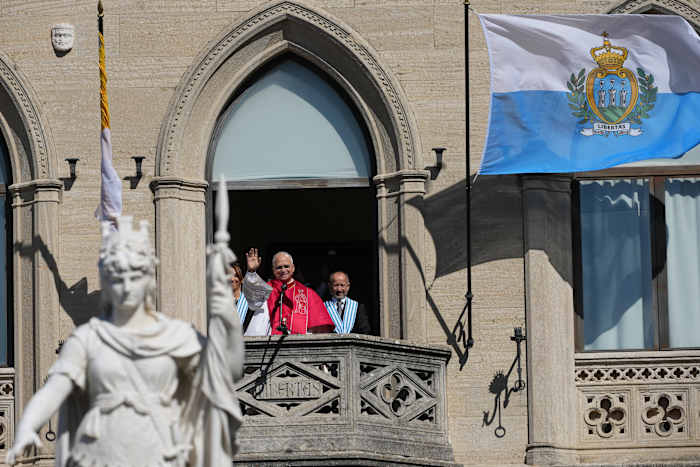
Pope Leo XIV just pointed a spotlight at one of the smallest nations on Earth to deliver a blunt message about modern governance. During his recent visit to San Marino, the pontiff labeled the tiny republic a shining model of political freedom and civic responsibility. He used the historic microstate to take a sharp swipe at global powers that prioritize money and authority over human dignity.
If you look past the headlines, the timing and location of this papal visit reveal a lot about how the Vatican views modern political friction. Let's break down why this tiny enclave matters right now.
Inside the World's Oldest Republic
Nestled entirely within Italy, San Marino boasts a population of roughly 35,000 people. Its roots stretch back to the fourth century, making it the oldest surviving republic in the world.
The governance model here is deliberately decentralized. Power doesn't sit in the hands of a single executive. Instead, a 60-member parliament elects two captains regent every six months to serve jointly as heads of state. That biannual power-sharing shuffle is explicitly designed to prevent anyone from hoarding authority.
Pope Leo praised this setup as a "laboratory of good politics". He credited the nation's spiritual founders, Saints Marino and Leone, with baking community trust and mutual respect directly into the local civic foundation.
The Subtext of Human Dignity
You can't talk about San Marino and the Vatican today without addressing the elephant in the room. Back in 2021, voters in this deeply Catholic microstate approved a historic referendum to legalize abortion during the first 12 weeks of pregnancy, completely upending a generations-old ban.
During his address to local authorities, Pope Leo used standard church terminology regarding the protection of human life "from conception to natural death". While he didn't explicitly wave flags about the 2021 referendum during his speech, he made his stance clear. He warned against political frameworks that claim to offer freedom while ultimately failing the individual.
It is a classic diplomatic tightrope walk. The Vatican wants to praise the structural integrity of San Marino's power-sharing traditions while pushing back quietly against modern social policy shifts.
Lessons for a Broken Political Landscape
Why did the pope single out San Marino out of all the places he could visit? Honestly, large democracies are struggling with intense polarization, institutional distrust, and tribalism.
Small communities often handle social cohesion better because accountability is local. When your lawmakers are your neighbors, corruption and ego are much harder to hide. Leo pointed out that smaller political communities offer vital lessons in public service precisely because they resist the urge to centralize control.
He also highlighted rural areas in the surrounding San Marino-Montefeltro region that are fighting back against depopulation. Instead of waiting around for centralized government bailouts, these small towns rely on grassroots mutual support and shared services to survive.
What This Means Moving Forward
We live in an era dominated by mega-states, massive tech monopolies, and hyper-polarized national elections. The system feels bloated.
San Marino proves that alternative governance models can survive for centuries without imploding under the weight of authoritarian impulses. Whether global leaders choose to learn from microstates like this or continue down paths of centralized friction remains to be seen. Keep an eye on how smaller municipalities begin adopting localized power-sharing agreements to bypass bureaucratic gridlock at the national level.