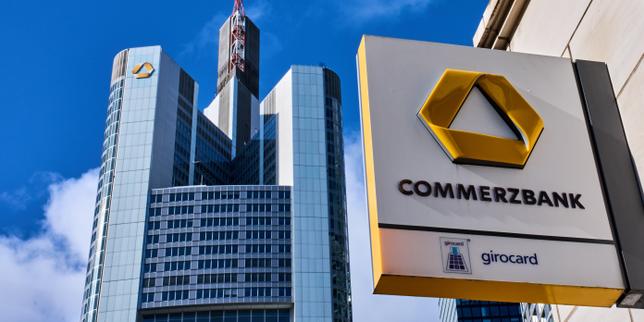
Andrea Orcel does not move like a traditional banker. In the hushed, carpeted hallways of European high finance, where caution is usually the default setting, the CEO of UniCredit operates with the precision of a grandmaster and the nerves of a high-stakes gambler. For weeks, he has been quietly encircling Frankfurt’s "Yellow Tower," the headquarters of Commerzbank, with the kind of calculated patience that makes regulators sweat and politicians panic.
This isn't just a corporate merger. It is a siege.
To understand why a 9% stake—and now a move toward 21%—has sent shockwaves through the German chancellery, you have to look past the balance sheets. You have to look at what Commerzbank represents to the average German Mittelstand business owner. Imagine a third-generation tool manufacturer in Baden-Württemberg. For decades, his family has relied on Commerzbank for the credit that keeps the assembly lines moving. To him, the bank isn't a ticker symbol on the DAX; it is the bedrock of the German industrial identity.
Now, an Italian giant is knocking on the door. And it isn't asking for permission.
The Art of the Ambush
Orcel’s maneuver was a masterpiece of financial stealth. While the German government was busy patting itself on the back for selling off a portion of its state-owned stake in Commerzbank—a legacy of the 2008 bailout—UniCredit was waiting in the tall grass. They didn't just bid. They swooped. By using complex derivatives and private transactions, UniCredit effectively bypassed the usual diplomatic channels, presenting Berlin with a fait accompli.
Berlin was humiliated. Chancellor Olaf Scholz, usually a man of measured words, reacted with uncharacteristic vitriol, calling the move an "unfriendly attack."
But why the visceral reaction? If we believe in the European project, shouldn't a cross-border banking union be the ultimate goal? Theoretically, yes. In practice, the prospect of an Italian bank controlling the primary lender to German small-and-medium enterprises feels, to many in Frankfurt, like losing control of the national circulatory system.
The fear is not about the numbers. It is about the "invisible hand" of the Italian state and the perceived instability of Rome’s own debt-heavy economy. There is a deep-seated, perhaps unfair, anxiety that if UniCredit swallows Commerzbank, the capital that currently fuels German factories might one day be redirected to shore up a crisis in Milan or Turin.
The Architect of Aggression
Andrea Orcel is often called the "Ronaldo of Investment Banking." He is a man who deals in the language of "synergies" and "scale," but his real currency is power. By increasing UniCredit's potential stake to 21%, he has effectively cornered the German government.
He knows that in the modern era, a bank that is merely "big" is a target. A bank that is "colossal," however, is a fortress.
Consider the leverage he now holds. If the European Central Bank (ECB) approves his request to increase the stake, he becomes the de facto owner of Commerzbank's future. He can block dividends. He can force board changes. He can wait. He has the luxury of time, while the German government, facing an upcoming election and a stuttering economy, is trapped in a defensive crouch.
The tension is palpable. Inside the Yellow Tower, employees are bracing for the inevitable "restructuring"—a polite word for the scythe that follows every major banking merger. Thousands of jobs are on the line. But more than that, a culture is on the line. Commerzbank is perceived as cautious, steady, and intrinsically linked to the German state. UniCredit is seen as lean, aggressive, and ruthlessly efficient.
These two spirits do not mix easily. They collide.
The European Paradox
The tragedy of this conflict is that, on paper, Orcel is right. Europe is a fragmented mess of mid-sized banks that lack the muscle to compete with American titans like JPMorgan Chase or Goldman Sachs. Without consolidation, European banks are destined to remain bit players on the global stage, forever reacting to shifts in US interest rates or Chinese trade policy.
But the "Holistic European Market" is a ghost. It exists in Brussels' white papers, not in the hearts of the people.
When a German politician looks at UniCredit, they don't see a "European partner." They see an outsider trying to seize a strategic national asset during a moment of weakness. It is a reminder that when the chips are down, nationalism usually trumps the ideal of a borderless economy.
The ECB finds itself in an impossible position. Christine Lagarde has long called for more banking consolidation to strengthen the Euro. To block UniCredit now would be to admit that the European Banking Union is a fantasy. To allow it, however, is to risk a political firestorm that could destabilize the very foundation of the German-Italian relationship.
The Human Cost of the Spreadsheet
Behind every derivative trade and regulatory filing, there are people.
There is the Commerzbank branch manager in a quiet town like Fulda, who knows his clients by their first names and understands that a "bad" credit score sometimes hides a good man with a temporary problem. He fears that under Milanese management, his autonomy will vanish, replaced by an algorithm optimized for return on equity rather than local stability.
Then there is the UniCredit shareholder, perhaps a pension fund in Paris, wondering why their capital is being used to fight a protracted political war in Germany instead of being returned as a dividend.
The stakes are invisible until they are agonizing.
Orcel’s gamble is that the logic of the market will eventually steamroll the sentiment of the state. He is betting that the German government cannot afford to remain a shareholder forever and that the ECB will prioritize financial efficiency over national pride.
The Silent Room
Picture the boardrooms tonight. In Milan, there is the quiet hum of victory—the feeling of a predator who has successfully isolated the prey. In Frankfurt, there is the frantic sound of damage control—telephones ringing, lawyers debating, and the hollow realization that the gate was left unlocked.
The most dangerous part of this "offensive" isn't the hostile intent. It is the silence that follows.
When a merger is forced rather than invited, the resulting institution is often a hollow shell, paralyzed by internal friction and cultural resentment. You can buy a bank’s shares, but you cannot easily buy its trust. Orcel may eventually get his union, but he might find that the Commerzbank he coveted has evaporated, leaving behind only the cold, yellow walls of a tower that no longer knows who it serves.
The battle for Commerzbank is no longer about interest rates or capital ratios. It is a struggle for the definition of "European." Is it a collection of nations protecting their own, or a single entity where the strongest lead?
The answer is being written in real-time, one percentage point at a time. And as the sun sets over the Main River, the shadows of the Yellow Tower grow longer, stretching toward a future that looks increasingly Italian, and increasingly uncertain.
The predator is no longer at the gate; he has a key, and he is testing the lock.