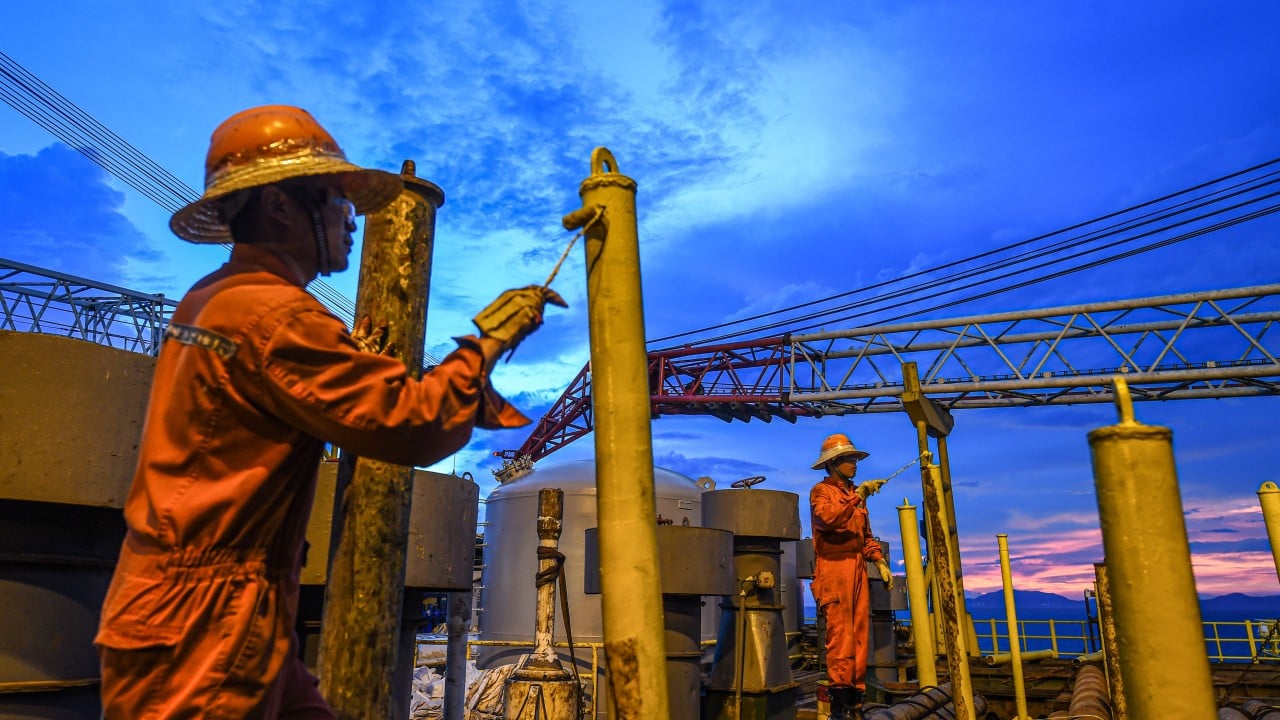
A fisherman named Roberto wakes up at three in the morning in a small coastal village in Zambales. He doesn’t check the international news. He doesn't read the latest transcripts from the Philippine House of Representatives. He simply checks the wind and the price of diesel. For Roberto, the South China Sea isn't a map of geopolitical "zones" or "blocks." It is his backyard. It is where his father died and where his son hopes to earn a living.
But lately, the backyard is getting crowded. The horizon, once empty and dark, is now speckled with the lights of massive steel vessels that don't belong to his neighbors.
In Manila, the air is thick with a different kind of tension. Inside the halls of power, lawmakers are looking at a ledger that won't balance. The Philippines is hungry. Its energy reserves are thinning. The Malampaya gas field, the country’s primary domestic energy source, is drying up like an old well. Without a new source of power, the lights in Manila will flicker, and the cost of living will soar beyond the reach of the common worker.
This brings us to the deal.
Recently, a chorus of Philippine lawmakers began drumming their fingers on the table, suggesting that perhaps it is time to look back toward Beijing. They argue that the only way to tap into the vast oil and gas reserves beneath the seabed is through a joint venture with China. On paper, it sounds like a pragmatic handshake. In reality, it is a walk into a dark room where the floor is made of glass.
The Mathematics of a Map
Consider the concept of a "joint exploration." It sounds equitable. Two neighbors sharing the cost and the harvest. But in the South China Sea, the map is a mess of overlapping ink. China claims nearly the entire sea under its "nine-dash line," a historical boundary that an international tribunal in The Hague declared invalid in 2016. The Philippines, meanwhile, holds legal rights to its Exclusive Economic Zone (EEZ).
When you agree to "share" resources in your own house with someone who claims they own the foundation, you aren't just sharing the oil. You are implicitly questioning your own deed to the property.
The lawmakers pushing for this deal see the immediate crisis. They see the rising cost of electricity. They see the looming shadow of an energy shortage. They want a quick win. But critics, including seasoned diplomats and maritime experts, warn that this isn't a partnership. It is a trap. If the Philippines signs a deal that acknowledges China’s "sovereign rights" in Philippine waters, the 2016 legal victory—a piece of paper bought with years of diplomatic sweat—becomes a relic.
The Ghost of the Reed Bank
To understand the stakes, we have to look at the Reed Bank. This is a large tablemount in the South China Sea, rich in potential natural gas. For years, it has been the "X" on the treasure map.
Imagine a hypothetical scenario. Let’s call our protagonist Elena, a young analyst at a Philippine energy firm. She spends her days looking at seismic data, knowing that beneath the waves lies enough gas to power her country for decades. She wants to see her country thrive. But every time her company tries to send a survey ship to the Reed Bank, Chinese Coast Guard vessels appear. They don't fire shots. They just sit there. Massive, grey, and immovable.
It is a slow-motion blockade.
By preventing the Philippines from exploring its own waters, China creates a vacuum. They wait for the hunger to grow. They wait until the desperation in Manila reaches a fever pitch. Then, they offer a solution: "We can help you get that gas, as long as we do it on our terms."
This is the leverage. It is the "debt-trap" diplomacy of the sea. It isn't about the money spent on rigs or pipes. It is about the legal precedent. If Manila enters a deal where they are the junior partner in their own territory, they have effectively surrendered without a single shot being fired.
The Weight of the Debt
Sovereignty is a heavy word. It feels abstract until you realize it’s the difference between being a tenant and being an owner.
When a nation loses its grip on its resources, the consequences aren't just felt in the halls of government. They are felt at the kitchen table. Consider what happens next: a deal is signed. Chinese state-owned enterprises move in. They provide the capital, the technology, and the security.
But the "split" is never truly 50-50. There are hidden costs. There are "service contracts" that favor the larger power. There is the environmental impact that a local fisherman like Roberto has no power to stop. And most importantly, there is the military presence that follows the money. Under the guise of protecting "joint assets," the South China Sea becomes even more militarized.
The warning from the opposition is clear: this is not an energy policy. It is a slow-motion annexation.
One word. Surrender.
The tragedy of the situation is that the Philippines is caught between a rock and a hard place. The country needs the energy to survive, but the price of that energy might be the very ground—or water—it stands on. It’s a gamble where the house always wins, and the house is located in Beijing.
The Invisible Chains
We often think of colonization as something involving flags and soldiers. In the 21st century, it looks like a memorandum of understanding. It looks like a complex infrastructure loan with a high interest rate. It looks like a "joint development area" where one side has all the ships and the other has all the paperwork.
The lawmakers in Manila arguing for these deals aren't necessarily villains. Many are simply desperate for a solution to a real, biting economic problem. They see the poverty in the provinces. They see the manufacturing sectors struggling with the highest power rates in Southeast Asia. They want to provide.
But there is a difference between providing and selling the future.
If the Philippines walks into a deal that ignores the 2016 ruling, it signals to the world that international law is optional. It tells other nations that if you are big enough and patient enough, you can eventually wear down a neighbor’s resolve.
The South China Sea is one of the most productive fishing grounds on the planet. It is a vital artery for global trade. If it becomes a closed lake controlled by a single power through a series of "deals," the global economy shifts. The "trap" isn't just for the Philippines. It’s for anyone who believes in a rules-based order.
The View from the Boat
Back in Zambales, Roberto pulls his nets. They are lighter than they used to be. He sees the giant ships on the horizon and feels small. He doesn't know about the "Nine-Dash Line" or the UN Convention on the Law of the Sea (UNCLOS). He just knows that the sea feels less like his own every year.
If the lawmakers get their way and the deals are signed, Roberto might see more ships. He might see the rigs go up. He might even see the price of his electricity drop by a few pesos. But he will also see the Chinese flag flying over the assets that harvest his country’s wealth.
He will be a spectator in his own home.
The real problem lies in the illusion of choice. The Philippines is being told it must choose between energy security and sovereignty. It is a false binary designed to force a mistake. There are other ways. Partnerships with other nations, diverse energy portfolios, and a steadfast refusal to blink in the face of maritime bullying. These paths are harder. They take longer. They require more courage.
But the alternative is a handshake that you can never let go of.
The ink on a contract can be just as permanent as the concrete on an artificial island. Once the Philippines signs away its right to its own resources, the "trap" snaps shut. The lights in Manila might stay on for a generation, but the cost will be a debt that can never be repaid in currency.
It is paid in identity. It is paid in the quiet, steady erosion of a nation's soul.
The sun begins to rise over the South China Sea, casting a long, golden light over the disputed waters. Roberto turns his boat back toward the shore. Behind him, the steel giants remain, waiting. They are not in a hurry. They have all the time in the world to wait for the hunger to do its work.
A nation can survive a power outage. It cannot survive the loss of itself.