Lin stands on the concrete pier at Hualien, watching the Pacific blue deepen as the sun dips behind the Central Mountain Range. He is a fisherman, a man who measures his life in knots and the silver flash of mackerel. To him, the horizon has always been a promise of tomorrow's catch. But lately, when he looks East, he doesn't just see the water. He sees the gray silhouettes of ships that don't belong to his neighbors. He hears the low hum of engines that aren't pulling nets.
For Lin, and for twenty-three million others living on this tobacco-leaf-shaped island, peace is not an abstract concept discussed in ivory towers. It is the literal silence of the air. It is the ability to wake up, brew a cup of oolong, and know that the roof will still be there by noon. Meanwhile, you can read related stories here: Geopolitical Friction and the Inertia of Indian Diplomatic Engagement in Nepal.
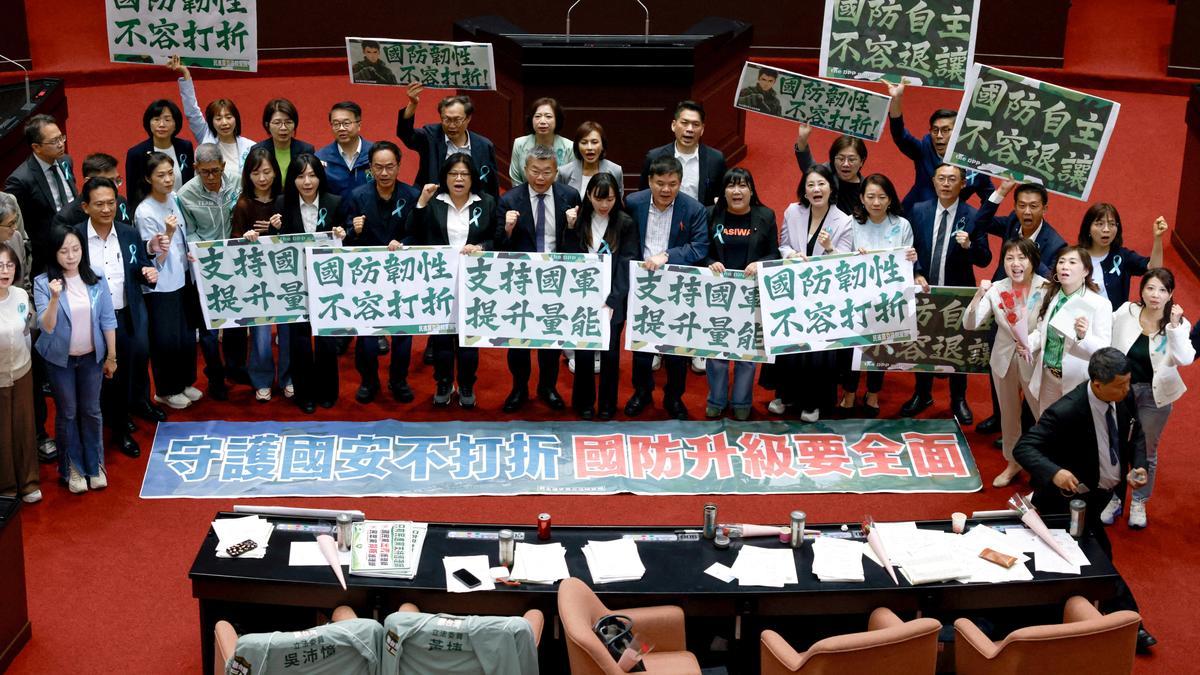
In a sterile briefing room hundreds of miles away in Taipei, that silence was just bought for a staggering sum. $25 billion.
It is a number so large it loses all meaning. To a fisherman, it is an infinity of nets. To a student, it is a mountain of textbooks. To the legislators who just pushed the green button on this massive defense spending bill, it is something else entirely: an insurance premium against the end of the world. To see the bigger picture, we recommend the recent article by USA Today.
The Mathematics of Survival
Money usually buys things we can touch. A new bridge. A high-speed rail line. A hospital. But when a nation pours roughly 800 billion New Taiwan Dollars into its military coffers, it isn't buying "stuff" in the traditional sense. It is buying time.
Consider the sheer scale of the commitment. This isn't part of the regular annual budget; this is an extraordinary appropriation. It is a "special" fund, a term the government uses when the house is already beginning to smoke and the fire department is still several blocks away. The bulk of this capital is earmarked for two specific, lethal categories: anti-ship missiles and high-performance naval vessels.
Why these? Because the geography of the strait is a cruel teacher.
The water separating Taiwan from the mainland is roughly 180 kilometers wide at its thickest point. In the world of modern ballistics, that is a backyard fence. To maintain the status quo, the island cannot simply match a superpower plane for plane or hull for hull. That would be a fool’s errand. Instead, they are investing in "asymmetry."
Imagine a hypothetical scenario. A massive, iron-clad giant tries to force its way through a narrow garden gate. The owner of the garden doesn't need to be as strong as the giant. They just need to make the gate so sharp, so jagged, and so difficult to touch that the giant decides the pain of entering isn't worth the prize inside.
This $25 billion is the sharpening of the gate.
The Invisible Shield
Deep within the lush, subtropical forests of the island's interior, engineers are working on things that Lin the fisherman will never see. They are refining the Hsiung Feng (Brave Wind) missile systems. These aren't just tubes of explosives; they are the island's primary argument for continued existence.
The new budget accelerates the mass production of these systems. It moves them from the laboratory to the back of mobile trucks that can hide in tunnels, under bridges, or inside nondescript warehouses. This mobility is the heartbeat of the strategy. If the defense is fixed, it can be broken. If it is everywhere and nowhere, it becomes a ghost that haunts any potential invader's planning sessions.
But the spending goes beyond hardware. It flows into the "Sky Bow" air defense systems, designed to knit a digital canopy over the cities of Taipei, Taichung, and Kaohsiung.
Think of the psychological weight this carries for a citizen. Every time a new battery is deployed, a young mother in a high-rise apartment sleeps a fraction of a second more soundly. The government isn't just purchasing steel and silicon; they are purchasing the continuation of the morning commute, the evening night market, and the freedom to argue about politics over stinky tofu.
The Ghost in the Ledger
There is a quiet, simmering tension that comes with such a bill. Critics point to the schools that could have been built. They point to the aging power grid that flickers during the humid summer months. They ask, "Is the threat real enough to justify the hunger of the war machine?"
It is a fair question. To answer it, one must look at the "gray zone."
Every day, ADIZ (Air Defense Identification Zone) incursions become the new normal. Pilots are scrambled. Radars lock on. The metal of multi-million dollar jets fatigues under the constant strain of intercepting "uninvited guests." This $25 billion is, in part, a response to this exhaustion. It is a transition from a reactive posture—where the island's forces are worn down by constant pestering—to a proactive one.
The bill includes a heavy focus on "Sea Guardian" drones and coastal surveillance. These are the unblinking eyes. By automating the watch, the island saves its most precious resource: its people.
We often talk about "defense" as a collection of machines, but every machine has a operator. Every drone is guided by a person who would likely rather be coding a new app or hiking the Xueshan trails. By spending this money, the state is attempting to lower the human cost of vigilance.
A Legacy Written in Lead
Taiwan has walked this tightrope for seven decades. What makes this particular $25 billion moment different is the shift in the global wind. The era of "strategic ambiguity" is thinning like mountain mist at noon.
In the past, defense spending was a periodic update, like a software patch. Now, it feels like a total system rebuild. The bill covers a five-year window, a frantic sprint to ensure that by the time the decade turns, the island is "untouchable."
There is an inherent tragedy in this. In a perfect world, $25 billion would be the seed money for a green energy revolution or a cure for a dozen rare diseases. Instead, it is spent on the hope that the weapons will never, ever be used. It is the only investment in the world where the buyer prays for a zero percent return on the actual utility of the product.
If a Hsiung Feng missile is fired in anger, the investment has already failed in its primary goal: deterrence. Success is a missile that sits in a dark silo until it becomes obsolete and is eventually dismantled by a grandson who doesn't remember why it was built in the first place.
The Resonance of a Pen Stroke
Back on the pier in Hualien, the sun has finally vanished. The mountains are now jagged silhouettes against a violet sky. Lin packs his gear. He hears a distant roar—the sound of two F-16s returning to the nearby airbase, their afterburners glowing like twin orange sparks.
He doesn't know the specifics of the $25 billion bill. He doesn't know the range of a Mark 48 torpedo or the payload capacity of a Reaper drone. But he knows that the roar of those engines means the sky is still his.
The politicians in Taipei have finished their sessions. The ink on the bill is dry. The markets will react, the diplomats will issue their carefully worded condemnations, and the factories will begin the grim work of forging more "Brave Winds."
The cost of peace is exorbitant. It is unfair. It is a burden placed on the shoulders of every taxpayer from the tech hubs of Hsinchu to the betel nut stands of the South. But as Lin drives his truck home through the quiet streets, passing children playing and elders gossiping under streetlights, the value of that $25 billion becomes clear.
It is the price of a Wednesday. It is the cost of an uninterrupted nap. It is the premium paid to ensure that the only thing crashing onto these shores tomorrow morning is the tide.
The lights of the city flicker on, one by one, a vast grid of ordinary lives continuing in the shadow of extraordinary stakes. The horizon remains dark, silent, and for tonight, empty.