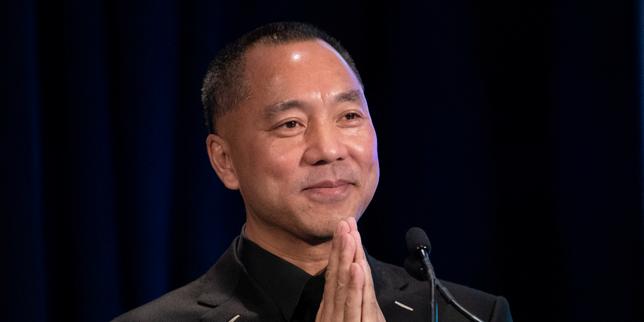
The penthouse overlooking Central Park did not look like a trap. With its sprawling views of the Manhattan skyline, its gold-leaf moldings, and the quiet, heavy air of unimaginable wealth, it looked like a fortress. To the thousands of people watching through the glowing screens of their smartphones, the man pacing across those Persian rugs was not just a billionaire. He was a savior.
Miles Guo, born Guo Wengui, understood a fundamental truth about human nature: people who have lost their homeland will give anything for a sense of belonging. They will give even more for a sense of revenge.
For years, Guo operated as a phantom of the high-finance world, a tycoon who fled China in 2014 just ahead of corruption charges, landing in New York with a suitcase full of state secrets and a bank account deep enough to buy political influence. He positioned himself as the ultimate dissident, the one man brave enough to tear down the Chinese Communist Party from a luxury yacht docked in the Hudson River.
But behind the smoke and mirrors of his anti-Beijing crusade lay a far older, far more cynical reality. It was a massive, sophisticated financial fraud that drained more than a billion dollars from the very people who looked up to him as a freedom fighter. When a federal judge handed down a devastating thirty-year prison sentence, the illusion finally shattered. The billionaire dissident was revealed to be a master illusionist, leaving behind a trail of broken lives, empty bank accounts, and a profound sense of betrayal that ripples through the global Chinese diaspora.
Consider the mechanics of trust. Imagine an immigrant, let us call her Lin, who spent two decades working twelve-hour shifts in a suburban New York restaurant. She left everything behind in Fuzhou. She watches the news with a mixture of nostalgia and deep anxiety, feeling entirely isolated in a country whose language she still struggles to master. One evening, she clicks on a livestream.
There is Guo. He is charismatic, sharply dressed, and speaking her native tongue with absolute authority. He claims to know the elite secrets of the regime she fears. He promises to overthrow them. More importantly, he promises to protect her. He speaks of a new society, a democratic utopia, and he invites his followers to invest in his media companies, his exclusive clubs, and his new digital currency.
To Lin, this is not a speculative investment. It is a holy cause. She transfers her life savings—money meant for her children’s college tuition, money meant for her retirement—into an account controlled by Guo’s associates. She feels a rush of pride. She is part of the revolution.
What Lin did not see was where that money actually went.
As hundreds of millions of dollars poured into Guo’s various entities, including GTV Media Group and the Himalaya Exchange, the funds did not go toward funding a political movement. Instead, the capital flowed directly into an international spending spree of breathtaking decadence.
Federal prosecutors laid out the ledger of greed with clinical precision. While his followers believed they were financing freedom, Guo was purchasing a 50,000-square-foot mansion in New Jersey. He bought a custom-made $3.5 million Ferrari for his son. He spent tens of thousands of dollars on high-end mattresses, exquisite luxury watches, and a $100,000 grand piano. The digital currency exchanges and exclusive memberships he sold were nothing more than a digital ledger of air, backed by nothing, designed only to extract wealth from the hopeful.
The psychological brilliance of the scam was its fusion of politics and finance. Guo constructed an echo chamber where criticism was treated as treason. If an investigative journalist questioned his finances, Guo labeled them a spy for the Chinese government. If a follower asked for their money back, they were targeted online, harassed by Guo’s fiercely loyal internet army, and branded as traitors to the cause.
This tactic created a powerful form of cognitive dissonance. For a victim to admit that Guo was a fraud, they would also have to admit that their dream of a free homeland was being weaponized against them. It was easier to believe the lie. It was safer to keep sending money.
The collapse of the empire began not with a grand political gesture, but with the quiet ticking of financial regulations. The Securities and Exchange Commission began circling. Banks started freezing accounts. By the time federal agents raided his Sherry-Netherland hotel penthouse, the sheer scale of the deception was undeniable. Even as his luxury apartment caught fire under mysterious circumstances during the raid, the theatricality that defined Guo's life remained on full display.
During the trial, the defense attempted to paint Guo as a passionate, eccentric political figure whose financial dealings were merely unconventional, a byproduct of his ongoing war with a hostile foreign state. They argued that his followers knew the risks and believed in the broader mission.
The jury saw through the performance. The financial records spoke louder than any political manifesto. The transfers were direct, the luxury purchases undeniable, and the victims' testimonies devastating.
The courtroom became a stage where the abstract numbers of financial fraud transformed into human tragedy. People who had lost their homes, families that had fractured under the stress of financial ruin, and elderly immigrants who were forced back into the workforce all watched as the man who claimed to be their champion sat silently in a tailored suit, facing the reality of his actions.
The thirty-year sentence is more than a standard punishment for wire fraud, securities fraud, and money laundering. It is a definitive statement on the vulnerability of exile communities. It exposes how easily patriotism can be commodified and how deeply people crave a leader when they feel politically homeless.
Guo’s downfall leaves a complex legacy. For the Chinese government, his conviction is a propaganda victory, a chance to point at a prominent critic and label him a common criminal. For the anti-communist movement, it is a catastrophic distraction, a stain that complicates the work of legitimate activists who risk their lives to fight for human rights.
But the truest tragedy belongs to the anonymous hundreds who believed in the man on the yacht.
The money is largely gone, scattered across offshore accounts, shell companies, and depreciating luxury assets. The legal system will attempt to claw back what it can, but the process is slow, tedious, and rarely whole. For the victims, the financial loss is only part of the wound. The deeper scar is the realization that their deepest yearnings for justice, community, and freedom were used as raw material to buy a billionaire his next sports car.
The New York harbor remains unchanged. The yachts still cruise past the Statue of Liberty, their white hulls gleaming against the dark water. But the man who once stood on the deck of the Lady May, broadcasting visions of a new world to a captive, desperate audience, will spend the rest of his life inside a federal prison cell. The revolution he sold was never real. It was just the most expensive ticket to nowhere ever purchased.