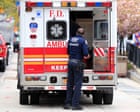
The coffee grows cold on the dispatch desk, ignored because the radio has not stopped squawking for three straight hours. In a city that never pauses, the pulse of New York beats through a network of yellow ambulances and the high-pitched wail of two-tone sirens. Yet beneath the relentless motion of the metropolis, a quieter, more devastating erosion is taking place. The people who answer the call when terror knocks on a stranger’s door are quietly walking away.
Consider a hypothetical veteran medic named Marcus, though his story echoes across hundreds of lockers in every borough from Staten Island to the Bronx. Marcus has twenty-four hours on his shift, though those hours rarely respect the clock. By hour fourteen, his knees ache from the concrete floor of a cramped apartment stairwell where he spent twenty minutes performing chest compressions on an elderly man while family members wept against the wallpaper. By hour twenty, he is buying a lukewarm protein bar from a bodega because there was no time for a meal break. By hour twenty-six—because the shift overran due to a late-call backlog—he is driving home past dawn, calculating whether his paycheck will cover next month’s rent or the car repair he has been postponing since winter. For a deeper dive into similar topics, we suggest: this related article.
The math simply stops making sense.
New York City emergency medical service workers are among the lowest-paid uniform personnel in the municipal safety apparatus. While police officers and firefighters perform heroic, high-stakes labor, the starting salary for an EMT has historically lagged woefully behind comparable city roles. An EMT stepping onto the streets of the nation’s largest urban center might start at wages that barely clear the threshold for local affordability, forcing many to work mandatory double shifts or take second jobs just to stay afloat. For broader details on this development, detailed analysis can be read at Associated Press.
This is not merely an administrative oversight. It is a slow-motion fracturing of the city's safety net. When experienced medics look at their pay stubs and then look at the rising cost of groceries, rent, and basic survival in the tri-state area, the choice becomes stark. They leave. They take their life-saving expertise, their ability to remain calm while a toddler turns blue, and their institutional knowledge of neighborhood shortcuts to private transport companies, suburban fire departments, or entirely different industries altogether.
The revolving door spins faster each year. Fresh recruits enter the academy with bright eyes and heavy boots, eager to save lives, only to experience severe burnout within twenty-four months. The institutional memory of the service bleeds out, replaced by a constant influx of green crews learning the harsh realities of urban trauma on the fly.
To understand why this matters, you have to look past the cold spreadsheets of municipal budgets and into the back of a moving box.
Imagine the spatial claustrophobia of the ambulance cabin. It is a metal capsule barreling down FDR Drive at seventy miles per hour, lights strobing against the night sky. Inside, two human beings are wrestling with mortality. One is fighting to keep a shattered airway clear; the other is navigating traffic while simultaneously radioing a trauma team at Bellevue Hospital. There is no room for error. A split-second miscalculation in drug dosage or a fumbled IV line can mean the difference between a life saved and a funeral arranged.
Now, strip away the adrenaline. Imagine doing that job while worrying about whether your electric bill was paid this morning, or whether your own children have health insurance that actually covers your household needs. The cognitive load is staggering. We expect our first responders to be unflappable machines of pure empathy and precision, yet we compensate them as if their labor were disposable.
The retention crisis within the New York City emergency medical workforce is a glaring contradiction. A city that prides itself on resilience, on standing tall in the face of crisis, has chronically undervalued the very individuals who hold the line when disaster strikes. Every time an experienced paramedic resigns, a piece of the city's collective safety infrastructure frays.
Public officials point to complex budgetary constraints, collective bargaining agreements, and city-wide fiscal guardrails. But explanations do not pay rent. They do not mend strained family bonds frayed by seventy-hour workweeks. And they certainly do not stop the hemorrhage of talent.
The consequences ripple outward in ways that are difficult to measure until you or someone you love is waiting for that yellow box to turn the corner. Response times stretch across minutes that feel like hours. Crews arrive exhausted, operating on fumes and sheer willpower. The margin for error widens, not because the workers are careless, but because human biology has limits that even New York grit cannot override.
Change will not come from empty praise or ceremonial applause from apartment windows—remnants of a pandemic era that celebrated essential workers while structural inequities remained firmly in place. It requires a fundamental reckoning with value. It requires recognizing that keeping emergency medical services staffed with experienced, well-rested, and fairly compensated professionals is just as vital as paving bridges, policing streets, or putting out fires.
Until that shift occurs, the sirens will continue to wail across the asphalt canyons of Manhattan, Brooklyn, and beyond. But behind the wheel and inside the cabin, the faces will keep changing, replaced by the next wave of hopeful recruits, waiting for their own moment to realize what the veterans already know.
The city demands everything. And eventually, it asks for more than anyone has left to give.