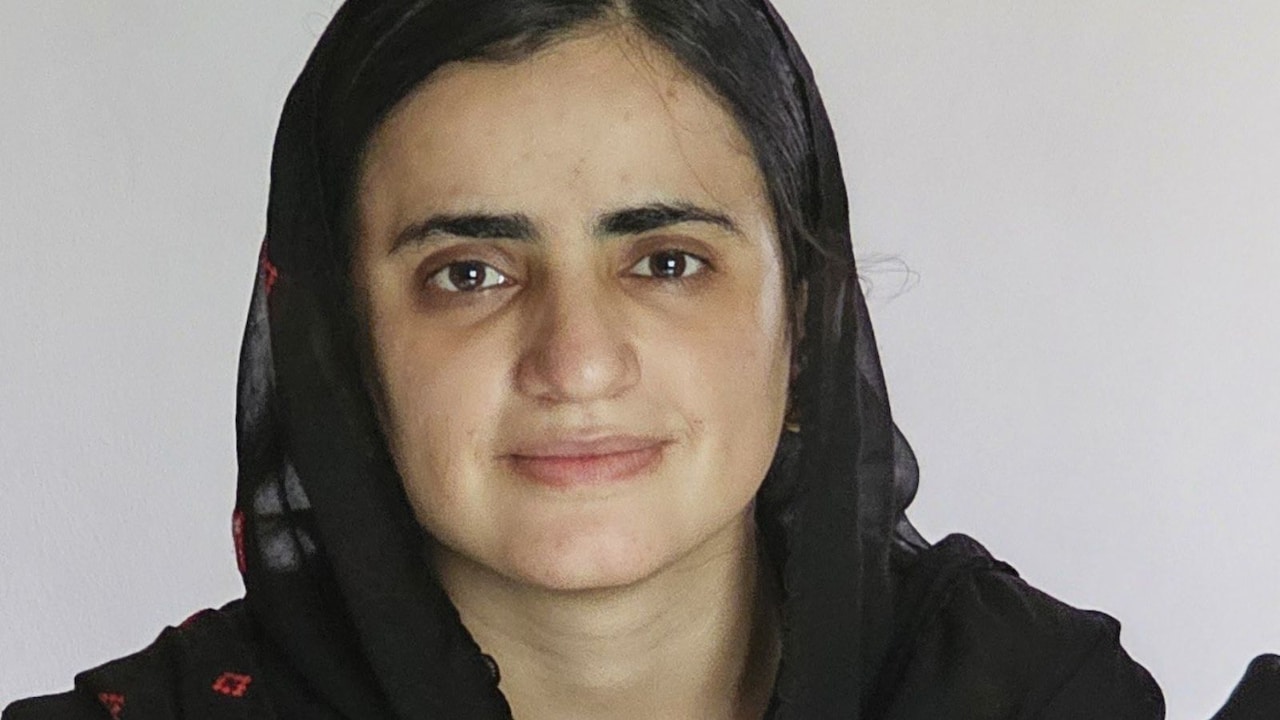
The courtroom did not smell like justice. It smelled of damp concrete, old paper, and the suffocating heat of a Pakistani summer that refuses to relent. When the gavel fell, it didn't make a grand, cinematic thud. It was a sharp, dry crack. With that single sound, Mahrang Baloch—a thirty-three-year-old woman who had spent her youth marching down asphalt roads under a blistering sun—was sentenced to spend the rest of her natural life behind bars.
To the bureaucrats in Islamabad, she was a case file. A disruption. A threat to state sovereignty wrapped in a traditional embroidered shawl. But to understand why a young doctor became the most dangerous woman in Pakistan, you have to look past the sterile headlines. You have to look at the dirt.
Balochistan is a land of cruel ironies. It is Pakistan’s largest province, a vast expanse of rugged mountains and sun-baked deserts that holds the nation’s richest deposits of natural gas, gold, and copper. Yet, its people are among the poorest. It is a place where wealth is extracted from the earth while the communities living above it go without clean water, electricity, or schools. For decades, a quiet, devastating crisis has unfolded here: the phenomenon of enforced disappearances. Activists call it a systematic campaign to silence dissent. The state calls it national security.
Imagine sitting down for dinner with your family. The door is kicked open. Men in uniforms or plain clothes enter without a warrant. They take your father, your brother, or your son. No charges are filed. No police station acknowledges their arrest. They simply vanish into thin air.
This is not a hypothetical nightmare. This was Mahrang’s reality.
In 2009, her father, Gaffar Baloch, a left-wing political activist, was abducted by security forces. For two years, a teenage Mahrang transformed from a student into a protester, learning the brutal geography of grief. She learned which offices to petition, which protests to join, and how to keep breathing when hope rotted away. In 2011, her father’s body was found. It bore the unmistakable marks of severe torture.
Grief does strange things to human beings. It crushes some. It turns others into flint. Mahrang became flint.
The Long March from the Edge of the Map
When her brother was also briefly detained years later, Mahrang realized that silence was a luxury she could no longer afford. She did not pick up a weapon. Instead, she picked up a microphone and organized the Baloch Yakjehti Committee (BYC).
Late last year, the crisis reached a boiling point after the extrajudicial killing of a young Baloch man named Balaach Mola Bakhsh. Mahrang did something extraordinary. She mobilized the women.
Historically, the public sphere in Balochistan has been deeply patriarchal. Women stayed within the walls of their homes. But the sheer volume of missing men forced a cultural seismic shift. Mothers, daughters, sisters, and wives stepped into the vacuum left by their missing men. They became the public face of resistance.
Mahrang led them on a historic 1,600-kilometer long march from the remote town of Turbat all the way to the capital city of Islamabad.
The journey was grueling. They walked through freezing winter nights and dust storms. They carried portraits of their missing loved ones pressed against their chests like shields. Along the way, they faced harassment, blockades, and water cannons. When they finally arrived in Islamabad, the state’s response was icy. They were met with mass arrests, batons, and a smear campaign in the media that labeled them as proxies for foreign intelligence agencies.
Yet, the image of Mahrang Baloch, standing defiantly before a wall of riot police, her hand raised, her voice steady, went viral. She had done the one thing the authorities feared most: she had made the invisible stakes visible to the world.
The Chemistry of Silence
The state's apparatus relies heavily on the weariness of ordinary people. It counts on the fact that eventually, people will get tired of shouting into the void. They will accept the status quo because survival demands it.
Consider how power operates in these regions. It doesn't just lock people up; it attempts to rewrite the narrative. The state argues that Balochistan is plagued by violent separatist militancy—which is true, as insurgent groups have targeted infrastructure and security forces for years. The tragedy lies in the state’s inability, or unwillingness, to distinguish between a militant with a rifle and a grieving daughter with a megaphone. By treating peaceful protest as terrorism, the space for moderation is systematically obliterated.
When the courts handed down the life sentence to Mahrang on charges of sedition, anti-state propaganda, and inciting public disorder, it was meant to be a therapeutic exercise for the establishment. A surgical removal of a thorn in their side.
But intimidation possesses a volatile chemistry. Sometimes, when you compress a gas too tightly, it doesn't dissipate. It explodes.
The Echoes in the Alleyways
What happens to a movement when its focal point is locked away? The authorities often operate under the illusion that movements are top-down organizations, like corporations or militaries. Cut off the head, and the body dies.
They misunderstand the nature of modern resistance. Mahrang Baloch is no longer just a person. She is an idea, a living symbol of a collective trauma that spans generations. Her imprisonment does not erase the thousands of missing persons profiles filed away in the memory of Baloch families. It validates them.
The real problem lies in the calculation of cost. The state believes the cost of silencing Mahrang is low—a few weeks of international human rights press releases, a couple of social media trends, and then back to business as usual. But the hidden cost is the permanent alienation of an entire generation of Baloch youth who watched a peaceful, constitutional advocate get buried alive by the legal system. They look at her sentence and receive a dangerous message: The system will never hear you.
The streets of Quetta and Turbat are quiet tonight, but it is the heavy, loaded silence that precedes a storm. In the small, mud-brick houses where families gather around single gas burners, the conversations are not about surrender. They are about what comes next.
A life sentence is a long time. It is a declaration by the state that they intend to outlast her. But as Mahrang herself noted before her arrest, the desert has a different relationship with time than the city. The mountains do not move for the convenience of the road.
The cell door has closed, and the lock has turned. The state has its verdict. But history rarely accepts the first draft written by a fearful court. Somewhere in a small village, a little girl is looking at a photograph of a woman in an embroidered shawl, her fist raised against the sky, and she is learning how to speak.