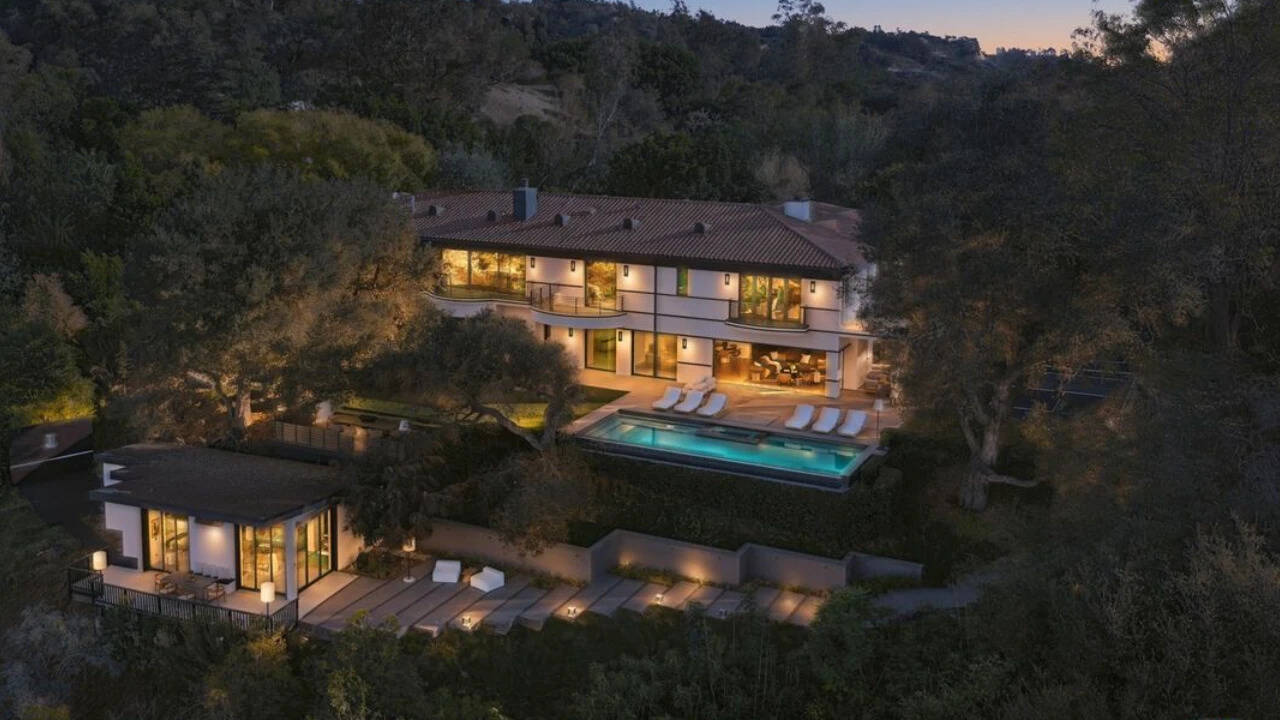
Listing a $14.9 million Los Angeles estate owned by Warren Beatty and Annette Bening exposes the fundamental friction between brand-driven media coverage and institutional real estate valuation. Standard entertainment reporting reduces ultra-prime property transactions to square footage, bedroom counts, and celebrity provenance. This approach obscures the actual market mechanics governing Beverly Hills and Bel Air asset liquidity. High-net-worth buyers do not acquire $15 million residential properties based on Hollywood nostalgia; they underwrite them based on land value, replacement cost, capital stack efficiency, and regulatory friction.
To evaluate the Beatty-Bening listing accurately, an analyst must separate the observable physical asset from the unquantifiable provenance premium. When an estate enters the market at $14.9 million, it sits directly inside Los Angeles's most volatile regulatory and liquidity bracket. Understanding whether this asset will clear the market near ask or suffer prolonged days on market requires stripping away lifestyle narratives and applying rigorous real estate economics.
The Provenance Fallacy in Ultra-Prime Residential Valuation
Entertainment coverage universally treats celebrity ownership as a direct value multiplier. In operational brokerage practice, provenance acts as an awareness mechanism rather than a price determinant. Media syndication generates top-of-funnel impressions—bringing global visibility to a listing without paying for paid acquisition—yet impressions rarely convert to closed escrow at a premium.
In institutional real estate appraisal, value derives from three distinct methodologies:
- The Sales Comparison Approach: Benchmarking the asset against closed transactions of similar lot size, topography, and utility within a tight geographic radius over the trailing six months.
- The Cost Approach: Calculating the acquisition cost of raw land plus the current labor and material cost to construct the existing improvements, minus physical and functional depreciation.
- The Income Capitalization Approach: Rarely applied to owner-occupied trophy estates, though relevant when evaluating ultra-prime assets as long-term inflation hedges or collateralized debt instruments.
Celebrity ownership fails to register in any of these three models. Appraisers working for private wealth lenders—such as First Republic's successors, J.P. Morgan Private Bank, or Goldman Sachs—explicitly strip out intangible brand premiums when determining loan-to-value (LTV) ratios. If Warren Beatty and Annette Bening's estate commands $14.9 million, a lender will underwrite the dirt and the bricks. Should the asking price embed a 15% to 20% "Hollywood legacy" markup above comparable neighborhood sales, the buyer must bridge that appraisal gap entirely with liquid cash.
The mechanism of provenance only yields a financial premium under one narrow condition: when the property possesses documented architectural pedigree—such as designs by Paul R. Williams, Richard Neutra, or John Lautner—where the structure itself functions as collectible fine art. Absent museum-grade architectural significance, celebrity history often introduces a negative externality. Long-term occupancy by legacy Hollywood figures frequently correlates with dated floor plans, deferred mechanical upgrades, and bespoke aesthetic choices that require seven-figure capital expenditures to modernize.
Deconstructing the $14.9 Million Capital Stack and Holding Costs
A $14.9 million asking price is merely the entry ticket to an ongoing operational burn rate. Media reports omit the carrying costs that dictate buyer urgency and seller capitulation in Southern California. Evaluating this asset requires modeling the buyer's annual cost of ownership and the seller's transaction friction.
The Measure ULA Transfer Tax Bottleneck
Effective April 2023, the City of Los Angeles implemented Measure ULA—colloquially termed the "mansion tax"—which imposes a 4% gross transfer tax on property sales exceeding $5 million and a 5.5% tax on sales exceeding $10 million.
If the Beatty-Bening estate sits within Los Angeles city limits (such as Bel Air, Holmby Hills, or the Beverly Hills Post Office 90210 zip code) rather than the independent municipality of the City of Beverly Hills, a sale at $14.9 million triggers an immediate 5.5% municipal levy. That equals $819,500 extracted directly from the seller's gross proceeds before accounting for brokerage commissions (typically 4% to 5%, or $596,000 to $745,000) and title/escrow fees.
This regulatory structure creates a severe pricing distortion:
- Seller Resistance: Sellers inflate asking prices by 5% to 6% to pass the ULA tax burden onto the buyer.
- Buyer Resistance: Buyers refuse to absorb an unrecoverable tax that adds zero intrinsic value to the collateral.
- Liquidity Freeze: Transaction volume in the $10 million to $20 million bracket across LA city limits contracted sharply post-2023 as bid-ask spreads widened beyond historical norms.
If the property is located within the City of Beverly Hills proper, it bypasses Measure ULA entirely, insulating the transaction from that $819,500 friction cost and making the $14.9 million valuation substantially more competitive against nearby LA-city inventory.
Annual Carrying Cost Architecture
Assuming a buyer acquires the asset at or near the $14.9 million ask, the ongoing operational expense structure functions as follows:
- Property Taxes: Under California's Proposition 13, the property's assessed value resets to the purchase price upon transfer. At an effective base rate of approximately 1.15% to 1.25% in Los Angeles County, annual property taxes immediately reset to roughly $171,350 to $186,250. For long-term owners like Beatty and Bening, Prop 13 capped their annual tax increases at 2% per year, meaning their holding cost was a fraction of what the incoming buyer will pay.
- Insurance Underwriting Friction: Southern California's hillside and canyon estates face an acute property insurance crisis. Standard carriers have retreated from high-fire-severity zones (such as Benedict Canyon, Beverly Glen, and Bel Air). Securing comprehensive coverage for a $15 million estate often requires layering a California FAIR Plan policy with a Difference in Conditions (DIC) policy from excess and surplus lines carriers, pushing annual premiums from a historical baseline of $15,000 to upwards of $60,000–$100,000+.
- Physical Maintenance and Staffing: Estate-scale properties require continuous capital allocation for landscape irrigation, pool systems, security monitoring, and HVAC servicing, easily consuming another $100,000 to $150,000 annually.
Combined, a new owner faces an unleveraged annual holding cost exceeding $350,000 before factoring in debt service. At a 6.5% jumbo mortgage rate with 30% down ($10.43 million loan), annual debt service adds roughly $790,000, bringing total annual cash outflow past $1.14 million.
Land Value Versus Functional Obsolescence
When long-term residents bring an estate to market after decades of ownership, the central analytical question is whether the asset trades as a turnkey residence or a land-value redevelopment play.
In Los Angeles's core luxury submarkets, lot utility dictates ceiling value. Flat, usable acreage—known locally as "promontory" or "flat-pad" land—commands exponential premiums over steep hillside terrain where retaining walls, caissons, and geological stabilization eat into buildable square footage.
- The Turnkey Scenario: For the Beatty-Bening estate to clear at $14.9 million as an existing residence, the floor plan must align with contemporary luxury buyer demands: high ceiling clearances (10 to 14 feet), seamless indoor-outdoor structural glass transitions, dual primary baths/closets, and modernized mechanical, electrical, and plumbing (MEP) infrastructure. Legacy homes built or remodeled in the 1980s and 1990s typically suffer from compartmentalized layouts, 8-to-9-foot ceilings, and aging systems.
- The Tear-Down / Gut-Renovation Scenario: If the structure exhibits functional obsolescence, sophisticated buyers will underwrite the $14.9 million ask purely as a land acquisition. In this scenario, the buyer calculates the After-Repair Value (ARV) of a newly constructed 10,000-to-12,000-square-foot contemporary spec home in that specific micro-location. Hard construction costs for ultra-prime Los Angeles residential builds currently run between $1,000 and $1,500 per square foot, excluding soft costs (architecture, structural engineering, city permitting, and carry interest during a 24-to-36-month entitlement and build cycle).
If a developer must spend $14.9 million on land and another $12 million to $15 million on hard and soft construction costs, their total basis hits $27 million to $30 million. To justify the risk and earn a standard 15% to 20% developer margin, the neighborhood must support exit comps at $33 million to $36 million. If the surrounding street caps out at $20 million, the math breaks, forcing the $14.9 million asking price down until land residual value aligns with neighborhood exit ceilings.
Behavioral Economics and Seller Pricing Strategy
Why do high-profile sellers anchor at specific price points like $14.9 million? The pricing reflects deliberate psychological and algorithmic positioning rather than random estimation.
Algorithmic Search Thresholds
Real estate portals (Zillow, Redfin, MLS syndication feeds) and institutional buyer alerts filter inventory by hard numerical brackets. Pricing at $14.9 million rather than $15.0 million captures every buyer whose upper search filter is capped at $15 million. Crossing the $15.0 million threshold instantly cuts the visible digital buyer pool by excluding all search queries bounded at $10M–$15M.
Endowment Effect and Legacy Anchoring
Long-term celebrity owners routinely fall victim to the endowment effect—overvaluing an asset simply because of personal history and emotional tenure. Because Warren Beatty and Annette Bening represent decades of Hollywood continuity, their advisory team (business managers, real estate attorneys, and listing agents) must manage the gap between sentimental valuation and market-clearing price.
Listing at $14.9 million functions as an initial price-discovery mechanism. In ultra-prime real estate, the first 30 to 60 days on market serve as a live stress test:
- Days 1–30: Driven by media hype and curious showings. Qualified cash buyers and family offices tour the asset to assess lot geometry and privacy.
- Days 31–90: Media buzz evaporates. If no credible offers materialize within 10% of the ask, the market has rejected the valuation.
- Days 90+: The listing risks becoming "shopworn." In luxury brokerage, extended days on market signal desperation, inviting predatory lowball bids from opportunistic developers.
Tactical Framework for Evaluating Celebrity Listings
Analysts, prospective buyers, and competing brokers should apply a four-step diagnostic protocol before assigning credibility to any celebrity real estate headline:
- Verify Municipal Boundaries: Cross-reference the parcel's Assessor's Identification Number (AIN) against Los Angeles City versus independent municipal boundaries (Beverly Hills, West Hollywood, Malibu, Santa Monica). Immediately discount LA-city listings by 5.5% to account for Measure ULA friction.
- Isolate Price Per Square Foot of Land: Ignore the price per square foot of the structure until you establish the underlying land value per square foot. Compare the lot's usable flat acreage against raw land sales or tear-down comps within a 0.5-mile radius.
- Audit Permit History: Pull the municipal building permit logs for the past 20 years. A lack of recent structural, roofing, electrical, or seismic retrofitting permits confirms that the buyer will absorb immediate capital expenditures post-closing, which must be deducted from the offer price.
- Assess Privacy and Ingress/Egress: For ultra-high-net-worth buyers, security is a hard financial metric. Gated street access, double-gated driveways, mature perimeter hedging, and non-line-of-sight topography from neighboring ridges add measurable liquidity value that standard square-footage metrics miss.
Strategic Execution for Market Participants
For buyers evaluating the Beatty-Bening estate—or any comparable $15 million legacy property in Los Angeles—do not negotiate against the $14.9 million asking price or the celebrity narrative. Anchor your valuation exclusively to trailing 6-month closed land comps and documented renovation costs. Submit an all-cash offer with a compressed 14-day due diligence contingency, structuring the bid to reflect the exact cost of required mechanical modernization and municipal transfer taxes. If the listing crosses 75 days on market without entering escrow, execute a second-round bid discounted by 12% to 18% below ask, capitalizing on the seller's declining leverage once initial media exposure has fully decayed.