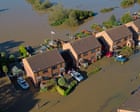
Real estate markets rely on the assumption of permanent geographic stability. When the physical environment shifts due to changing weather patterns and rising sea levels, financial systems encounter a friction point between actuarial reality and long-term asset valuation. The public warning issued by insurance leadership regarding uninsurable residential properties in high-risk zones highlights a structural vulnerability in how modern property markets price environmental risk.
Market mechanisms typically absorb risk through premium adjustments. When a property faces an increased probability of inundation, insurance underwriters calculate the expected loss and scale the premium upward. This mechanism functions effectively up to a specific mathematical threshold. Beyond that threshold, the annual cost of indemnification approaches or exceeds the replacement value of the asset itself, rendering standard underwriting economically unviable.
The Underwriting Breakdown Mechanism
Property insurance operates on the principle of distributed risk. A large pool of policyholders pays premiums into a common reserve, from which a small percentage experiences catastrophic loss. This model collapses when risks are correlated rather than independent. In a geographically concentrated flood zone, an extreme weather event impacts the entire risk pool simultaneously, destroying the actuarial balance.
Underwriters evaluate risk exposure using three primary variables: hazard probability, asset vulnerability, and financial exposure.
Risk = Hazard Probability × Asset Vulnerability × Financial Exposure
When hazard probability shifts from an anomalous tail event to a near certainty within a thirty-year mortgage lifecycle, insurers face an existential choice. They can either price policies to reflect the true expected loss, which prices the consumer out of the market, or withdraw coverage entirely.
The withdrawal of private underwriting transfers the financial burden directly to property owners, local municipalities, and ultimately, state-backed backstops. However, state-backed pools face the same mathematical constraints. Without capitalization from general taxation, public flood insurance programs accumulate massive deficits when facing recurring catastrophic losses.
The Mortgage Market Transmission Vector
The intersection of insurance availability and mortgage lending creates a secondary transmission vector for financial instability. Mortgage originators require property insurance as a mandatory condition for loan servicing. If a residential property cannot secure private or government-backed insurance, lenders legally cannot issue or maintain the mortgage.
This creates a liquidity cliff for property values in high-risk zones.
- Insurance Withdrawal: Underwriters cancel policies or raise premiums to prohibitive levels due to recurrent flood exposure.
- Mortgage Ineligibility: Lenders refuse to extend credit or renew financing because collateral lacks loss protection.
- Asset Devaluation: Properties become untradeable, triggering a rapid markdown in local real estate collateral values.
- Municipal Tax Erosion: Local governments experience diminished property tax revenues, degrading their capacity to fund infrastructure remediation like sea walls or drainage systems.
The speed of this transition depends on regulatory frameworks. In markets where insurers maintain the freedom to reprice annual policies based on real-time risk data, the repricing shock occurs rapidly. In markets with strict rate regulations, insurers experience cumulative losses until they petition for withdrawal en masse, causing a sudden market freeze.
Capital Allocation Failures in Mitigation
Capital deployment toward flood defense often suffers from the moral hazard of public subsidization. When property owners believe that government entities will perpetually rebuild damaged infrastructure or bail out flooded communities, the price signal of environmental risk is distorted. Developers continue to build in vulnerable floodplains because the downside risk is externalized to taxpayers, while the upside gain is privatized.
Effective adaptation requires shifting capital away from post-disaster reconstruction and toward preemptive structural relocation or engineered fortification. Yet, traditional municipal financing models rely on property tax growth, incentivizing local authorities to permit development in hazardous zones to maximize short-term municipal revenue.
To break this cycle, financial reporting standards must account for climate-adjusted asset depreciation. Real estate valuations that ignore the declining operational lifespan of high-risk structures misstate corporate and individual balance sheets.
Urban planning policy must decouple zoning permissions from municipal revenue generation. If local councils do not internalize the long-term liabilities of approving residential projects in flood-prone areas, private capital will continue to misallocate resources into stranded assets. The adjustment will occur either through orderly, preemptive down-zoning or through disorderly, market-driven defaults when insurance markets completely close access to capital.