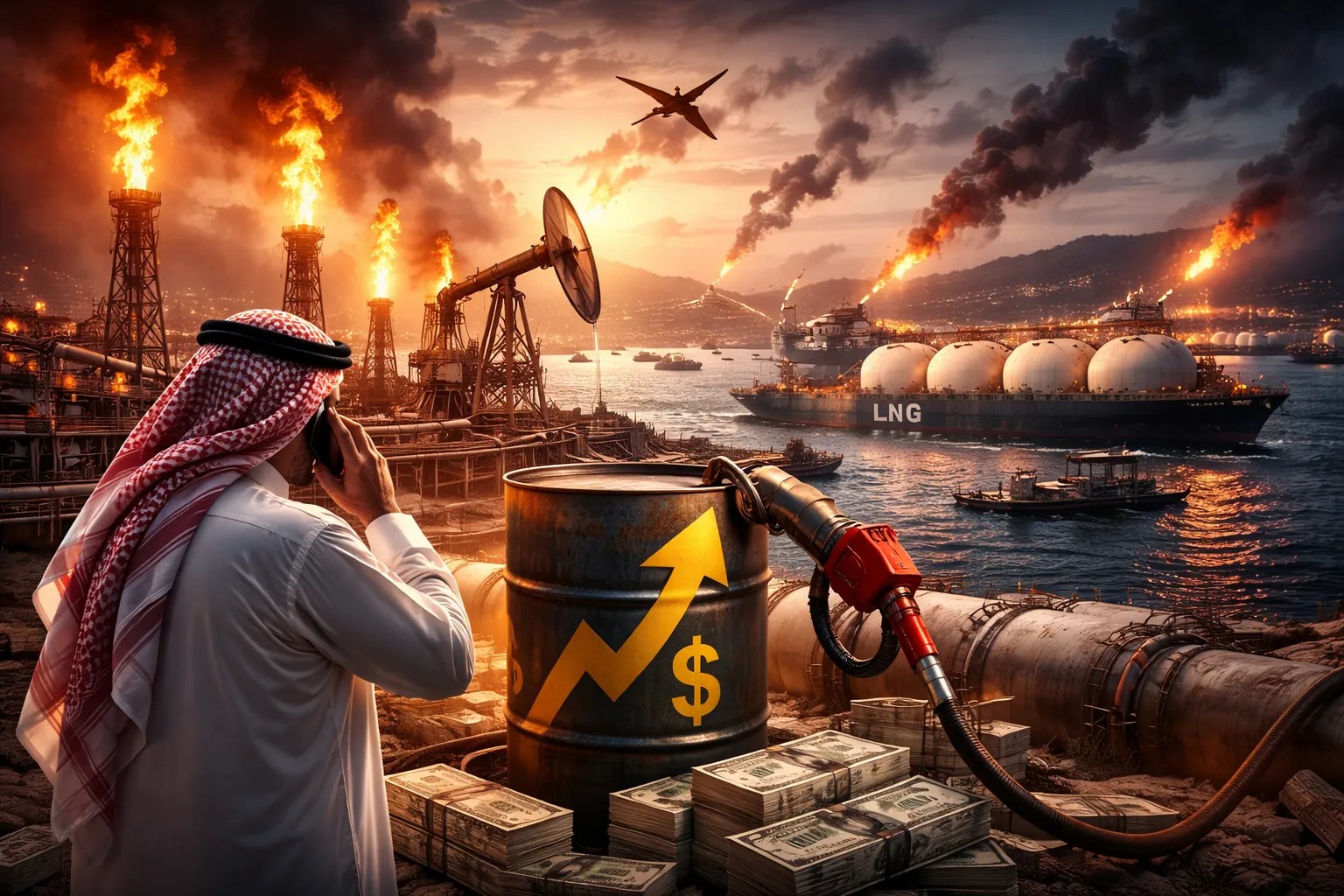
The global energy market is currently held hostage by a geography problem that no amount of green transition talk can solve. When Qatar issues a warning about liquefied natural gas (LNG) shipments, the world doesn't just listen; it calculates the cost of potential industrial collapse. Recent escalations in the Middle East have pushed the tiny, gas-rich peninsula to signal a hard truth that Western capitals have tried to ignore. If the transit corridors of the Red Sea remain a combat zone, the flow of energy will stop. This isn't a mere pricing fluctuation. It is a fundamental breakdown of the supply chain that keeps Europe warm and Asian factories humming.
Qatar Energy recently paused transit through the Bab el-Mandeb Strait. This decision follows a series of strikes and counter-strikes that have turned one of the world's most vital maritime arteries into a shooting gallery. While the immediate reaction in the commodities pits was a spike in futures, the deeper story lies in the exhaustion of the global "buffer." We are out of easy alternatives.
The Death of the Shortcut
For decades, the Suez Canal served as the ultimate efficiency hack for global trade. By cutting through the Red Sea, Qatari LNG tankers could reach European terminals in roughly two weeks. The alternative is a grueling detour around the Cape of Good Hope. This path adds approximately 9,000 kilometers to the journey. It tacks on ten days of travel time. It burns thousands of tons of additional marine fuel.
Most importantly, it breaks the schedule.
The global LNG fleet is not infinite. When you increase the duration of every voyage by 40 percent, you effectively shrink the available fleet by the same margin. You cannot deliver the same volume of gas with the same number of ships if those ships are stuck sailing around the entire African continent. This creates a physical shortage that no amount of financial hedging can fix. We are witnessing the forced de-globalization of energy in real-time.
Why the US Pivot Failed to Provide a Safety Net
Common wisdom suggested that the surge in American shale gas would insulate the world from Middle Eastern volatility. That turned out to be a fantasy. While the United States has become a leading exporter of LNG, its capacity is largely locked into long-term contracts. Furthermore, American export terminals are facing their own hurdles, ranging from regulatory pauses on new permits to the physical limitations of the Panama Canal, which has been hampered by historic droughts.
Europe thought it could swap Russian pipeline gas for a mix of American and Qatari LNG and call it "diversification." Instead, they swapped a single point of failure for a complex web of maritime risks. If Qatar stops using the Red Sea, the burden shifts entirely to a global shipping infrastructure that is already stretched to the breaking point.
The Myth of Decoupling
There is a persistent narrative in policy circles that the "energy transition" is making these geopolitical flare-ups less relevant. The data suggests the opposite. Natural gas is the "bridge fuel" that every major economy is relying on to phase out coal while waiting for renewables to scale. When that bridge catches fire, the entire strategy crumbles.
In emerging economies across Asia, high LNG prices don't just mean higher utility bills. They mean "demand destruction." This is a polite economic term for factories shutting down because they can't afford to keep the lights on. When Qatar warns of disruptions, they are reminding the world that the "just-in-time" delivery model for energy is incompatible with a world at war.
Logistics as a Weapon of War
We have entered an era where the ship is as important as the commodity. Insurance premiums for vessels entering the Red Sea have't just risen; they have entered the realm of the prohibitive. Some underwriters are simply refusing to cover ships with links to certain nations.
Qatar occupies a unique position as a mediator that also happens to own the world’s most important gas fields. Their warnings are rarely bluster. They are clinical assessments of risk. If a state-owned entity like Qatar Energy decides the risk is too high, it sends a signal to every commercial fleet on the planet. They are essentially declaring the Red Sea a "no-go zone" for the energy trade.
The Cape of Good Hope Bottleneck
Rerouting around Africa is not as simple as changing a destination on a map. The ports along the African coast are not equipped to handle a massive influx of diverted mega-tankers needing bunkering or emergency repairs. The waters are rougher. The mechanical strain on the vessels is higher.
The increased cost of these voyages is inevitably passed down to the consumer. We see this in the "basis risk" in natural gas pricing—the difference between the price at the wellhead and the price at the delivery hub. That gap is widening into a canyon.
The Cold Reality for Heavy Industry
The sectors most vulnerable to this Qatari shift are those that cannot simply "switch off." Fertilizer production, glass manufacturing, and steel smelting require a constant, high-pressure flow of gas. In 2022, Europe survived a winter by paying record-high prices to outbid Asian buyers. That was a one-time trick. You cannot win a bidding war every year without bankrupting your industrial base.
If the Red Sea remains closed to LNG traffic through the end of the year, we will see a permanent shift in industrial geography. Companies will move where the gas is, rather than waiting for the gas to come to them. This means a flight of capital away from Europe and toward the Gulf and the US Gulf Coast.
The Intelligence Gap in Energy Markets
Most analysts are looking at storage levels in Germany or North Sea production figures. They are looking at the wrong things. The real data points that matter now are the daily transit counts through the Mandeb Strait and the fluctuating insurance war-risk premiums in London.
The market is currently pricing in a "temporary disruption." But there is nothing in the current geopolitical landscape to suggest this is temporary. The non-state actors causing the disruption have discovered that they can achieve global leverage with relatively cheap technology. A drone costing $20,000 can effectively divert a $200 million LNG cargo, forcing it on a $1 million detour. The math of modern conflict is heavily skewed against the status quo of global trade.
Sovereignty vs. Solvency
For Qatar, the decision to pause or reroute is a matter of protecting their most valuable assets—their ships. For the rest of the world, it is a matter of economic survival. This friction point is where the new world order is being forged. We are moving away from a globalized market governed by rules and toward a fragmented market governed by geography and naval power.
The era of cheap, reliable energy delivered through predictable channels is over. The "seven heavens" of high prices mentioned in regional reports aren't a peak; they are the new floor. Investors and policymakers who are waiting for a "return to normal" are ignoring the smoke rising from the horizon.
Check the shipping manifests. Watch the bunkering hubs in Singapore and South Africa. The tankers are turning around, and they aren't coming back to the old routes anytime soon.