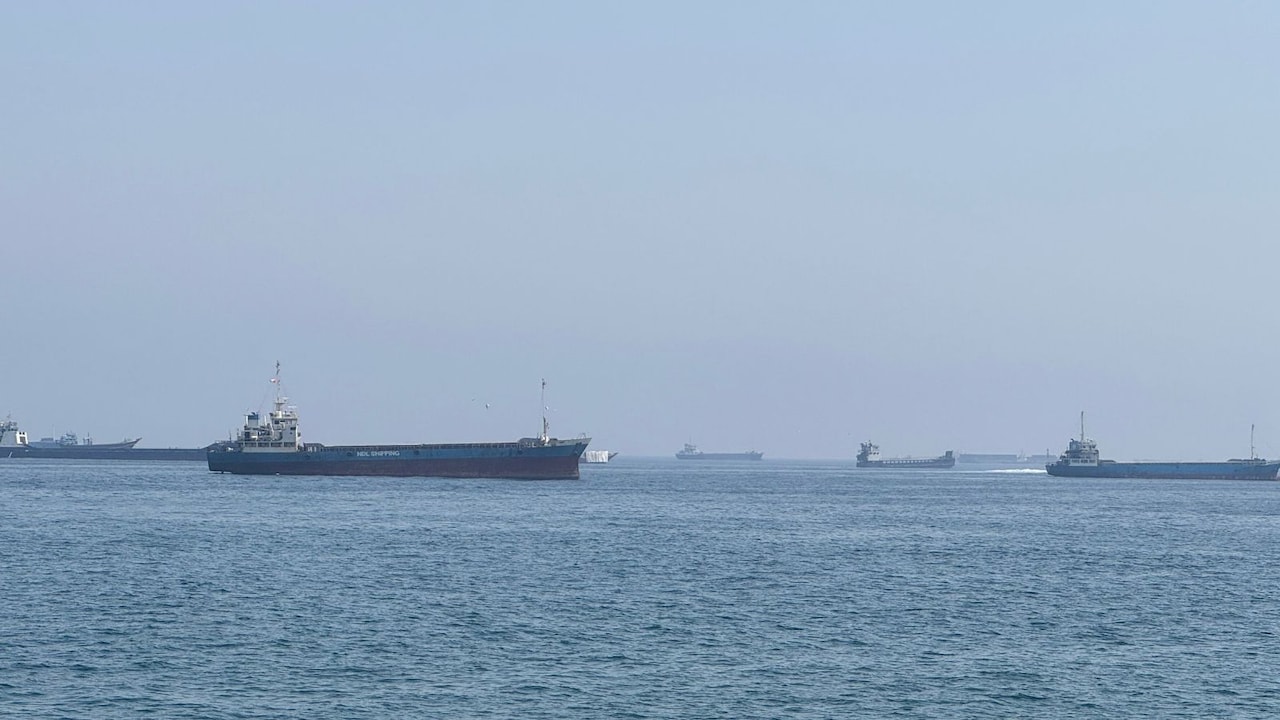
Salt crusts on the bridge windows of a Very Large Crude Carrier before the sun even clears the jagged peaks of Musandam.
Down in the engine room, the air smells of heated marine diesel, ozone, and old sweat, vibrating at a frequency you feel in your teeth rather than hear with your ears. To understand what happens when Tehran draws an invisible line through the Strait of Hormuz—letting ships bound for Mumbai and Ningbo glide through while Western hulls stall in the Gulf of Oman—you have to stop looking at colored arrows on a cable news map and start looking at the coffee cup trembling on a chief engineer's console.
Consider a hypothetical scenario on the water right now. Two supertankers sit twelve nautical miles apart, separated by nothing more than radar blips and diplomatic intent. One flies a flag of convenience, chartered by a European trading house, carrying two million barrels of Saudi heavy crude destined for Rotterdam. Its captain stares at a blinking VHF radio, waiting for clearance from naval patrol boats idling near Qeshm Island. Twelve miles off his port bow, a second tanker—identical steel, identical draft, carrying nearly identical crude—churns steadily through the twenty-one-mile-wide choke point without slowing a single knot. Its bill of lading points to Paradip, on India's eastern coast, or perhaps Zhoushan in eastern China.
Same ocean. Different rules.
When Iran announced exemptions for Indian and Chinese vessels from its tighter maritime restrictions in the Strait of Hormuz, the headlines treated it like a neat geopolitical footnote. Analysts called it pragmatic. Traders adjusted their spreadsheets. Yet beneath that cold, transactional language lies a profound shift in how the modern world breathes. Roughly twenty percent of the world's petroleum liquids—around twenty to twenty-one million barrels every single day—must squeeze through this narrow throat of water connecting the Persian Gulf to the open ocean. Alongside that oil moves nearly a fifth of global liquefied natural gas, mostly out of Qatar. For forty years, the unspoken rule of global energy was simple: the Strait was either open to everyone, or it was a burning battlefield closed to all.
That binary world just died.
The Anatomy of a Two-Speed Ocean
I remember standing on a windy pier in Fujairah years ago during an earlier spike in Gulf tensions, watching dozens of black-hulled tankers anchored like sleeping whales just outside the Strait. A retired Greek port captain stood beside me, nursing lukewarm tea from a paper cup. He pointed out toward the haze where the water narrowed. "People think a blockade is a chain across the harbor," he said, his voice raspy from forty years of salt air and cigarettes. "It isn't. A blockade is an insurance underwriter in London deciding he won't sign a piece of paper."
He was right. You do not need to sink a ship to stop it; you only need to make its war-risk insurance premium climb from a fraction of a percent to millions of dollars per transit.
By carving out an explicit exemption for India and China, Tehran performed a surgical strike on that financial mechanism. Think of the Strait of Hormuz not as a highway, but as a tollbooth where the attendant suddenly recognizes only two currencies. If you are a refiner in Jamnagar or a state-owned petrochemical giant in Guangdong, the sea remains wide, predictable, and insurable. Your crude arrives on schedule. Your domestic fuel prices stay anchored. Meanwhile, if you are a utility in Frankfurt, a logistics firm in Rotterdam, or a motorist in Ohio watching global benchmark prices react to supply bottlenecks, you are suddenly standing in a very different, much more expensive line.
Why did Iran make this move? The answer sits at the intersection of survival and leverage—not the buzzword kind, but the literal weight of an economy trying to stay afloat under decades of Western sanctions. China absorbs the overwhelming majority of Iran's exported crude, often routed through complex ship-to-ship transfers in Malaysian waters and processed by independent "teapot" refineries in Shandong province. India, while far more cautious with direct Iranian barrels due to Washington's pressure, remains one of the fastest-growing energy markets on earth and a critical diplomatic counterweight that refuses to join Western sanctions regimes.
Blocking Hormuz completely would be economic suicide for Tehran. It would choke off the very customers keeping Iran's treasury liquid and turn Beijing and New Delhi from cautious partners into furious adversaries overnight. By selectively opening the gate, Iran found a way to squeeze Western economies and their regional allies without cutting its own oxygen supply.
The Invisible Ripple in Your Grocery Aisle
It is easy to feel detached from maritime politics when you live thousands of miles from the Persian Gulf. We tend to think of oil as something that only matters when we pull up to a gas pump and wince at the digital numbers rolling upward.
That is a comfortable illusion.
Crude oil and liquefied natural gas are the invisible architecture of daily life. When maritime restrictions slow down non-exempt tankers—forcing them into holding patterns, longer alternative routes, or fierce bidding wars for non-Gulf barrels from West Africa, Brazil, or the United States—the cost does not stay at the port. It migrates. It slips into the diesel burning inside the refrigerated truck hauling tomatoes up the interstate. It embeds itself in the petrochemical feedstocks used to manufacture the plastic IV bags in your local hospital, the fertilizer spread across Midwest wheat fields, and the asphalt beneath your tires.
Consider what happens next in a mid-sized manufacturing town in Ohio or a textile hub in northern Italy. When European and Asian buyers who lack Iranian exemptions scramble for alternative LNG cargoes to replace delayed Qatari shipments, spot prices jump. A European glassmaker, suddenly facing a thirty percent spike in natural gas costs, shuts down a furnace. Weeks later, a craft brewery in Pennsylvania cannot get amber bottles, or pays double for them. Nobody in that supply chain ever mentions Qeshm Island or maritime exclusion zones, yet the fingerprint of Hormuz is pressed firmly onto the invoice.
At the same time, look at what happens in Mumbai or Shanghai under this two-speed arrangement. Because Indian and Chinese refiners retain uninterrupted access to Persian Gulf crude—and often buy discounted Russian or Iranian barrels on top of it—their energy input costs remain comparatively insulated. A plastics manufacturer in Gujarat or an electronics assembler in Shenzhen suddenly enjoys a quiet, structural cost advantage over a competitor in Germany or Japan. Over months, that gap compounds. Factories stay competitive in one hemisphere while margins thin out in another.
I will admit something that analysts rarely say out loud: watching this unfold is deeply unsettling because the old safety valves no longer work the way textbooks promise. For decades, the standard response to a Gulf crisis was naval deterrence—aircraft carriers steaming into the region to guarantee freedom of navigation. Yet naval destroyers cannot easily force a private shipping company to sail through contested waters when the threats are asymmetric drones, limpet mines, and selective legal seizures rather than a conventional fleet battle. You cannot escort every commercial hull twenty-four hours a day, and even if you could, you cannot force an insurer in Zurich to underwrite the risk at peacetime rates.
The Illusion of the Bypass
Whenever tension flares in the Strait of Hormuz, someone inevitably pulls out a map and points to the pipelines. "Can't Saudi Arabia and the United Arab Emirates just pump their oil around the Strait?" they ask.
On paper, yes. In reality, barely.
Saudi Aramco operates the East-West Pipeline, stretching from the oilfields of Abqaiq across the desert to the Red Sea port of Yanbu, with a capacity of roughly five million barrels per day. The UAE operates the Habshan-Fujairah pipeline, which carries around 1.5 million barrels per day directly to the Gulf of Oman, bypassing Hormuz entirely. Together, when running flat out, those two arteries can move roughly six to seven million barrels a day.
Now do the math. Twenty-one million barrels go through the Strait every day. Even if every single bypass pipeline operated at peak theoretical capacity—which they rarely do—more than two-thirds of the Gulf's export volume would still be trapped behind that narrow bend of water. And for liquefied natural gas, there is no pipeline bypass at all. Qatar's massive North Field exports depend entirely on specialized cryogenic tankers gliding past Iranian coastal batteries.
That physical bottleneck is why Tehran holds such disproportionate influence over a stretch of water barely wider than the English Channel. Geography does not negotiate. You cannot dredge a new ocean overnight, and you cannot reroute supertankers through desert sand.
A New Map of Global Trust
Step back from the barrels and the freight rates for a moment, and look at the psychological shift taking place on the water.
For more than seventy years, the global economy operated on an assumption of neutral commons. The oceans, the major canals, the critical straits—they were treated as shared infrastructure, policed largely by American naval power and governed by maritime law that applied equally to a ship carrying grain to Cairo or crude to Tokyo. Even during the bitterest days of the Cold War, commercial shipping lanes retained a baseline predictability.
A selective restriction in Hormuz fractures that neutrality. It turns maritime geography into a loyalty test.
Think about what this signals to every energy-importing nation on earth. If you are a policymaker in Seoul, Tokyo, or Brussels, watching Indian and Chinese tankers pass freely while your own energy security hangs on diplomatic friction between Washington and Tehran, what lesson do you take home? You realize that neutrality is no longer automatic; it has to be negotiated, hedged, or bought. You start questioning whether relying on a single security umbrella guarantees your lights will stay on next winter.
Meanwhile, for India and China, the exemption is both a lifeline and a delicate trap. Neither New Delhi nor Beijing wants to look like a junior partner whose energy supply exists solely at Tehran's pleasure. India, in particular, has spent years walking a tightrope—maintaining deep defense and technology ties with the United States while preserving historic trade and port investments, such as Chabahar, with Iran. Accepting an exemption keeps Indian refineries humming and shields hundreds of millions of citizens from crippling fuel inflation, yet it also hands Tehran a subtle form of moral and diplomatic pressure to cash in later.
China plays a longer, cooler game. Beijing has spent two decades building strategic petroleum reserves, overland pipelines from Russia and Central Asia, and a massive domestic renewable and electric vehicle industry specifically to reduce its vulnerability to maritime choke points like Hormuz and the Strait of Malacca. For China, Iran's exemption is simply an immediate dividend on years of patient diplomatic hedging—proof that refusing to align with Western sanctions pays tangible rewards when geopolitical storms break.
The Human Weight on the Bridge
Out on the water, grand strategy feels much smaller and far more immediate.
It looks like a twenty-eight-year-old third officer from Manila standing watch at three in the morning on a vessel flagged in Liberia, owned by a firm in Athens, insured in London, and chartered by a trader in Singapore. He does not care about multipolarity or sanctions architecture. He cares about the radar screen glowing green in the dark, the slow, ghostly silhouettes of unlit patrol craft hugging the shoals off Iran, and whether the cargo manifest in the captain's safe puts their hull on the approved list or the target list.
When a waterway becomes selective, every transit becomes an interrogation. Radio channels crackle with demands for vessel names, IMO numbers, cargo origins, and final destinations. Captains double-check their Automatic Identification System transponders, knowing that a glitch—or a sudden change in ownership mid-voyage—could turn a routine passage into an armed boarding.
We like to imagine the global economy as weightless, digital, and instantaneous—numbers flashing across glass screens in New York, London, and Singapore. Yet every single number on those screens is still tethered to rusting steel hulls pushing through salt water at fourteen knots, guided by tired human beings staring into the dark.
Tonight, in the narrow elbow between Oman and Iran, two tankers will pass each other in the moonlight, their running lights red and green against the black water. One will carry papers stamped for Mumbai, sliding smoothly into the open Arabian Sea toward waiting refineries and lit cities. The other will drop anchor miles away, its engines idling in a slow, expensive burn, waiting for a world that used to share the same ocean to decide who gets to cross.