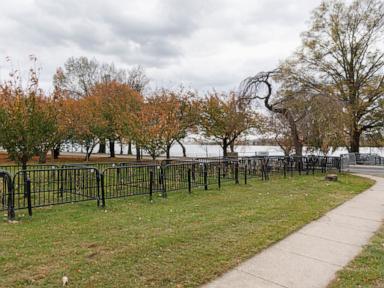
The dew on East Potomac Park does not care who holds the deed. At six in the morning, when the fog still clings to the Potomac River like wet wool and the Jefferson Memorial looks like a chalk sketch across the water, the grass belongs to whoever showed up with a rusted seven-iron and twenty-five dollars in their pocket.
I know that damp chill in the ankles. I have walked municipal fairways before sunrise when the greenskeepers were still dragging hoses across the fringe and the air smelled of cut fescue, river mud, and cheap diner coffee. On a public course, nobody checks your watch. Nobody asks what your father did for a living. The guy ahead of you might be a retired postal worker with a swing held together by duct tape and muscle memory, and the kid behind you might be hitting range balls he fished out of a creek.
Then the bulldozers start idling at the edge of the story.
This week, a federal judge stepped onto that figurative first tee and blew a whistle loud enough to echo from Hains Point to the White House. By issuing a temporary block halting the Trump administration's push to redevelop Washington, D.C.'s historic public golf courses, the court did far more than pause a construction timeline. It froze a collision between two irreconcilable ideas of what public land is actually for.
To understand why a patch of municipal turf in the nation's capital suddenly feels like a constitutional fault line, you have to look past the zoning maps and architectural renderings. You have to look at the people standing on the practice green.
The Architecture of an Open Gate
Consider Arthur, a hypothetical composite of the thousands of D.C. regulars who treat East Potomac, Langston, and Rock Creek not as country clubs, but as neighborhood backyards. Let us say Arthur is sixty-eight, a retired city bus driver whose knees ache when the barometric pressure drops. Three mornings a week, he pulls a battered pushcart out of the trunk of a 2011 sedan. He pays a greens fee that costs less than a downtown lunch. For four hours, under the flight path of Reagan National, Arthur is not a retiree on a fixed income. He is a strategist, a walker, a man measuring his life in fourteen-foot par putts.
Now imagine telling Arthur that the grass beneath his spikes is underperforming.
That word—underperforming—is where the friction begins. When private developers and executive branch planners look at the National Park Service's three historic D.C. golf facilities, they do not see Arthur's sanctuary. They see prime waterfront and parkland real estate generating modest municipal returns while infrastructure crumbles. They see leaking irrigation pipes, encroaching invasive weeds, and clubhouses that look like they survived the Carter administration on sheer stubbornness.
Their pitch sounds seductively simple on paper. Bring in private capital. Tear up the tired layouts. Build championship-caliber fairways, gleaming modern clubhouses, and luxury amenities worthy of a world capital.
Wait.
Who pays for the marble in that new clubhouse?
History offers an uncomfortable answer, and it rarely favors the guy with the 2011 sedan. Across the country, when municipal courses undergo high-end privatization or luxury overhauls, a predictable metamorphosis occurs. Greens fees climb from thirty dollars to a hundred and fifty. Tee times vanish into dynamic pricing algorithms and corporate blocks. The dress code tightens. The vibe shifts from welcome to audition. The gate stays technically open to the public, just like the lobby of a five-star hotel is technically open to anyone who walks off the street—right up until you look at the menu prices and realize you were never meant to sit down.
A Century of Concrete and Promise
You cannot separate these three courses from the complicated, often painful history of Washington itself. They are not merely recreational facilities; they are physical receipts of civil rights struggles and New Deal public works.
Take Langston Golf Course, tucked along the Anacostia River in Northeast D.C. Opened in 1939 after Black golfers fought for a place to play in a segregated city, Langston was named after John Mercer Langston, the first African American elected to Congress from Virginia. For decades, while private clubs across the Potomac barred Black players at the gates, Langston was the beating heart of Black golf in America. Legends like Lee Elder—who would go on to break the color barrier at the Masters in 1975—honed their games on its fairways.
East Potomac Park, designed in part by Walter Travis in the 1920s, was built on dredged river silt with a radical democratic mission: golf for the masses, accessible by streetcar, open to every federal clerk and bricklayer in the District. Rock Creek Park Golf Course wound its way through dense urban forest, offering working families a sliver of Appalachian quiet ten minutes from rowhouse porches.
Think of these courses like a public library branch in a working-class neighborhood. Nobody expects a public library to turn a profit. You do not walk past the children's reading room, calculate the square-footage lease value of the real estate, and suggest replacing the paperbacks with a luxury bookstore because the carpet is frayed. You fix the carpet. You replace the roof. Because the value of the room is measured in who gets to walk inside without asking permission.
When the federal court intervened to temporarily block the redevelopment plan, the ruling hinged on procedural guardrails—the statutory requirements governing how public parkland is altered, how environmental and historic preservation reviews are conducted, and whether executive ambition had sprinted ahead of legal mandate. Judges do not issue injunctions because they feel nostalgic about worn-out golf carts. They issue them when the law demands a pause before irreversible dirt gets moved.
Once you bulldoze a historic routing, strip mature tree canopies, and regrade riverfront topography, you cannot hit an undo button.
The Anatomy of a Pause
I will admit something that legal commentators rarely confess: watching federal land-use battles unfold can feel dizzying, even intimidating. Between administrative law statutes, National Park Service lease authorities, preservation acts, and executive directives, the paperwork alone is designed to exhaust ordinary citizens into silence. You read three paragraphs of a court filing and suddenly feel like you need a law degree just to ask what is happening to your local park.
That confusion is a feature, not a bug. Complex bureaucracy creates a fog under which monumental decisions get made while the public is still trying to figure out which agency holds the microphone.
Let us strip away the legalese and look at the mechanics of what just happened in that courtroom.
- The Ambition: The Trump administration moved aggressively to overhaul Washington's public golf infrastructure, framing the effort as a bold modernization of neglected federal assets in the nation's capital. Given the administration's deep roots in the luxury golf industry, the vision leaned heavily toward high-end transformation—turning weathered municipal layouts into marquee destinations.
- The Pushback: Preservationists, local golfers, civic advocates, and legal watchdogs raised the alarm. Their argument was twofold. First, the administration was bypassing mandatory review processes meant to protect historic landscapes and public access. Second, radical redevelopment threatened to price out the very residents the Park Service is legally obligated to serve.
- The Brake: By granting a temporary block, the federal judge ruled that the challengers raised serious, credible legal questions that deserve a full hearing before a single backhoe touches the turf. In plain terms, the court looked at the speed of the train, looked at the missing track inspections, and pulled the emergency cord.
It is not a permanent victory for the preservationists. It is a timeout.
What Happens When the Grass Goes Up-Market
To see what is truly at stake once that timeout expires, consider Maya, another hypothetical D.C. resident—a thirty-four-year-old middle school teacher living in Capitol Hill who picked up golf during the pandemic because she needed an outdoor escape that did not require a gym membership. Maya buys secondhand clubs online. She practices on East Potomac's driving range after grading papers, hitting a medium bucket of balls while the sun drops behind the Washington Monument.
Maya does not care about championship bunker styling. She does not need valet bag drop or artisanal flatbreads on the patio. She needs a safe, affordable, unpretentious patch of green where a beginner can top a drive thirty yards down the fairway without feeling eyes burning into the back of her neck.
Now trace the ripple effect if East Potomac or Rock Creek transforms into a high-end showpiece.
First comes the price hike. Even when redevelopment agreements include vague promises of "resident discounts" or "community hours," the underlying economics of luxury maintenance require massive revenue. Bentgrass greens manicured to tournament speed cost exponentially more to irrigate, aerate, and mow than hardy municipal turf. Someone has to cover the payroll for expanded hospitality staffs and debt service on multimillion-dollar capital improvements. That bill always lands on the scorecard.
Second comes the cultural eviction. Every golfer knows the invisible velvet rope. It is woven from subtle cues—the gleaming pro shop stocked exclusively with hundred-dollar polos, the marshals hovering with stopwatches, the tournament banners celebrating corporate sponsors. Slowly, quietly, people like Arthur and Maya stop showing up. Not because a sign forbids them, and not because a law changed, but because the place stopped feeling like theirs.
And what happens to the youth programs? Across D.C., organizations use these public courses to introduce Black and brown kids to a sport that has historically shut them out. Juniors learn etiquette, patience, and geometry on those practice greens for pennies on the dollar. Turn those facilities into high-margin showcase venues, and junior access shrinks to a PR talking point—a single Tuesday afternoon clinic squeezed between corporate outings.
The False Choice of Neglect Versus Luxury
Supporters of aggressive redevelopment are not villains twirling mustaches. Many of them point to an undeniable truth: Washington's public courses have suffered from decades of deferred maintenance. Anyone who has played Rock Creek in recent years knows the heartbreak of washed-out cart paths, flooded fairways, and shuttered holes. Leaving historic public lands to rot in the name of "preservation" is its own form of betrayal.
Here lies the trap that catches so many cities off guard. We are constantly presented with a false binary: either accept crumbling, underfunded mediocrity, or hand the keys to high-end developers who will polish the brass while locking out the neighborhood.
There is a third path, though it lacks the glamour of a ribbon-cutting ceremony.
Cities from New York to San Francisco to Minneapolis have proved that municipal golf can be restored without pricing out the public. When Bethpage Black on Long Island hosted the U.S. Open, New York residents could still walk onto one of the greatest championship courses on earth for less than seventy dollars. When St. Andrews Links in Scotland manages the Old Course—the literal birthplace of the game—it operates as a public trust that fiercely protects local resident tee times alongside international tourism.
Restoration does not require gentrification. You can rebuild drainage systems, restore classic architectural lines, upgrade irrigation, and renovate aging clubhouses while keeping greens fees anchored to what a schoolteacher or a retired bus driver can afford. You do it through transparent public-private partnerships with ironclad rate caps, community oversight boards, and strict adherence to environmental and historic preservation laws.
That is precisely why the judge's temporary injunction matters so much. Legal processes like the National Environmental Policy Act and the National Historic Preservation Act are often mocked by developers as red tape designed to strangle progress. In reality, they are the only mechanisms forcing powerful institutions to answer awkward questions in daylight: Who benefits? Who pays? And what do we lose forever if we get this wrong?
The Silence Before the Next Ruling
For now, the legal battle shifts to briefs, evidentiary hearings, and statutory interpretations. Lawyers will argue over administrative record completeness and executive authority. Politicians will trade soundbites about modernization versus obstruction.
Down at the river's edge, though, the rhythm remains stubbornly ordinary.
Tomorrow morning, before the city wakes up and long before the first gavel drops in a federal courtroom downtown, someone will pop the trunk of an older sedan in the parking lot at East Potomac. They will lace up scuffed golf shoes, drop a sleeved ball onto a wooden tee on the first hole, and take a slow practice swing into the river mist. The monuments will gleam white in the distance, reminders of a democracy built on the radical promise that the finest spaces in the capital belong to the people, not the privileged.
The ball will lift into the gray morning air, hanging for a second against the skyline before falling back toward the grass—waiting to see who will still be allowed to walk after it when it lands.