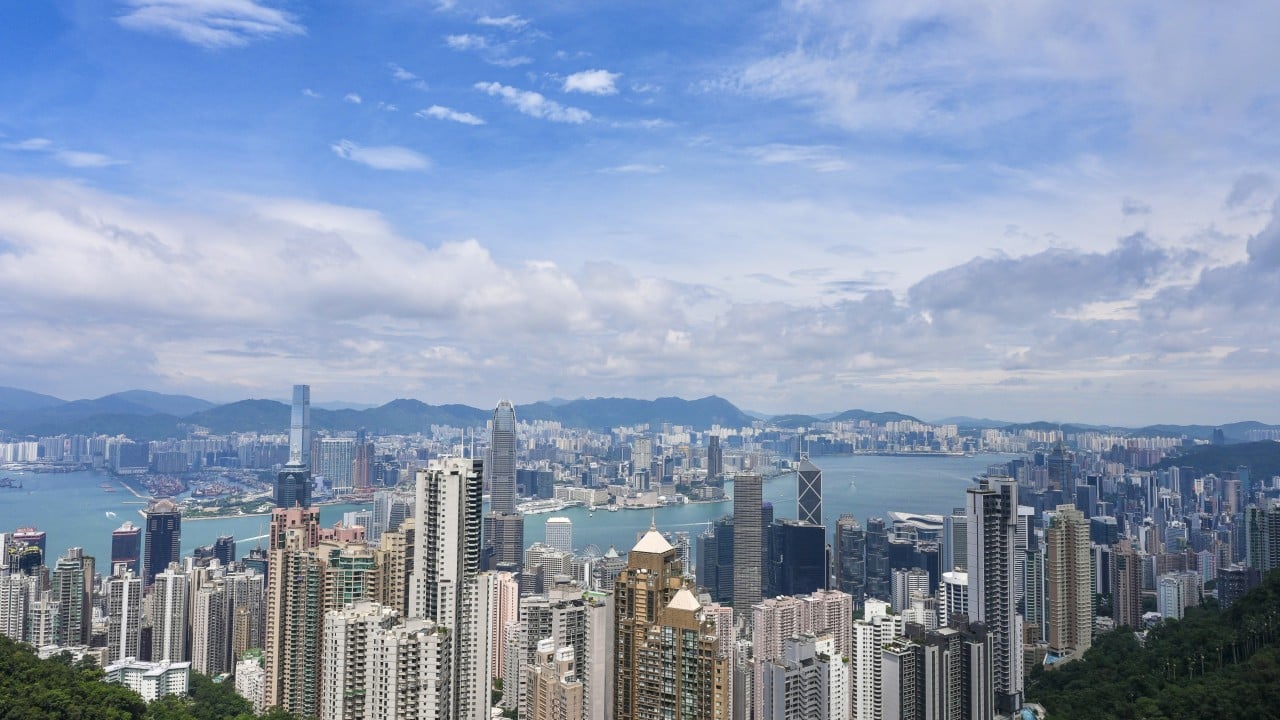
The neon still hums over Nathan Road at midnight, casting electric pinks and blues onto wet asphalt, yet the conversations inside the glass towers of Central have changed pitch.
Walk into any financial law office overlooking Victoria Harbour on a Tuesday morning, and you will hear a specific kind of silence. It is the sound of people reading the exact same sentence twice before hitting send. A diplomatic press release drops in Washington, an official rebuttal fires back from Tamar hours later, and on the thirty-eighth floor of an office building in Admiralty, an analyst pauses over a spreadsheet, wondering how a war of words eight thousand miles away will change the rules of her afternoon. Building on this theme, you can also read: Why the Palisades Arson Retrial Conviction Changes Everything About Wildfire Accountability.
That tension surfaced again when the Hong Kong government sharply rejected a recent United States report accusing the city of steadily expanding its national security powers. Officials in Hong Kong dismissed the assessment as biased, politically motivated, and detached from the reality of a city restoring stability after years of turmoil. Washington insisted the trajectory threatens autonomy, free expression, and the foundational promises that once made the territory an anomaly in East Asia.
To an outsider scrolling past headlines on a commuter train, it reads like familiar diplomatic theater. Two capitals trading well-rehearsed adjectives. One side cites legal safeguards and public order; the other cites eroding freedoms and extraterritorial reach. Observers at Al Jazeera have shared their thoughts on this trend.
Look closer, though, and the story stops being abstract.
Two Perspectives on the Same Street
Consider a hypothetical scenario that plays out in variations across the city every week. Picture David, a mid-level compliance officer at a European logistics firm based in Kwun Tong, and Mei, a veteran editor at an independent cultural magazine in Sheung Wan. Neither of them is a politician. Neither drafts foreign policy. Yet both live directly inside the gap between Washington’s diagnosis and Hong Kong’s defense.
When the Hong Kong government slams a US report for ignoring its constitutional order and economic vitality, officials are pointing to tangible things David sees every morning. The trains run on time. Street violence that once shattered storefronts in 2019 has vanished. Courts still operate in English and Chinese, processing commercial disputes with practiced efficiency. From the perspective of city leaders, the 2020 National Security Law and the subsequent domestic legislation under Article 23 of the Basic Law were necessary guardrails—a firewall erected to prevent chaos from ever returning. To hear foreign diplomats describe those measures as creeping authoritarianism feels, to Beijing and Hong Kong officials, like deliberate distortion by rivals who enforce strict security statutes of their own.
Now step across town to Mei’s desk in Sheung Wan.
Mei does not organize rallies. She commissions essays on architecture, cinema, and urban memory. When she reads the US report’s warnings about expanded security powers, she is not thinking about geopolitical grand strategy. She is thinking about the invisible line that has migrated slowly inward over the past five years. Under the expanded legal framework—which covers offenses ranging from treason and insurrection to external interference and the theft of state secrets—the boundaries of permissible speech feel less like a painted curb and more like shifting fog. Mei spends half her week acting as an amateur lawyer, asking herself whether an interview with an overseas academic could be misconstrued as colluding with external forces, or whether archiving old civic photographs carries unforeseen risk.
Same city. Same harbor. Two entirely incompatible realities coexisting on the same afternoon.
The Architecture of a Diplomatic Standoff
To understand why these annual reports trigger such fierce pushback, it helps to strip away the diplomatic jargon and look at what is actually being contested. Think of Hong Kong’s legal system as a high-rise building constructed under the "one country, two systems" blueprint following the 1997 handover from Britain to China. For over two decades, international investors treated that building as a uniquely engineered bridge: physically anchored in China, yet operating on common law wiring familiar to London and New York.
Washington’s reports—mandated under US legislation such as the Hong Kong Policy Act—function like recurring structural inspections conducted by an outside engineer. Every year, the US State Department measures whether the building still operates with the high degree of autonomy promised at its founding. When American officials accuse Hong Kong of expanding security powers, they point to several concrete developments: the passage of the Safeguarding National Security Ordinance in March 2024, broadened definitions of sedition and state secrets, closed-door procedural shifts in select national security trials, and the issuance of arrest warrants and bounties targeting activists living in the United States and Europe.
Hong Kong’s leadership views those inspections not as neutral assessments, but as hostile interference.
In their rebuttal, officials argue that every sovereign jurisdiction possesses an inherent right—and duty—to protect national security. They point out that the United States itself maintains sweeping statutes like the Espionage Act and the Foreign Agents Registration Act, alongside rigorous counterterrorism laws passed after September 11. From Tamar’s vantage point, Washington’s critique rests on a double standard: punishing Hong Kong for closing legal loopholes that had remained open for twenty-seven years while ignoring the city’s continued standing as a global financial hub.
Both arguments carry internal logic. That is precisely what makes the standoff so intractable.
What Happens When Words Become Policy
It is tempting to dismiss diplomatic friction as noise that never touches ordinary lives. History suggests otherwise. Words written into State Department assessments rarely stay trapped on paper; they act as the legal predicate for tariffs, visa restrictions, sanctions on officials, and compliance warnings issued to multinational corporations.
I remember sitting in a cramped café in Wan Chai years ago, listening to a senior trade lawyer explain how geopolitical friction actually travels through an economy. It does not arrive like a thunderstorm, he told me, with sudden lightning strikes and dramatic evacuations. It arrives like humidity. Slowly, imperceptibly, paper begins to curl at the edges.
You see that humidity in the boardrooms of international banks and law firms operating between New York and Hong Kong. When Washington highlights expanded security powers, corporate risk committees in Manhattan and Zurich take notice. Even if no immediate sanctions follow, the friction forces companies into exhausting administrative gymnastics:
- Data siloing: Firms separate Hong Kong servers from global networks to avoid conflicts between local national security disclosure rules and Western privacy laws.
- Travel recalibrations: Visiting executives use burner laptops and clean phones before landing at Chek Lap Kok, treating a routine business trip like a sensitive intelligence deployment.
- Talent hesitation: Mid-career professionals weighing a relocation package weigh not just tax rates and harbor views, but whether their children’s schools or their own digital footprints could become liabilities.
None of these decisions make front-page news. A company does not issue a press release announcing it quietly shifted three regional compliance roles to Singapore or Tokyo. Yet over months and years, those micro-adjustments alter the texture of a city.
Meanwhile, Hong Kong’s government works tirelessly to counter that narrative, flying international delegations into the city, hosting global financial summits, and pointing to capital inflows and IPO pipelines as proof that confidence remains intact. When officials slam a US report, they are fighting to protect the city’s brand as an open, rules-based marketplace—a reputation that took generations to build and cannot survive on domestic reassurance alone.
The Invisible Cost of Living Between Giants
There is an honesty required when looking at Hong Kong today that neither official statement captures.
If you rely solely on Washington’s framing, you might picture a city frozen in fear, emptied of commerce and daily joy. Step off the Star Ferry in Tsim Sha Tsui on a Sunday evening, and that caricature collapses immediately. Families crowd the waterfront promenade, street musicians play Cantonese pop ballads near the clock tower, and restaurants in Soho are booked weeks in advance. Life goes on with remarkable resilience.
Conversely, if you rely solely on the Hong Kong government’s rebuttals, you might believe nothing fundamental has changed—that the city simply swapped disorder for harmony and returned to business as usual. Spend an hour talking off the record with journalists, university professors, or civil society organizers, and that version collapses just as quickly. Independent unions have dissolved. Outspoken newspapers have shuttered. Public debate has narrowed to technical policy critiques, stripped of the raw, unruly political energy that once defined the city’s public squares.
Admitting both truths at once feels uncomfortable because modern politics demands clean heroes and simple villains. Yet Hong Kong has never been a simple place. It has always existed in the pressurized zone between East and West, thriving precisely because it translated one world to the other.
Today, that translation mechanism is straining under the weight of great-power rivalry. When the United States and China treat every municipal law in Hong Kong as a proxy battle in a broader contest for global influence, the people actually living in the city become secondary characters in their own story.
A Quiet Evening on the Harbor
Back in Kwun Tong, David finishes his compliance review just as dusk settles over Victoria Harbour. He closes his laptop, packs his bag, and walks toward the MTR station, passing a glowing digital billboard advertising a new wealth management summit. Across the water in Sheung Wan, Mei locks the door of her small office, leaving a stack of approved magazine proofs on her desk—carefully edited, legally vetted, and safe to print.
Neither of them will read the full text of the US report or the lengthy point-by-point refutation issued by the Hong Kong government. They do not need to. They already feel the contours of both documents in the quiet compromises of their daily routines, in the pauses before speaking, and in the careful distance they keep from lines no one can quite see.
Across the harbor, the ferry horn blows once, low and steady, cutting through the humid night air as the lights of the skyline flicker on, one by one, reflected in dark water that never stops moving.