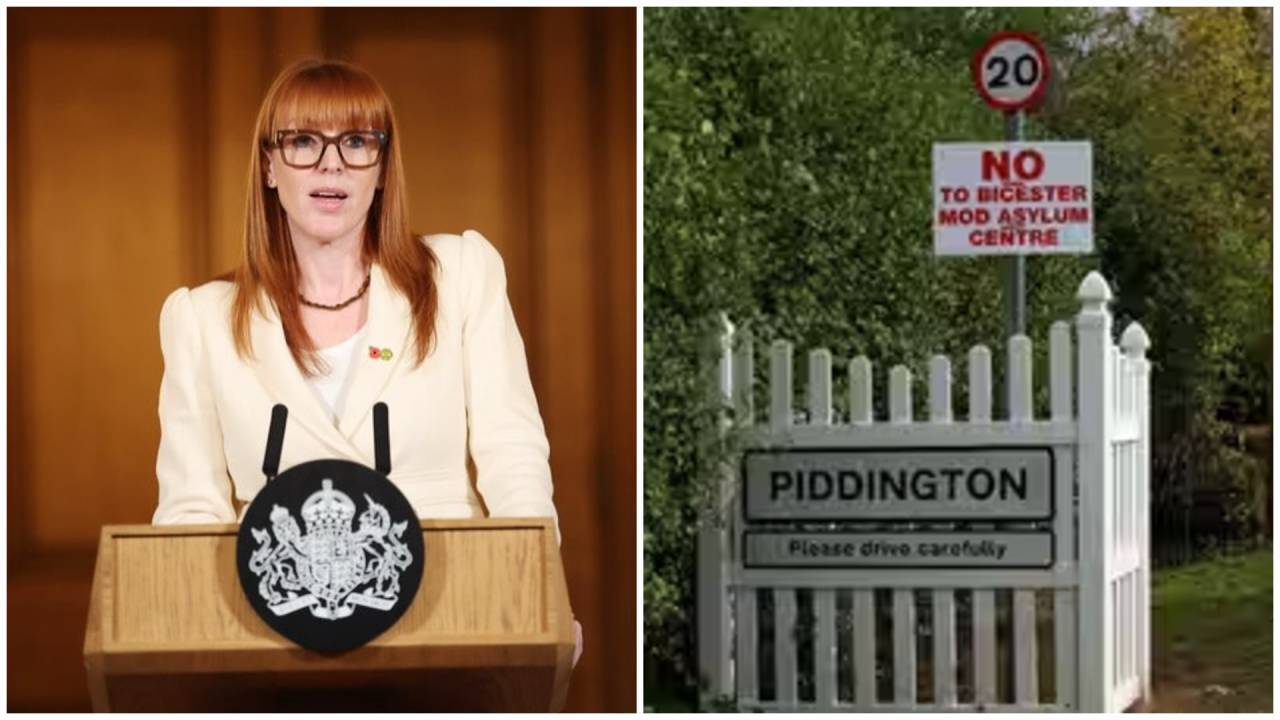
Dusk settles over Oxfordshire with a particular kind of hush.
Not silence, exactly. The late-afternoon rush along the lanes near Bicester still carries the low hum of tires on damp tarmac, the distant thrum of a delivery van, the clink of a gate latching somewhere out of sight. In Piddington, a village that measures time in seasons rather than notifications, light drops off the hedgerows in slow, amber sheets. Grass smells sharp after rain. Woodsmoke drifts low over garden walls before thinning into the cool air.
Then the letter arrives, or the news breaks across a kitchen table, and the ordinary weight of an evening shifts.
For residents of Piddington and neighboring parishes around former Ministry of Defence land near Bicester, approval for a large asylum accommodation site housing up to 1,256 men does not read like an administrative line item. On paper, a ministerial sign-off looks tidy. A signature on a file. A capacity figure—1,256—written in clean, uniform type. Yet in small rural communities, numbers rarely stay abstract for long. They attach themselves to narrow country roads, single-track bridges, local clinics, village halls, and the quiet rhythm of people who chose a slower place because they wanted room to breathe.
And on the other side of that same ministerial signature stand 1,256 men whose lives have already been upended long before a single perimeter fence or modular block enters view.
I have sat in enough village halls and community rooms over the years to know the sound of a room tightening before a meeting even begins. Folding chairs scrape across linoleum. Thermoses sit beside stacks of printed maps and planning notes. Someone taps a pen against a knee. You hear the same refrain in different voices: people saying the fight is not finished, insisting the war isn't over, even as official decisions move forward.
That word—war—is heavy. Most days, no artillery fires in an English village. No trenches are dug beside turnip fields. Using it is a metaphor, and I want to be clear about that from the start: villagers are not taking up arms against the state or against vulnerable men. When someone in a parish hall says the war isn't over, they are reaching for a language strong enough to hold their sense of powerlessness. They feel outgunned by central decisions made miles away from their lanes, handed down as faits accomplis rather than shared conversations.
Consider what happens next when a community feels bypassed.
Suspicion fills the quiet spaces. Rumors travel faster than facts along parish WhatsApp groups and over garden fences. A question that starts as practical—"How will local healthcare cope?" or "Where will the buses run?"—hardens into certainty that nobody in Whitehall cares whether the lane floods in November or whether a single rural GP surgery is already stretched thin.
Let me introduce a hypothetical character to show how this plays out on the ground. Call her Clara. Clara is not a real resident of Piddington, and her story is invented to illustrate a pattern seen repeatedly across rural Britain when large-scale accommodation plans collide with small-scale infrastructure.
Clara has lived in her cottage for twenty-two years. She knows which ditches back up after three days of drizzle and which neighbor to call if an elderly relative has a bad fall in winter. When she hears that 1,256 men could be housed on former MoD land near Bicester, her first reaction is not a speech. It is a mental ledger. One thousand two hundred and fifty-six is larger than many villages entirely. It is a small town dropped beside quiet countryside. She pictures lanes crowded with vehicles never meant for heavy daily throughput. She wonders about strain on local services, about safety after dark on unlit paths, about whether the people making the call have ever tried to turn a car around on a narrow rural bend at school-run time.
Then, almost immediately, a second thought troubles her conscience. Where do those men go if not here? What does it mean to spend months or years waiting in limbo, unable to work freely, living behind gates or in temporary quarters while bureaucratic wheels grind at a glacial pace?
That tension—between local anxiety and wider human reality—is the real fault line.
The Weight of a Number
Numbers have a strange trick of flattening human beings into statistics while simultaneously magnifying fear.
When officials state a figure like 1,256 men, the number sounds clinical, logistical, almost architectural, like pallets stacked in a warehouse. To residents living nearby, 1,256 feels massive against a backdrop of cottages, fields, and winding roads. It feels sudden. Even when sites have been discussed or contested in stages, approval lands like a hammer blow because it signals momentum shifting from debate to execution.
Historians and sociologists who study rapid demographic or institutional shifts in small towns point to a predictable pattern: friction spikes hardest when scale outpaces preparation. It is rarely the mere presence of newcomers alone that sparks intense resistance; it is the perception of imposition without consent, paired with visible strain on everyday life. If roads clog, appointments get harder to book, or communication from authorities feels evasive or late, resentment takes root quickly.
I will admit openly: I do not have a neat formula that makes a 1,256-person facility feel effortless to a village of a few hundred people. Anyone who claims large-scale asylum housing has zero friction on nearby communities is either ignoring reality or selling a comforting fiction. Rural infrastructure in much of England was built for smaller populations, sparser traffic, and gradual change. Dropping a sudden surge of over a thousand residents into a largely rural orbit tests those seams immediately.
At the same time, pretending that asylum seekers do not exist—or assuming they can simply vanish into thin air—does not solve anything either. Behind every number in a government brief is a person who left home, family, language, or safety behind. Some fled conflict; some fled persecution; some took desperate journeys because staying felt worse. Most are waiting—waiting for interviews, waiting for decisions, waiting for a life they cannot yet build.
Two realities occupy the same map. Neither disappears just because the other feels inconvenient.
Promises, Decisions, and Distrust
In disputes like the one unfolding around Piddington and Bicester, anger rarely focuses on just one target. It pools around ministers, planners, councils, and contractors alike.
When senior figures—including high-profile ministers like Angela Rayner in government decision-making roles—become associated with approvals that locals oppose, frustration sharpens into personal grievance. To villagers watching from afar, decision-makers in London can seem insulated from daily consequences. A minister signs off on policy or site approval and returns to Westminster; a local resident still drives the same lane the next morning.
That gap between decision and consequence breeds bitterness. Locals ask why former defence sites are chosen when alternative options might seem fairer or better connected. Campaigners argue that consultation felt thin, rushed, or predetermined. Parish leaders point to practical bottlenecks—transport links, policing, waste, medical capacity—and say those questions were treated as afterthoughts rather than preconditions.
Yet governments face a bind of their own, even when their handling draws fierce criticism. Hotel accommodation has faced intense political and public backlash over cost and suitability, pushing policymakers toward large sites or repurposed estates in search of control and lower expenditure. Every option carries a political storm. Move people into hotels in busy towns, and town centers push back. Place them on former military land near rural villages, and country parishes mobilize.
It becomes a game of musical chairs where every chair has tacks on it.
When locals say the war isn't over, they are signaling that legal challenges, campaign letters, media pressure, and community organizing will continue. In English local politics, resistance often shifts from stopping a project outright to contesting every detail—traffic assessments, environmental impacts, operating conditions, timelines, accountability. Even when a main approval stands, battles over how a site runs can drag on for months or years.
What Happens When Fear Goes Unanswered
Fear is a restless tenant. Left alone in the dark, it grows larger than the facts.
In disputes over asylum accommodation, two kinds of worry often mingle until they become hard to untangle. The first is tangible and practical: road congestion, strain on local clinics, pressure on community spaces, uncertainty over oversight and security. These concerns deserve straight answers, real mitigation, and honest numbers—not dismissals or vague reassurances.
The second worry is more nebulous: a sense that the community's voice counts for less than an administrative target, or an unease about unfamiliar faces walking past familiar gates.
Let me introduce another hypothetical figure to trace that second layer. Call him Tariq. Tariq is not a real person at Bicester; he stands in for the hundreds of men caught inside national housing shifts. Before arriving in Britain, Tariq worked as a technician, fixed generators, shared meals with brothers and cousins, and knew the names of shopkeepers on his street. Now he moves from place to place on instruction, holding documents written in a language he is still learning, living in enforced idleness while months stretch into years.
Put Clara and Tariq side by side, even only in thought, and the tragedy of the situation comes into sharper focus.
Clara worries her quiet corner of Oxfordshire is being overrun without proper backup. Tariq sits in limbo, unwanted by neighbors who fear him before they know him, stuck in a system that leaves him neither settled nor free to rebuild his life. Both feel powerless inside machinery far bigger than themselves.
If local leaders and central authorities treat Clara's worries as mere prejudice, they alienate people whose everyday lives are genuinely affected. If campaigners treat every single one of those 1,256 men as a threat rather than a human being, fear hardens into hostility that makes any peaceful coexistence harder to achieve.
Neither posture heals a community. Both keep everyone trapped in defensive corners.
The Invisible Stakes Beneath the Headlines
Headline coverage often treats stories like Piddington and Bicester as pure political theater: angry villagers versus government ministers, protestors versus planners, soundbite against soundbite.
Theater gets clicks. It rarely illuminates what is actually at stake beneath the noise.
One stake is public trust in democratic process. When people feel decisions are rammed through without genuine local weight, cynicism deepens. Next time a council or department asks for public engagement on anything—housing, transport, energy, health—skepticism is already baked in. Trust, once frayed in rural areas, takes years to mend.
Another stake is basic social cohesion. A site of 1,256 men does not exist in a vacuum; it sits within a living geography of lanes, shops, bus stops, and nearby towns. How authorities manage security, daily routines, support services, and transparent communication with local councils will determine whether friction stays manageable or spirals into recurring flashpoints.
And there is a moral stake that many people wrestle with quietly, even when arguing fiercely against a specific location: how a country that prides itself on rule of law, fairness, and decency handles people seeking refuge while keeping faith with its own citizens.
You do not resolve those stakes with slogans. Slogans are armor; they keep people from getting hit, but they also keep them from hearing one another.
Life After the Headline Fades
Eventually, camera crews pack up. Breaking-news alerts move on to the next crisis. Parliament turns its attention elsewhere.
In Piddington, however, the lanes remain. The mist still rises off low fields at dawn. Dogs still bark across quiet yards. If the site goes ahead at full scale, 1,256 men will wake up behind gates or perimeter lines on ordinary mornings, looking at gray skies and waiting for news about their futures, while nearby residents drive past wondering what tomorrow's traffic or clinic wait will look like.
A vow that the war isn't over captures real grit and real anger. Villagers fighting for their community's voice are defending something tangible to them: a place they know, a pace of life they value, a feeling of agency over their own backyard.
Yet wars—even metaphorical ones—have a habit of leaving scorched earth even when one side claims a point. What lasts longer than anger is whether anyone builds bridges across the divide before resentment calcifies into permanent division.
Watch the lane at dusk, when the streetlights flick on and headlights sweep briefly across wet hedge leaves before fading into the dark.