There is a very specific sound that heavy paper makes when it is taped to a wooden door.
You do not hear it in textbooks on public policy. You will never find it recorded in the minutes of a state legislative session. It is a dry, papery rasp, the sound of an eviction notice vibrating slightly in the draft of a Milwaukee hallway.
When you are standing on the other side of that door, the world shrinks. Your peripheral vision disappears. Everything you thought you knew about merit, hard work, and the American ladder collapses into a single, terrifying math problem: how much money is in your checking account versus how much money is due on the first of the month.
Years ago, before the podiums, before the motorcades, before the oath of office in Madison, David Crowley stood in that exact hallway.
He was evicted. Twice.
Let that sit for a moment. Not once—a fluke, a bad month, a sudden transmission failure on the interstate—but twice. Anyone who has ever lived paycheck to paycheck knows that poverty is rarely a single catastrophic event. It is an ambush. It is the slow, grinding erosion of margin until a single unexpected bill knocks the foundation out from under your life. You pack your belongings into cardboard boxes you begged from behind a grocery store. You tape them shut. You look at your children and try to arrange your face so they do not see the panic vibrating behind your ribs.
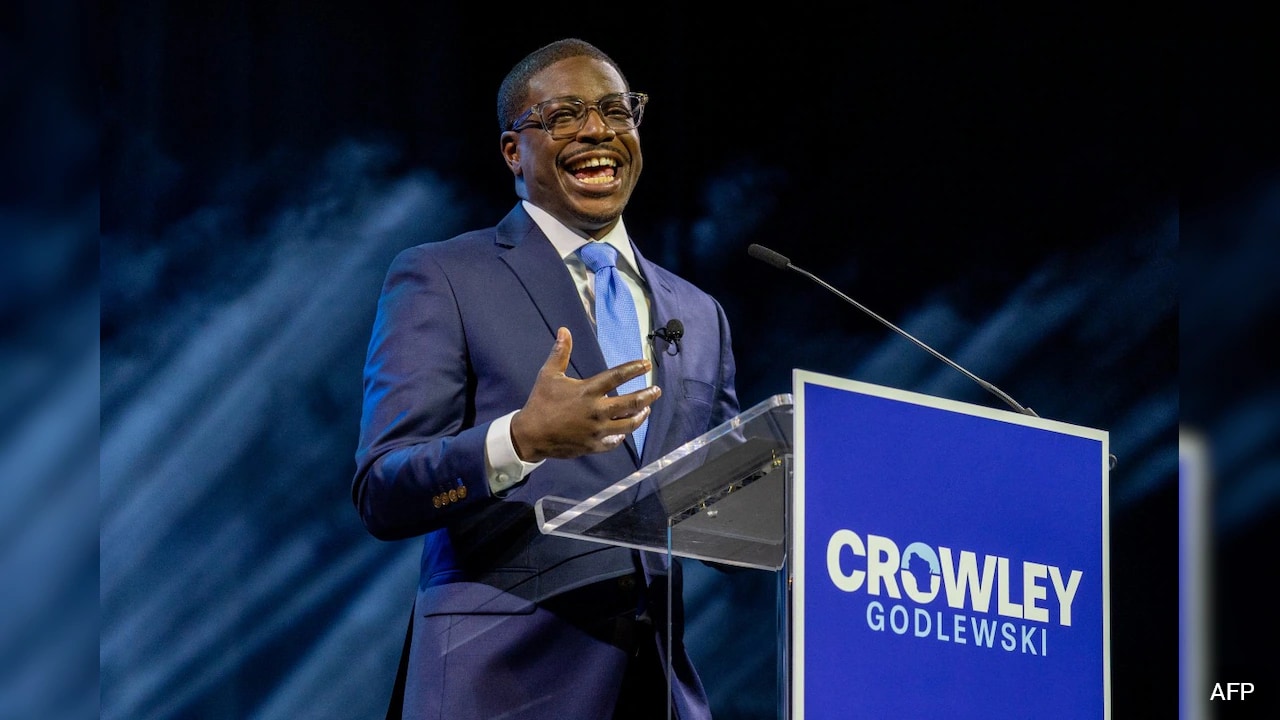
Today, David Crowley is the Governor of Wisconsin. The first Black governor in the state’s history.
If you read the standard political coverage of his rise, it reads like a neat, sanitized résumé. Milwaukee native. Raised in the 53206 zip code. University of Wisconsin–Milwaukee. Legislative aide. State Representative. Milwaukee County Executive. Governor. The headlines treat his past evictions like a colorful prologue—a gritty bit of backstory meant to make a politician look relatable before the journalists move on to tax brackets and infrastructure bills.
That misses the entire point.
To understand what happened in Wisconsin when David Crowley took the oath of office, you have to stop looking at his biography as a triumph of individual willpower and start looking at it as a collision between two worlds that almost never touch. In American politics, the people who write the laws about housing, wages, and social safety nets have almost never slept on a friend’s couch because a landlord changed the locks. They study poverty the way a marine biologist studies a deep-sea trench—from behind thick glass, protected by pressure suits, taking notes on creatures they will never become.
David Crowley did not study the trench. He lived at the bottom of it.
The Geography of 53206
To grasp the weight of Crowley’s journey, you have to understand the coordinates where it began.
In Milwaukee, the 53206 zip code is not just a postal designation; it is a shorthand used by sociologists, economists, and local reporters to describe systemic concentration of disadvantage. For years, researchers at the University of Wisconsin–Milwaukee pointed to 53206 as having the highest rate of Black male incarceration in the United States. The streets are lined with duplexes built in the early twentieth century, many of them owned by absentee landlords who treat maintenance as an optional expense. Factories that once anchored the North Side—places where a man with a high school diploma could earn enough to buy a house, fund a pension, and send his kids to college—closed their gates decades ago, leaving behind vast expanses of cracked asphalt and broken glass.
Consider a hypothetical family living three blocks off North Avenue in that same neighborhood. Let us call them the Millers, though they could be any of ten thousand households across urban and rural Wisconsin. Marcus works forty-two hours a week at a distribution warehouse. Elena works thirty-five hours at an assisted living facility. On paper, they are doing everything right. They are working. They are sober. They are raising two kids. Yet their combined income leaves them roughly four hundred dollars away from ruin every single month. If Marcus gets the flu and misses four days of unpaid shifts, the rent is short. Once the rent is short, the late fees trigger. Once the late fees trigger, the eviction filing hits the public record—a permanent digital scar that ensures no reputable landlord will rent to them for the next seven years.
That is not a failure of character. That is a trap built into the floor.
David Crowley grew up inside that architecture. His family moved constantly, chased from apartment to apartment by rising rents and stagnant wages. When he entered adulthood and started a family of his own, the cycle did not magically break simply because he had ambition. Ambition does not pay a security deposit. Determination does not stop a sheriff’s deputy from serving a writ of restitution.
When Crowley speaks about housing instability, he does not reach for white papers or focus-grouped talking points. He remembers the humiliation of having his furniture sitting near the curb. He remembers the scramble to find a place for his daughters to sleep while trying to maintain the composure required to show up to work the next morning as if nothing had happened.
Ask yourself: how many people sitting in state capitols across this country know what it smells like inside an eviction court? It smells like floor wax, stale coffee, and quiet desperation. Rows of mostly working-class parents sit on wooden benches, clutching manila folders filled with pay stubs and money order receipts, waiting ninety seconds for a court commissioner to decide whether their family will have a roof over their heads on Friday.
Crowley sat on those benches. And then, against every statistical probability built into the zip code that raised him, he walked out of that courthouse and began climbing toward the building where the rules of that courtroom are written.
The Invisible Ceiling in Madison
Wisconsin likes to think of itself as a progressive pioneer. Its state motto is literally one word: Forward.
It was the first state to pass a workers’ compensation law. It was the birthplace of the Republican Party as an anti-slavery coalition in Ripon in 1854. It pioneered unemployment insurance and public-sector collective bargaining. For generations, Wisconsin politicians boasted about a clean, functional, egalitarian democracy where anyone with grit could rise.
Yet for more than a century and a half—through forty-six governors, through world wars, through the civil rights movement, through the turn of the twenty-first century—every single person who sat behind the governor’s desk in the East Wing of the State Capitol was white.
Representation is a word that gets tossed around so casually in modern discourse that it has lost its teeth. People treat it like a cosmetic adjustment, a box checked on a diversity brochure. In reality, representation is about what gets noticed and what stays invisible.
Think of governance like an architect designing a building. If every architect who ever drafts the blueprints walks on two strong legs, they will naturally design grand staircases. They will not do it out of malice toward people in wheelchairs; they simply will not see the stairs as an obstacle because they have never had to roll up to the bottom step and realize there is no way up.
For one hundred and seventy-eight years, Wisconsin’s blueprints were drawn by people who had never stood at the bottom of those stairs.
When a governor has never worried about whether a bus route gets cut—because they have always owned a reliable car—public transit funding looks like an expendable line item during a budget crunch. When a governor has never watched a family member struggle to find mental health care without private insurance, Medicaid expansion feels like an ideological debate rather than an emergency room triage problem. When a governor has never faced eviction, housing policy is reduced to tax incentives for developers rather than emergency rental assistance for tenants three days away from homelessness.
Crowley’s ascent did not happen overnight, nor did it happen because the political establishment cleared a path for him. He worked his way through the unglamorous trenches of local government. He worked as a legislative aide in the Wisconsin State Assembly, learning how bills actually move—or die—in committee rooms at two in the morning. In 2016, he won a seat in the Assembly representing the 17th District, the very neighborhoods on Milwaukee’s North Side that had shaped him.
Four years later, in 2020, he ran for Milwaukee County Executive.
It was a brutal race in the middle of a global pandemic. The county was staring down a structural fiscal cliff—decades of stagnant state shared revenue combined with soaring pension obligations had left Milwaukee County slowly cannibalizing its own parks, transit system, and social services just to balance its books. At thirty-three years old, Crowley won, becoming the youngest County Executive in Milwaukee’s history and the first Black leader to hold the office.
Governing From the Scar, Not the Wound
There is an old saying among organizers and counselors: lead from your scars, not your open wounds. An open wound bleeds on everyone around you; it makes you reactive, bitter, and consumed by your own pain. A scar is healed tissue. It remembers the trauma, it knows exactly where the blade went in, and it makes the skin thicker where it used to be fragile.
As Milwaukee County Executive, Crowley proved that his past was a scar, not a wound.
When federal pandemic relief dollars arrived through the American Rescue Plan Act, officials across the country faced a choice. Many treated the money like a temporary sugar high, funding splashy one-off projects or plugging short-term budget holes without touching the underlying rot. Crowley steered Milwaukee County’s resources directly into the quiet emergencies he knew intimately.
He expanded the county’s "Right to Counsel" program, providing free legal representation to low-income tenants facing eviction. Why? Because he knew the math. In eviction court, nearly ninety percent of landlords show up with a lawyer, while fewer than ten percent of tenants do. Without counsel, families sign away their rights in the hallway just to avoid an immediate judgment, trapping themselves in a cycle of housing instability that costs taxpayers millions more in emergency shelter, foster care, and hospital visits. Giving a tenant a lawyer is not charity; it is basic structural engineering.
He declared racism a public health crisis in Milwaukee County—not as a performative press release, but as an operational framework that forced every county department to examine why life expectancy dropped by more than a decade depending on which side of the city you lived on. And perhaps most remarkably, he worked across an intensely polarized ideological divide to help negotiate Act 12 with a Republican-controlled legislature in Madison, securing a historic sales tax authority that pulled Milwaukee County and the City of Milwaukee back from the brink of municipal bankruptcy.
That last detail is crucial, because it destroys the caricature that political opponents tried to draw of him. You do not rescue a county from insolvency by yelling slogans into a microphone. You do it by sitting across the table from lawmakers who disagree with you on almost everything, understanding their leverage, respecting their constituencies, and refusing to walk away until the numbers work.
By the time Crowley launched his campaign for governor to succeed Tony Evers, he was no longer just a compelling biography. He was a tested executive who had managed a billion-dollar budget and a workforce of thousands during the most volatile economic period in a generation.
The Weight of the Oath
Still, running statewide in Wisconsin is a different beast entirely.
Wisconsin is the ultimate purple state, a place where presidential elections are decided by twenty thousand votes—less than the capacity of a single basketball arena—and where the cultural fault lines between Milwaukee, Madison, the suburban WOW counties, and the rural Northwoods run deep. For decades, conventional political wisdom held that a Black politician from Milwaukee could never win statewide. Critics whispered that Milwaukee carried too much baggage, that voters in Wausau, Eau Claire, and Green Bay would never see themselves in a leader from 53206.
That conventional wisdom underestimated a fundamental truth about human struggle: pain does not check your voter registration, and poverty speaks the same language in a dairy town as it does on a city block.
When Crowley traveled across the state—standing inside machine shops in the Fox Valley, talking to dairy farmers in Vernon County, listening to parents in Superior—he did not hide his past, nor did he weaponize it. He simply told the truth. He talked about what it feels like to work hard and still fall behind. He talked about the quiet terror of watching bills pile up on the kitchen table while trying to keep your kids fed and focused on school.
A laid-off paper mill worker in central Wisconsin might look nothing like David Crowley. Their life experiences might seem worlds apart. Yet when Crowley described the dignity of work and the gut-punch of losing your footing through no fault of your own, the recognition in the room was instant.
History, when it finally arrives, rarely looks like a Hollywood movie. There is no swelling orchestral score when the ballots are counted in the middle of a cold November night. There are only precinct totals ticking upward on a screen, exhausted volunteers drinking lukewarm coffee in union halls, and the slow, dawning realization that an invisible wall has finally given way.
When David Crowley raised his right hand to take the oath of office as the forty-seventh Governor of Wisconsin, he carried a crowd of ghosts with him into the Capitol rotunda. He carried the generations of Black Wisconsinites who arrived during the Great Migration, fleeing Jim Crow in the South only to find redlining and industrial collapse in the North. He carried his younger self, standing in a cold hallway staring at an eviction notice taped to a door. And he carried every working family in the state who has ever lain awake at three in the morning doing mental arithmetic in the dark.
What Changes When the Insider Was Once Locked Out
Skeptics—and politics breeds cynicism for good reason—will rightly ask what one man can actually change. A governor is not a monarch. Wisconsin’s legislature remains fiercely divided, special interests still command immense influence, and the economic forces squeezing working families are global, relentless, and complex. Winning an election does not magically erase centuries of inequality or lower the price of groceries overnight.
I will be honest: there is no guarantee that Crowley’s administration will solve the housing crisis or close every racial and economic gap in Wisconsin. Anyone who promises easy fixes in state government is either lying to you or has never read a state budget.
Yet something irreversible shifts the moment the person holding the veto pen knows the human cost of every line item from memory.
When a bill lands on Governor Crowley’s desk that cuts funding for childcare subsidies, he does not see a budget savings of forty million dollars. He sees a single mother having to quit her job because daycare costs more than her take-home pay. When a debate erupts over minimum wage, tenant protections, or public school funding, he does not have to hire a consultant to explain how those policies play out in the real world. He has already lived the rough draft.
Power in America usually flows in one direction: from comfort toward abstraction. People born into security make rules for people born into precarity, and then wonder why the rules never quite seem to work.
Every once in a while, the current reverses. Someone climbs out of the cold, walks up the marble steps, opens the heavy oak doors of the statehouse, and sits down at the desk—not to pull the ladder up behind him, but because he remembers every single rung that was missing on the way up.
Somewhere in Milwaukee tonight, in an apartment with radiators that clang when the heat kicks on, a kid is doing homework at a kitchen table while a parent sorts through a stack of envelopes, holding their breath before opening the ones with the red stamps. For the first time in the history of the state, the person sitting in the Governor’s Mansion knows the exact weight of those envelopes—and refuses to pretend they do not exist.