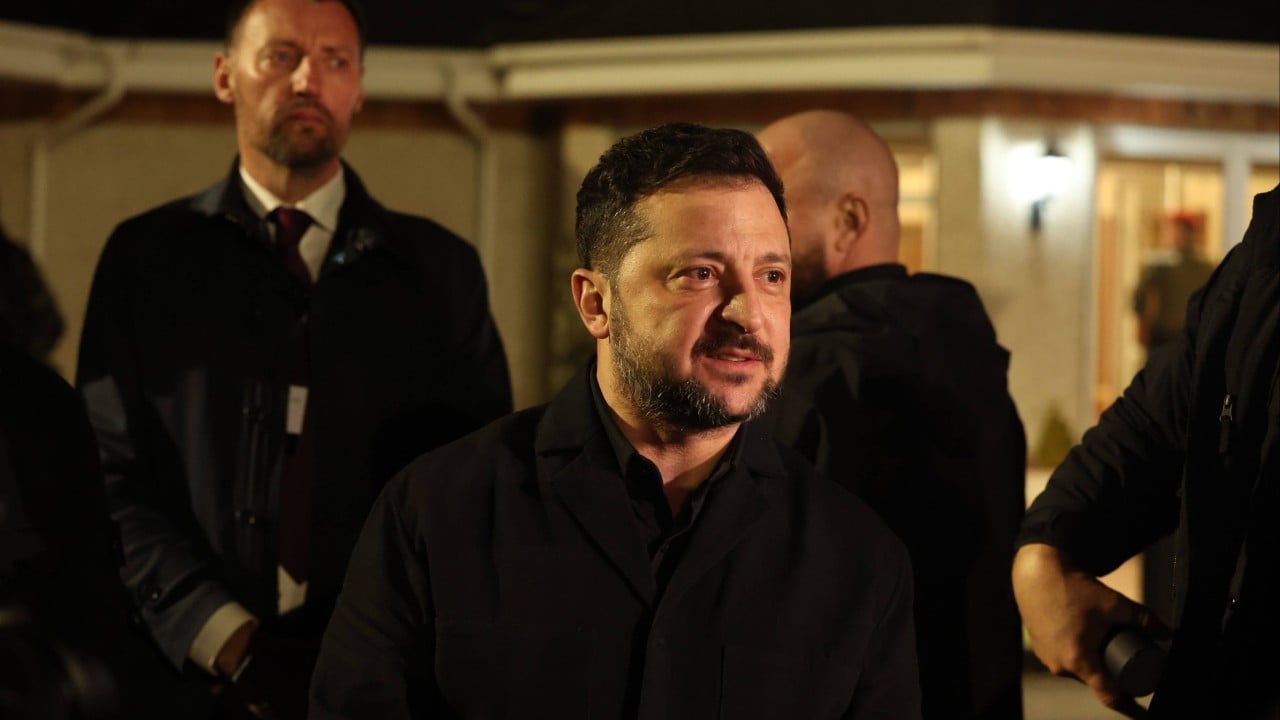
Ukrainian President Volodymyr Zelensky revealed that U.S. officials floated the idea of Ukraine ceding the Donbas region to Russia in exchange for NATO membership, according to statements reported by international media. While the proposal was never formalized as official policy, its mere existence in diplomatic backchannels exposes a widening fracture between Washington's desire to wind down an expensive war of attrition and Kyiv's constitutional refusal to surrender sovereign territory.
Diplomacy rarely happens in press releases. Most of the real maneuvering occurs in quiet rooms, over lukewarm coffee, where aides test the limits of what a desperate ally might swallow. For months, rumors circulated across European capitals that Western policymakers were gaming out "land-for-security" frameworks. Zelensky's acknowledgment pulled that whisper network into the daylight. In related news, we also covered: Why Pundits Completely Misread How Candidates Actually Win in Mississippi.
The Anatomy of a Backchannel Trial Balloon
When diplomats float an idea without putting it on official letterhead, they are running a stress test. In international relations, this is standard practice. An official mentions a hypothetical scenario during a bilateral meeting, watches the reaction in the room, and decides whether the concept has legs or dies on the carpet.
According to Zelensky's account, the suggestion from the American side centered on a blunt equation. Ukraine would formally relinquish claims to the contested territories in eastern Ukraine—specifically the Donetsk and Luhansk oblasts that make up the industrial heartland of Donbas—and in return, the remaining unoccupied territory of Ukraine would be brought under the security umbrella of NATO. The Washington Post has analyzed this critical subject in extensive detail.
The logic on paper looks clean. Too clean.
Proponents of this school of thought, often grouped under the banner of foreign policy realism, point to the West German model of 1955. Following World War II, Germany was divided. The Federal Republic of Germany joined NATO while the eastern portion remained under Soviet control. Article 5 protections applied only to the West, yet the alliance held the line for decades until peaceful reunification became possible in 1990.
Why the West German Comparison Breaks Down
Historians and military analysts quickly point out the flaws in applying 1955 Cold War mechanics to modern Eastern Europe.
First, the division of Germany followed a total military defeat and formal occupation by Allied powers, creating clear, static demarcation lines policed by hundreds of thousands of foreign troops. In Ukraine, the front line is an active, shifting meat grinder spanning over six hundred miles. Freezing a conflict without a comprehensive, enforceable settlement simply gives the aggressor time to rearm.
Second, Russia's leadership has repeatedly stated that Ukraine's entry into NATO—in any territorial configuration—is an existential red line. Moscow did not launch a full-scale invasion merely to capture coal mines and ruined factories in Donetsk. The Kremlin's stated objective has consistently been the permanent neutralization of Ukraine as a Western-aligned state. Offering Moscow a slice of Donbas while simultaneously handing Kyiv an Article 5 security guarantee violates the core political logic of both sides.
The Constitutional and Political Reality in Kyiv
Even if Washington and Brussels unanimously agreed to fast-track a rump Ukrainian state into the alliance, Zelensky cannot simply sign away the Donbas with the stroke of a pen.
Under the Constitution of Ukraine, specifically Article 73, any alteration to the territory of Ukraine can only be resolved through an all-Ukrainian referendum. Furthermore, Ukrainian law strictly prohibits holding national referendums or elections while martial law is in effect. To even put the question to the public, Kyiv would first have to lift martial law, demobilize hundreds of thousands of troops, and conduct a nationwide vote while millions of citizens remain displaced abroad or living under Russian occupation.
Beyond the legal wall sits a brutal domestic reality.
Tens of thousands of Ukrainian soldiers have died defending towns like Bakhmut, Avdiivka, and Chasiv Yar. Millions of Ukrainians have lost their homes, their livelihoods, and their families in the east. For any Ukrainian president to stand before the public and declare those sacrifices void in exchange for a treaty promise from foreign capitals would trigger immediate political collapse—and potentially civil unrest among heavily armed veterans returning from the front.
What NATO Membership Actually Requires
The trade-off also assumes that NATO membership is a commodity Washington can unilaterally hand out like a voucher. It is not.
Admitting a new member into the North Atlantic Treaty Organization requires the unanimous ratification of all 32 member states. Getting Finland and Sweden into the alliance took months of intense diplomatic horse-trading with Turkey and Hungary, and neither of those Nordic nations was actively at war with a nuclear superpower.
Several current NATO members remain deeply skeptical of admitting Ukraine while border disputes remain unresolved. Their fear is straightforward. Under Article 5 of the Washington Treaty, an armed attack against one member is considered an attack against all. If Ukraine joins the alliance while Russian forces remain entrenched across an unverified ceasefire line, any localized artillery exchange or drone strike could legally obligate American, British, German, and Polish troops to enter direct combat with Russia.
To bypass this trap, some analysts have proposed creative legal carve-outs—specifically, applying Article 5 only to territory controlled by Kyiv at the moment of accession. Yet critics argue that creating "two-tier" NATO membership undermines the credibility of the entire alliance. If deterrence relies on the absolute certainty that NATO will defend every inch of allied soil, introducing geographical asterisks invites Moscow to test where the line actually lies.
The Strategic Calculus Driving Washington
Why, then, would U.S. officials bring up a proposal that faces insurmountable legal hurdles in Kyiv, guaranteed rejection in Moscow, and fierce resistance within NATO itself?
The answer lies in the grinding math of attrition warfare.
Modern industrial warfare consumes ammunition, air defense interceptors, and armored vehicles faster than Western defense contractors can manufacture them. For years, U.S. policymakers operated under the assumption that sustained financial and military aid would eventually force the Kremlin to the negotiating table on favorable terms. That timeline has stretched indefinitely.
In Washington, fatigue is not just a political talking point; it is a logistical reality. Pentagon planners must balance the ammunition stockpiles sent to Eastern Europe against potential contingencies in the Indo-Pacific and ongoing crises in the Middle East. Meanwhile, congressional resistance to open-ended aid packages has forced the executive branch to explore every conceivable off-ramp.
Floating the Donbas-for-NATO concept serves a dual purpose for American strategists:
- Managing Expectations: It signals to Kyiv that unconditional Western backing has structural limits and that maximalist war aims—such as the full military recapture of Crimea and all eastern territories—may exceed what Western supply chains can support.
- Testing European Appetite: It forces European allies to confront the long-term cost of securing Ukraine. If European leaders reject territorial concessions, Washington can argue that Europe must shoulder a vastly larger share of the financial and military burden to sustain the fight.
The Overlooked Variable in Donbas
Discussions about trading territory often treat the Donbas as an abstract square on a diplomatic map. On the ground, the region represents something far more concrete: the backbone of Ukraine's defensive architecture.
Since 2014, Ukrainian engineers have spent over a decade turning the cities of Kramatorsk, Sloviansk, Kostiantynivka, and Pokrovsk into a heavily fortified defensive belt. These urban centers sit on elevated terrain and are anchored by dense industrial infrastructure, deep concrete bunkers, and intricate trench networks.
If Ukraine were to cede the remainder of Donetsk Oblast as part of a diplomatic settlement, Ukrainian forces would be forced to abandon their strongest fortified positions and fall back into the flat, open plains of central Ukraine. Without the natural and man-made barriers of the Donbas fortress cities, defending the approaches to Dnipro, Kharkiv, and eventually Kyiv would become exponentially harder if a ceasefire collapsed.
Military history offers a grim warning on this exact point. In 1938, the Munich Agreement forced Czechoslovakia to cede the Sudetenland to Nazi Germany in the name of European peace. The Sudetenland contained Czechoslovakia's entire mountain fortification line. Six months later, stripped of its natural defenses, the rest of the country was swallowed without a shot being fired.
For Ukrainian commanders, surrendering the uncaptured portions of Donbas isn't a compromise. It is unilateral disarmament.
The Trust Deficit
Ultimately, any proposal trading sovereign land for security guarantees runs straight into the wall of historical memory.
In 1994, Ukraine held the third-largest nuclear arsenal in the world. Under intense pressure from both Washington and Moscow, Kyiv agreed to surrender every single warhead in exchange for security assurances codified in the Budapest Memorandum. The United States, the United Kingdom, and Russia pledged to respect Ukraine's independence, sovereignty, and existing borders.
Twenty years later, one of the guarantors invaded and annexed Crimea. Eight years after that, it launched a full-scale war to erase the Ukrainian state entirely.
When Western officials suggest that Ukraine trade the Donbas for a seat in NATO, Ukrainian leaders hear an echo of 1994. They are being asked to give up tangible, blood-soaked assets today in exchange for paper promises that depend entirely on the future political will of foreign governments. If a future administration in Washington or a populist coalition in Europe decides that defending eastern Ukraine is not worth the risk of nuclear escalation, an Article 5 pledge becomes just another piece of parchment.
Zelensky's decision to make the American trial balloon public was a calculated preemptive strike. By dragging the private conversation into the press, he locked himself and his Western counterparts into public positions that make quiet backroom concessions nearly impossible. In high-stakes diplomacy, sunlight is the fastest way to kill a deal you never intend to sign.