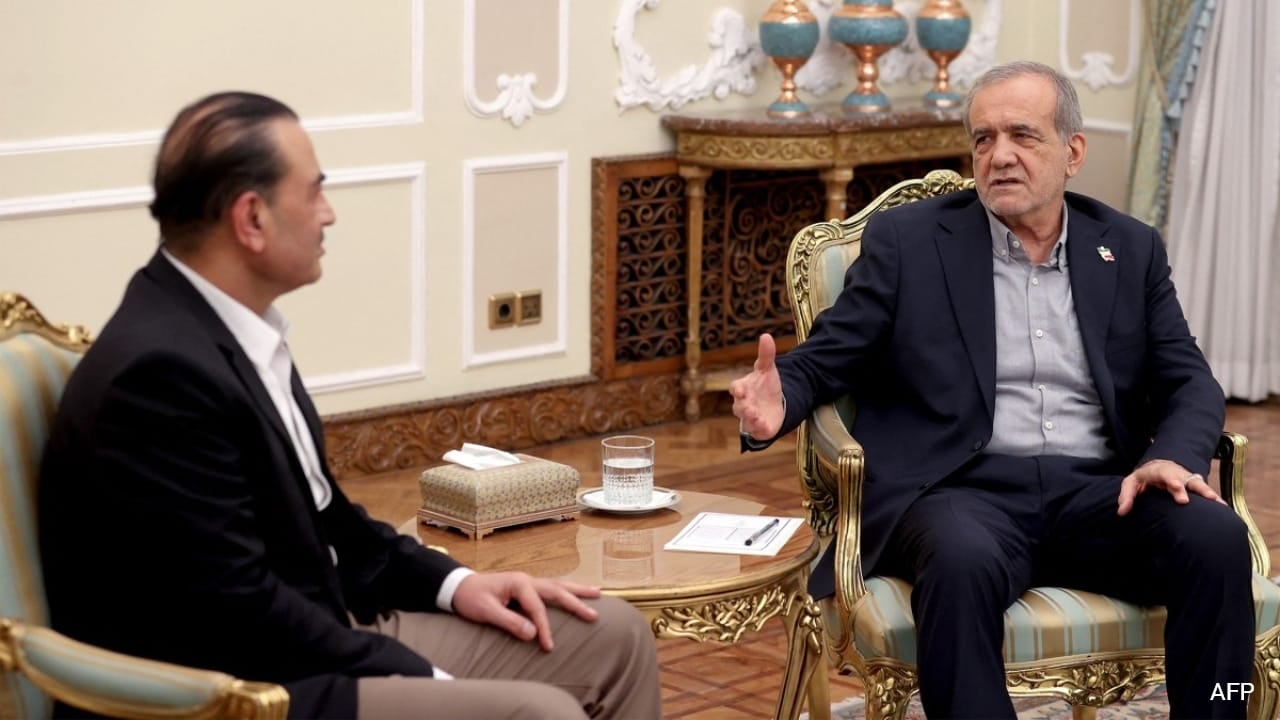
Cold steel. Heavy crates. And a word that carries the weight of a hundred quiet rooms.
No.
When a capital says "no" to moving enriched uranium across a porous, mountainous frontier, it rarely sounds like an explosion on television. It sounds like a heavy door clicking shut in a dimly lit office while rain taps against armored glass. It sounds like diplomats measuring every syllable as if each one could tip a scale that has hung steady only by sheer, exhausting effort.
I have spent years watching how borders behave when nerves fray. You learn quickly that the loudest threats are often the least dangerous, whereas the quietest refusals—the ones delivered with clipped politeness over tea or across a polished table—are the ones that reshape a decade. A rumor starts in a hallway. A whisper travels from Rawalpindi to Tehran, or from Tehran to Islamabad, before anyone has even decided whether a formal proposal exists or merely a trial balloon floated to test the wind.
Consider what happens next: a headline appears claiming a transfer plan has been floated, or a suggestion made by Pakistan's military leadership regarding Iranian uranium, and Tehran answers firmly that the material is not leaving Iran. Even when exact diplomatic transcripts remain behind closed doors, the core collision of interests is unmistakable. On one side sits a state guarding every kilogram of enriched uranium as sovereign insurance, a bargaining chip forged through decades of sanctions, isolation, and scientific pride. On the other side stands a neighbor with its own internal pressures, economic gravity, and strategic calculations, where any whisper of nuclear material moving across a volatile region sets off alarms from Washington to Riyadh to Tel Aviv.
Let me be honest with you. Nuclear diplomacy is dizzying.
If you feel a slight headache just trying to track centrifuges, enrichment percentages, enrichment cascades, and backchannel offers, you are in good company. Even seasoned analysts sometimes stare at a cable and wonder who is speaking for whom, whether a reported initiative was an earnest attempt at de-escalation, a face-saving workaround, or a political signal meant for domestic ears rather than an actual convoy of trucks rolling toward a border post.
To make sense of why Tehran would slam the door so firmly on any suggestion of transferring its uranium outward, let us use a hypothetical scenario—clearly labeled as fiction—to trace how these rooms work.
Imagine a fictional mid-level diplomat named Farhad sitting in an office in Tehran on a Tuesday afternoon. Outside, traffic hums along wide boulevards; inside, a folder sits on his desk with a single phrase underlined in red pencil: external custody. Farhad is not a firebrand on a podium; he is a man who has spent fifteen years reading treaty footnotes and counting barrels, sanctions waivers, and diplomatic slights. Across the table—or on a secure line connecting to Rawalpindi—is a hypothetical counterpart, Tariq, a seasoned security planner who knows that Pakistan's military establishment lives with constant pressure: a strained economy, restless borderlands, shifting alliances with Gulf states and China, and the ever-present need to stay indispensable without being dragged into someone else's war.
In this hypothetical scene, Tariq floats an idea. What if part of the material were moved, parked, or transferred under some arrangement meant to ease pressure, break a deadlock, or demonstrate restraint?
Farhad does not even need to consult a manual to know the answer.
To Farhad, handing over enriched uranium is not like lending a spare tire to a stranded motorist. It is handing over the engine while you are still driving down a mountain pass in fog. Once material leaves your soil, you lose physical control, chain-of-custody leverage, and the ability to say with certainty what happens next. In a region where trust is measured in fractions of a percent and memories of broken promises stretch back generations, physical possession is the only currency that never loses its face value.
That is the human truth beneath the cold diplomatic phrasing. Sovereignty is not an abstract legal textbook entry when you have lived under pressure for forty years. It is personal. It is the memory of every door that closed in your face, every shipment blocked at a port, every time concessions were demanded first and relief promised later.
Why Possession Means Everything
Walk through any bazaar or quiet neighborhood in either country and you will hear people talk about survival in remarkably concrete terms. Survival is flour prices. Survival is electricity staying on through a July afternoon. Survival is knowing your children will not inherit a war.
Yet high-level statecraft often treats nuclear material like a poker chip pushed across felt. Move it here, freeze it there, dilute it, ship it out, bring a little back. On paper, negotiators love clever logistics. They draw arrows on maps. They imagine neat technical fixes for messy political problems.
Rarely does a neat technical fix survive contact with historical memory.
Let us step back and look at why Tehran's refusal—whether aimed at a formal proposal, a regional intermediary, or a reported suggestion from Pakistan's army chief Asim Munir—carries such sharp resonance. Uranium enrichment has been a central pillar of Iran's strategic posture for more than two decades. Whatever critics outside say, inside the system it represents domestic technical mastery, resistance to outside dictation, and deterrence in a neighborhood bristling with armed rivalries. Surrendering enriched uranium to another country's territory or orbit would feel, to hardliners and pragmatists alike, like trading away hard-won leverage for uncertain promises.
At the same time, look at Pakistan's side of the equation through a grounded lens. Pakistan is a nuclear-armed state with deep institutional ties to its military leadership, complex relations with Iran along a long and sometimes restive frontier, and acute sensitivity to regional crises. Any suggestion involving nuclear material near or across Pakistan's borders immediately attracts intense scrutiny from global non-proliferation watchdogs and rival powers. Even an idea meant to cool tensions can ignite suspicion if it looks like proliferation risk in disguise or an attempt to play broker in a game too hot to handle.
Here is a metaphor to make the stakes clearer. Think of an old, pressurized boiler in the basement of a crowded apartment building. Nobody in the building likes the hiss of steam. Everyone worries about the gauge creeping upward. One neighbor suggests hauling a heavy valve assembly down the hall into another apartment to relieve the pressure. Another neighbor—the one who built and tended the boiler—refuses to let a single bolt leave the room because they believe losing that piece means losing control of the heat altogether.
The dispute is not merely about metal or isotopes. It is about who holds the wrench when the pressure spikes.
The Invisible Stakes Along the Frontier
Borders on a map look like thin ink lines. On the ground, they are dust, stone, scrubland, checkpoints, smuggling routes, and families divided by history.
I have stood near frontier crossings where the air smells of diesel exhaust and dry earth, watching trucks queue up under a pale sun. Drivers wait for hours over paperwork that changes from one week to the next. A tiny administrative hiccup can stall ten miles of commerce. Now scale that friction up to something far heavier than fruit, cement, or auto parts.
When people hear words like "uranium" and "transfer" in the same sentence, fear fills the gaps where facts are scarce. Even if no secret shipment is imminent, even if a diplomatic exchange was merely an exploratory probe or a misread signal, the mere mention of moving nuclear material triggers a chain reaction of anxiety. Markets twitch. Intelligence agencies pull old files. Commentators spin worst-case scenarios before noon.
What makes these moments so perilous is how easily ambiguity turns into accusation.
Suppose a senior official in Islamabad or Rawalpindi makes a remark or floats a concept framed around regional stability, mediation, or containment. Suppose Tehran hears—or chooses to hear—an infringement on its nuclear autonomy or an attempt to dictate terms over its stockpile. Tehran's response does not need to be loud to be unmistakable. A firm "not leaving Iran" draws a bright line in the sand. It tells external actors: do not treat our enriched uranium as a bargaining item to be moved around the board.
Consider what happens next when both sides have reasons to guard their pride:
- Tehran protects its leverage. Keeping enriched uranium inside Iran preserves physical control, deters pressure aimed at forcing unilateral concessions, and signals resolve to both regional rivals and Western capitals.
- Islamabad guards its balancing act. Pakistan's military and civilian leadership must navigate tight diplomatic ropes—maintaining neighborly calm with Iran, avoiding entanglement in wider regional conflicts, and keeping international non-proliferation scrutiny at bay.
- Outside powers read every twitch. Washington, European capitals, Gulf states, and neighboring rivals watch any talk of nuclear transfers like hawks, worried that any slip could alter regional deterrence or weaken inspection regimes.
None of these three dynamics exists in a vacuum. Pull one thread and the fabric shifts everywhere.
The Weight of Unspoken History
To understand why a simple refusal lands so heavily, you have to account for what neither side says out loud during a press briefing.
Diplomacy is an iceberg. Nine-tenths of it is cold memory submerged beneath polite phrasing. In Middle Eastern and South Asian statecraft, leaders rarely react only to today's sentence; they react to yesterday's betrayal, last decade's sanction, and a century of great-power interference. When a state has spent years absorbing economic blows over its nuclear program, any proposal that touches the physical location or custody of that program feels personal. It touches the core narrative of endurance.
I will admit something that analysts sometimes gloss over: we often do not know the full truth in real time. Information around nuclear matters is deliberately shrouded. Leaks are selective. Denials can be literal while still masking underlying friction, or firm rejections can shut down an idea before it ever becomes policy. Living with that uncertainty is part of following international affairs closely. If you pretend to have total clarity when the fog is thick, you mislead your readers.
What we can see clearly is the pattern of behavior. When pressure mounts around Iran's nuclear program, ideas constantly circulate—some serious, some half-baked, some floated to gauge reactions. Enriching uranium to higher levels, negotiating over stockpiles, debating diplomatic off-ramps, weighing military risks—every move carries a price. Tehran has consistently shown that giving up physical control over its enriched material is a red line it is loath to cross unless the terms address its deepest security concerns directly.
And Pakistan, led in its security sphere by figures like Army Chief Asim Munir, operates in an environment where strategic survival is a daily preoccupation. Whether a transfer concept was floated as a diplomatic idea, a security proposal, or a point of friction in talks, the clash between Tehran's insistence that uranium stays put and any talk of moving it outward highlights a central dilemma of modern regional politics: everyone wants calm, yet almost nobody trusts anyone else to hold the keys.
What Quiet Diplomacy Actually Costs
People sometimes picture high-level negotiations as grand chess matches played by cool geniuses in quiet rooms.
Messier. Far messier.
Real diplomacy involves jet lag, stale coffee, aides passing notes on folded paper, translators sweating over a single adjective, and leaders checking their phones to see how a statement is playing back home. One poorly phrased line can harden a position for months. One firm refusal can close a door that took years to unlock.
When Tehran says its uranium is not leaving Iran, it is not just stating a physical fact about where cylinders or containers sit. It is stating a boundary of identity and power. It is saying: our program, our terms, our soil.
For ordinary people watching from afar—whether in Tehran, Lahore, London, or Tel Aviv—the stakes are quiet until they aren't. A stalled diplomatic track can mean tighter sanctions, harsher rhetoric, higher energy jitters, or a sharper sense that the region is drifting closer to confrontation rather than compromise. Even when no shots are fired and no borders close, tension has a tax. It taxes investor confidence, public mood, and the space for rational problem-solving.
There is also a deeper irony here. Efforts to find creative off-ramps—ways to reduce proliferation fears without pushing a country into a corner—often fail precisely because the proposed mechanism threatens the very sovereignty or security cushion the target state refuses to surrender. You cannot ask someone to lay down their shield while telling them to trust the weather.
A Line Held Against the Wind
Picture a high ridge along a border at dusk. Wind sweeps across dry scrub and loose stones, bending the grass flat. A single fence post stands driven deep into hard earth, holding a taut wire against the gust. It does not stop the wind. It does not change the weather. Yet it marks where one ground ends and another begins.
Tehran's firm refusal to let uranium leave the country is like that post driven deep into frozen ground. Hard. Unyielding. Charged with meaning far beyond the metal itself.
The wind keeps blowing across the borderlands, carrying whispers, calculations, and unspoken fears—and the wire holds tight.


