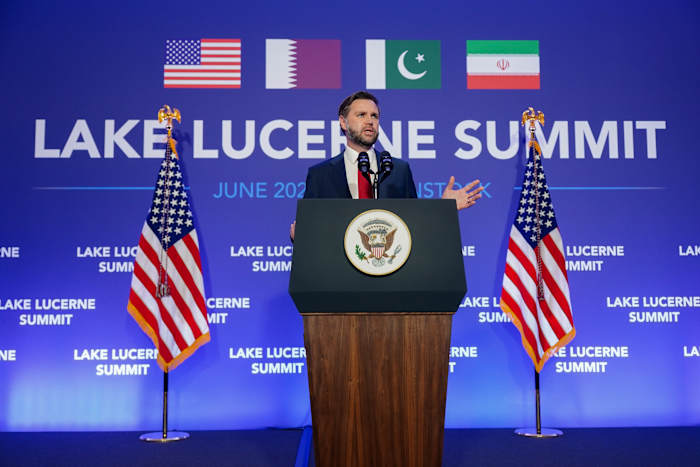
The air inside diplomatic briefing rooms is almost always unnaturally still. It smells of stale filter coffee, wool suits damp from the Washington drizzle, and the faint, chemical tang of laser printers running on overdrive. For months, the headlines have been dominated by the screech of metal, the thunder of airstrikes, and the cold, unyielding arithmetic of attrition. But when Vice President JD Vance stepped to the microphone to announce that recent talks with Iranian officials had established a "good foundation" for a deal to end the war, the shift in tone was palpable.
It was not a victory lap. It was something far more fragile. For an alternative view, check out: this related article.
Diplomacy in the midst of an active conflict is a strange, agonizing theater. To the public, it looks like a series of stiff handshakes and carefully vetted press releases. But beneath the surface lies a high-stakes psychological game where every pause, every inflection, and every cup of tea offered or refused carries the weight of human lives. When a government official says a foundation has been laid, they are not talking about a finished structure. They are talking about the fact that both sides have finally stopped digging the trenches deep enough to look each other in the eye.
Imagine a mid-level bureaucrat sitting across a mahogany table from a lifelong adversary. Let us call him David. David has spent the last three weeks sleeping on an office couch, surviving on cold takeout and adrenaline. His job is to read between the lines of translated transcripts. Across from him sits an Iranian counterpart who has lived under the suffocating pressure of economic sanctions and domestic unrest. Neither man trusts the other. Both know that a single misstep, an overly aggressive demand, or a leaked memo could send the entire apparatus crashing down, reigniting the violence on the ground. Further reporting on this matter has been shared by Reuters.
This is the invisible friction of peacemaking. It is tedious. It is exhausting. It is entirely unglamorous.
The Geography of Cold Realism
The public often demands a moral clarity from foreign policy that the world simply cannot provide. We want clear villains and unblemished heroes. We want unconditional surrenders and grand, sweeping treaties signed on the decks of battleships. But history rarely moves in straight lines. Instead, it crawls through the mud of compromise.
The conflict in question has radiated outward, touching everything from global energy markets to the price of grain in East Africa. For the average citizen, the war is an abstract entity experienced through a series of anxious glances at a smartphone screen during a morning commute. It is a spike in the cost of living. It is a vague, looming sense of instability. But for those in the crosshairs, the stakes are measured in structural concrete and shrapnel.
When Washington and Tehran begin to talk, they are not doing so out of a sudden burst of mutual affection. They are doing so because the alternative has become too expensive for either to bear. The decision to meet, even through intermediaries or in quiet third-party capitals like Muscat or Geneva, is an admission of limits. It is the moment where raw ideology collides with the brick wall of logistical reality.
Consider the mechanics of the breakthrough Vance alluded to. A "good foundation" implies progress on the core friction points that have kept the region on the brink of total escalation. It means finding a common language on regional proxy networks, maritime security routes, and the thorny architecture of sanctions relief. For Iran, the calculation is driven by an economy gasping for air under the weight of international isolation. For the United States, it is the imperative to prevent a localized conflict from spiraling into a catastrophic regional war that would draw in American boots and bleed trillions from the national treasury.
The Long Shadow of the Backchannel
The most important conversations in global politics happen when the cameras are turned off. In the history of diplomacy, the public breakthroughs are almost always the result of months of grueling, deniable backchannel communication.
Think back to the Cold War. The Cuban Missile Crisis was not resolved during the theatrical debates at the United Nations Security Council. It was defused through a series of hurried notes passed between the Soviet ambassador and the President’s brother in a closed room at the Department of Justice. The public saw the brinkmanship; the private reality was a desperate search for a face-saving exit.
The current breakthrough follows a similar script. For months, critics argued that engagement with Tehran was a sign of weakness, a betrayal of traditional allies in the region. The political risks for the administration were immense. Every meeting was an opportunity for opponents to scream appeasement. Yet, the administration chose to persist, gambling that the channel could hold long enough to yield something tangible.
The skepticism is understandable. Iran's track record is a long chronicle of defiance and strategic ambiguity. To trust a regime that has systematically funded destabilization across the Middle East requires a level of faith that many find impossible to muster. But effective diplomacy does not require trust. It requires verification, leverage, and an alignment of incentives. You do not make peace with your friends; you make it with the people who have the power to do you harm.
What a Foundation Looks Like on the Ground
Away from the marble halls of power, the news of these talks filters down to people who view the high-level maneuvering through a completely different lens.
Take an ordinary family living in a city that has spent the last year under the constant threat of drone strikes. Let us call the mother Sarah. For Sarah, a "good foundation" for a deal does not mean a shift in the geopolitical balance of power. It means the possibility of a full night of uninterrupted sleep. It means not having to mentally calculate the distance to the nearest bomb shelter every time she walks her children to school. It means the return of predictability to a life that has been stripped of it.
The tragedy of modern conflict is that the people who pay the highest price are the ones who have the least say in its execution. The decisions made by men in suits thousands of miles away dictate whether a shop opens in the morning, whether a electrical grid stays online, or whether a harvest is gathered or left to rot in the fields.
When we strip away the jargon of international relations—the talk of strategic frameworks, reciprocal concessions, and multilateral frameworks—we are left with a very simple human equation. Will the killing stop? Will the economic bleeding be halted? Can people begin the slow, painful process of rebuilding what was broken?
The foundation Vance described is significant because it represents the first real crack in the wall of inevitability. For months, the consensus among many analysts was that the war had no exit ramp. The logic of escalation seemed absolute. One strike led to a counter-strike, which led to a harsher retaliation, in an endless, bloody loop. By establishing a baseline for an agreement, the negotiators have proved that the loop can be broken.
The Fragility of the Next Phase
But a foundation is not a ceiling. It is vulnerable to the elements.
The danger now lies in the gap between a conceptual understanding and a binding, enforceable treaty. This is where many diplomatic efforts go to die. The devil is not just in the details; he is in the timing. Who blinks first? Does Washington lift sanctions before Iran verifiably rolls back its uranium enrichment and curtails its regional militia networks? Or does Tehran demand a guarantee of American compliance that no administration can permanently bind to its successor?
Furthermore, there are powerful actors on both sides who benefit from the continuation of the status quo. Hardliners in Tehran view any compromise with the West as an existential threat to the ideological purity of the state. In Washington and across various Western capitals, hawkish factions argue that any deal short of total capitulation is a strategic error. Then there are the regional allies who watch these bilateral talks with deep anxiety, fearing that their own security interests will be traded away in the pursuit of a quick American exit.
The pressure to walk away from the table will be immense. A single provocative act by a proxy group, an ill-timed statement by a politician looking for domestic leverage, or a bureaucratic delay could shatter the fragile consensus that has been built. The negotiators are walking through a minefield, and they are doing so in full view of an audience that is rooting for them to fail.
The coming weeks will test the true depth of the foundation. It will require a rare combination of political courage and strategic patience. The administration will have to defend the process against fierce domestic blowback while maintaining a position of strength at the negotiating table. Tehran will have to decide whether it is truly ready to transition from a revolutionary state to a rational actor willing to exist within the boundaries of international norms.
The path forward is dark and uncertain. There are no guarantees in this type of high-wire act. But for the first time in a long time, there is a path. The cold facts of the conflict have been shifted, if only by a fraction of an inch, by the stubborn persistence of human dialogue. In a world defined by its fractures, that alone is a reality worth watching.