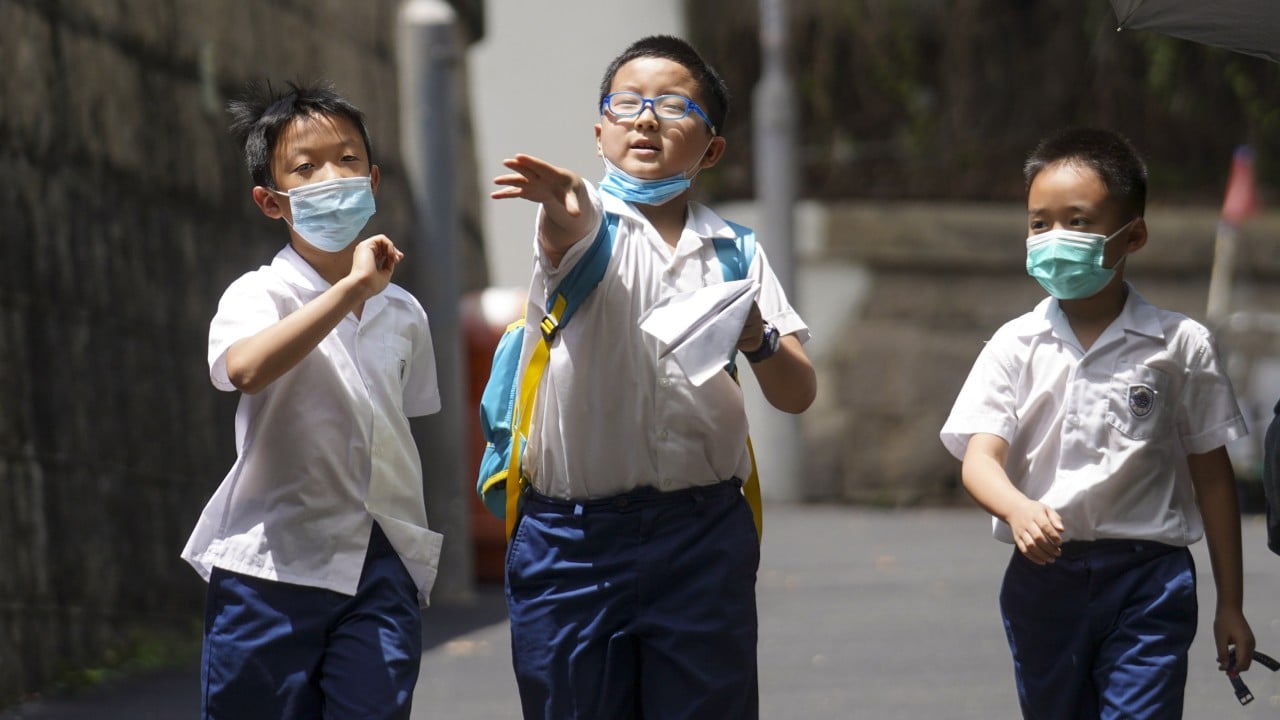
The envelope sits on a kitchen table in Sha Tin, thick enough to feel heavy, thin enough to tear with a trembling thumb.
Outside, the November air carries that brief, crisp mercy Hong Kong gets between the suffocating humidity of October and the damp chill of December. Inside a four-hundred-square-foot flat, a mother stares at a slip of paper bearing a school code. Her five-year-old son is on the linoleum floor, building a tower out of wooden blocks that will inevitably topple before he finishes. He has no idea that the trajectory of his next twelve years—his morning commute, his peer group, the dialect of ambition spoken in his hallways—was just decided by an algorithm running inside the Education Bureau.
She tears the flap. She reads the number. For the first time in a decade, the odds bent in her favor.
In the autumn of 2026, ahead of the 2027 academic intake, a record fifty-seven percent of Primary One applicants in Hong Kong secured a place at their preferred school during the discretionary admission stage. On a government press release, that number looks like a triumph. It reads like a clean, upward tick on a policy chart—evidence that the pressure cooker has finally let off steam, that the notorious gauntlet of early childhood admissions has softened into something merciful.
Look closer at the arithmetic, though. That fifty-seven percent is not a celebration of abundance. It is a symptom of contraction.
The Architecture of a Lottery
To understand why a single percentage point shifts the blood pressure of an entire city, you first have to understand how Hong Kong sorts its children.
For decades, the Primary One Admission system has operated like a high-stakes two-stage casino where the currency is residential addresses and family lineage. The first stage—discretionary places—accounts for roughly half of a school’s intake. Here, the rules are transparent on paper and brutally Darwinian in practice. If your child has an older sibling already enrolled, or if you work at the school, admission is guaranteed. Everyone else enters a points-based arena. You earn points if a parent graduated from the school. You earn points if your family shares the school’s religious affiliation. You earn points for being the firstborn.
Think of it less like an application and more like an inheritance tax paid in reverse. If you possess the right pedigree, the door swings open before a single test is administered. If you lack those connections, you are left holding a ticket in a blind draw where ties are broken by random computer-generated numbers.
I remember standing outside a coveted aided school in Kowloon Tong years ago, clutching a folder of my own child’s immunization records and birth certificates, watching fathers in bespoke suits compare catchment-area leases like poker hands. The air smelled of expensive espresso and quiet panic. Back then, the discretionary success rate hovered stubbornly in the low forties. More than half of the families who walked away from that initial round walked away empty-handed, forced into the dreaded Central Allocation stage—the "Big Draw"—where an unlucky spin of the digital wheel could send a six-year-old on a forty-five-minute cross-district bus ride every morning at dawn.
Parents bought properties they couldn't afford just to sit inside a specific school net. They baptized infants into faiths they didn't practice. They turned four-year-olds into miniature executives, rehearsing interview answers about favorite storybooks until the joy of reading evaporated entirely.
That was the machine. It ran on scarcity. And scarcity requires bodies.
The Vanishing Crowd
Now consider a hypothetical family—let us call them the Chans—navigating this exact ritual in late 2026 for their daughter, Chloe, who enters Primary One in September 2027.
Mrs. Chan grew up in Tsuen Wan, attended a neighborhood school without a famous name, and married an accountant from Kwun Tong. Neither holds alumni points at the elite institutions on Hong Kong Island. Neither belongs to a parish tied to a prestigious Catholic primary school. Under the old math, Chloe’s discretionary application was a long shot—a polite formality before bracing for the chaos of the Big Draw.
Yet when the results arrived for the 2027 cohort, Chloe got in.
She did not get in because the Education Bureau suddenly built dozens of new classrooms. She got in because the line outside the door has quietly thinned.
Hong Kong is living through a profound demographic retreat. The children entering Primary One in 2027 were mostly born between 2020 and 2021—years defined by closed borders, pandemic isolation, economic uncertainty, and a historic wave of emigration that saw tens of thousands of young families pack their lives into shipping containers bound for the United Kingdom, Canada, and Australia. At the same time, the city’s birth rate plunged to record lows, dropping well below replacement levels and staying there.
When the total pool of five-year-olds shrinks by thousands, the denominator changes. The coveted desks at popular schools remain fixed in number, bolted to the floorboards just as they were in 2015. With fewer applicants competing for those exact same discretionary slots, the success rate inevitably climbs. Fifty-seven percent is not magic. It is division.
What the Percentage Hides
Here is where the official narrative fractures into two entirely different realities, depending on which side of the street your school stands on.
If you are a parent like Mrs. Chan, this statistical shift feels like grace. You keep your child close to home. You skip the agonizing winter months spent preparing portfolios for "door-knocking"—the desperate summer tradition where rejected parents walk from school to school begging principals for a leftover seat. Your family breathes easier.
Walk two blocks over to a less famous neighborhood school, however, and that same fifty-seven percent feels like a slow-motion execution.
Because the discretionary stage allows parents to apply to any school in Hong Kong regardless of district, the shrinking pool of children overwhelmingly concentrates its applications at the top tier. Famous schools still fill their discretionary quotas effortlessly; they simply accept a slightly higher fraction of the families who apply to them, dipping marginally further down the points ladder.
Meanwhile, the schools that sit in the middle and lower tiers of public perception—institutions staffed by dedicated teachers who know every student’s name—watch their applicant numbers hollow out. When more than half of all children vanish from the pool before Central Allocation even begins, the remaining pool is no longer deep enough to keep every classroom full.
In education policy, an empty desk is not neutral. It is a liability.
Under Hong Kong’s funding rules, schools that fail to enroll a minimum threshold of Primary One students—typically sixteen pupils for a single class—face immediate structural consequences. They lose government funding for classes. Teachers face redundancy or forced transfers. Eventually, if the numbers do not recover, the school receives an order to merge or shut its gates permanently.
Imagine being a veteran teacher at an estate school in Tuen Mun or Wong Tai Sin, reading headlines celebrating a "record high" admission rate. To the public, the system looks healthier than ever. Inside your staffroom, you are counting heads, wondering whether next September’s budget will cover the music teacher’s salary, or whether the building you spent twenty years inside will be converted into a storage facility by 2030.
The Illusion of Choice
There is a subtle psychological trap built into this moment, and parents are walking straight into it.
When success rates rise, anxiety does not disappear; it mutates. For years, the central terror of Hong Kong parenting was rejection. You feared your child would be shut out of good schools entirely. Today, as the demographic tide recedes, a new fear takes its place: instability.
Parents now ask a different set of questions over dim sum on Sunday mornings. Not just Is this school prestigious? but Will this school still exist when my child reaches Primary Six?
Consider what happens when a neighborhood school loses a class. First, elective programs shrink. Then, veteran teachers leave for larger institutions with better job security. Word spreads through WhatsApp parent groups within hours. The following year, even fewer parents list that school on their preference forms, accelerating the very decline they feared. It becomes a self-fulfilling prophecy written in enrollment figures.
At the same time, the rise to fifty-seven percent masks an enduring inequality. Even in a shrinking market, the top tier of Direct Subsidy Scheme and private schools—institutions charging hefty tuition fees outside the government’s free allocation net—continue to attract fierce competition. Their admissions process runs parallel to the public system, siphoning off affluent families who want international curricula or guaranteed pathways to elite secondary schools.
So while the average parent enjoys better odds in the public discretionary round, the stratification of childhood remains intact. A family with the right surname or parish stamp still sails through effortlessly. A working-class family without points still relies on luck—only now, the dice are loaded slightly more generously because so many other players have left the table.
The Heavy Crown of the Only Child
Step inside a kindergarten classroom in 2026 and look at the faces of the children heading toward that 2027 intake.
Almost every child at those miniature tables is an only child.
That demographic reality changes the emotional weight of Primary One admissions in ways no spreadsheet can capture. When a family raises three children, educational outcomes diffuse across siblings; one thrives in academics, another in sports, another in trade. When a family stakes everything on a single child—the sole inheritor of two parents’ sacrifices and four grandparents’ expectations—every administrative milestone carries existential freight.
Even with a fifty-seven percent chance of early success, parents still stay up past midnight comparing school banding statistics. They still enroll four-year-olds in English phonics classes and Olympic mathematics drills. Why? Because cultural habits outlive the conditions that created them. The scarcity mindset forged during the baby booms of the late twentieth century has hardened into parenting orthodoxy. You do not stop running simply because the track got wider; you just run faster toward a narrower finish line.
And yet, something quiet is shifting beneath the surface.
Talk to younger parents—couples in their early thirties raising toddlers in Tseung Kwan O or Kai Tak—and you hear a faint, unfamiliar note of pragmatism. Because the odds of getting a decent local school have improved, some are choosing not to bankrupt themselves for a tiny flat in Kowloon Tong. Some are skipping the frantic round of weekend interview prep courses. They are realizing, perhaps cautiously, that a six-year-old does not need a resume to learn how to read.
The Sound of a Quiet Corridor
History rarely announces a turning point with fireworks. Usually, it arrives as a statistical footnote that nobody quite knows how to interpret until a decade later.
In the 1970s, Hong Kong scrambled to build rooftop schools and rooftop playgrounds just to accommodate a surging youth population clamoring for basic literacy. Classrooms held forty-five students. Morning and afternoon sessions split the day in two because there simply wasn't enough concrete to house everyone at once. Scarcity was physical, loud, and undeniable.
Half a century later, the city faces the inverse crisis. The concrete is everywhere. The smartboards are installed, the libraries are stocked, and the bus routes are mapped. What is missing is the noise.
When fifty-seven percent of families open their letters this season and exhale in relief, they are experiencing a genuine personal blessing. A child gets to walk to school holding a parent’s hand instead of waking up in the dark for a long commute. A mother sleeps through the night without drafting backup appeal letters in her head. Those small, domestic victories matter deeply to the people living inside them.
Still, numbers never tell just one story.
Down the hallway from the celebrating family in Sha Tin, another door closes softly. Somewhere across the harbor, a school janitor locks a gate that fewer small hands will push open next September. A classroom stands ready with thirty freshly wiped desks, sunlight slanting across empty chairs, waiting for a generation that never arrived.