Cotton. Denim. Fleece.
We treat fabric as a language, a shorthand for who we are and what we want from the world before we ever open our mouths. We spend mornings standing in front of open closets, calculating the weather, the dress code, the impression we hope to leave on a stranger across a crowded room. Yet when a woman or a girl survives a sexual assault, that harmless daily ritual is weaponized against her. Suddenly, the hem of a skirt or the tightness of a sweater becomes a piece of cross-examination evidence, a silent accusation whispered in police precincts, family kitchens, and courtrooms around the globe.
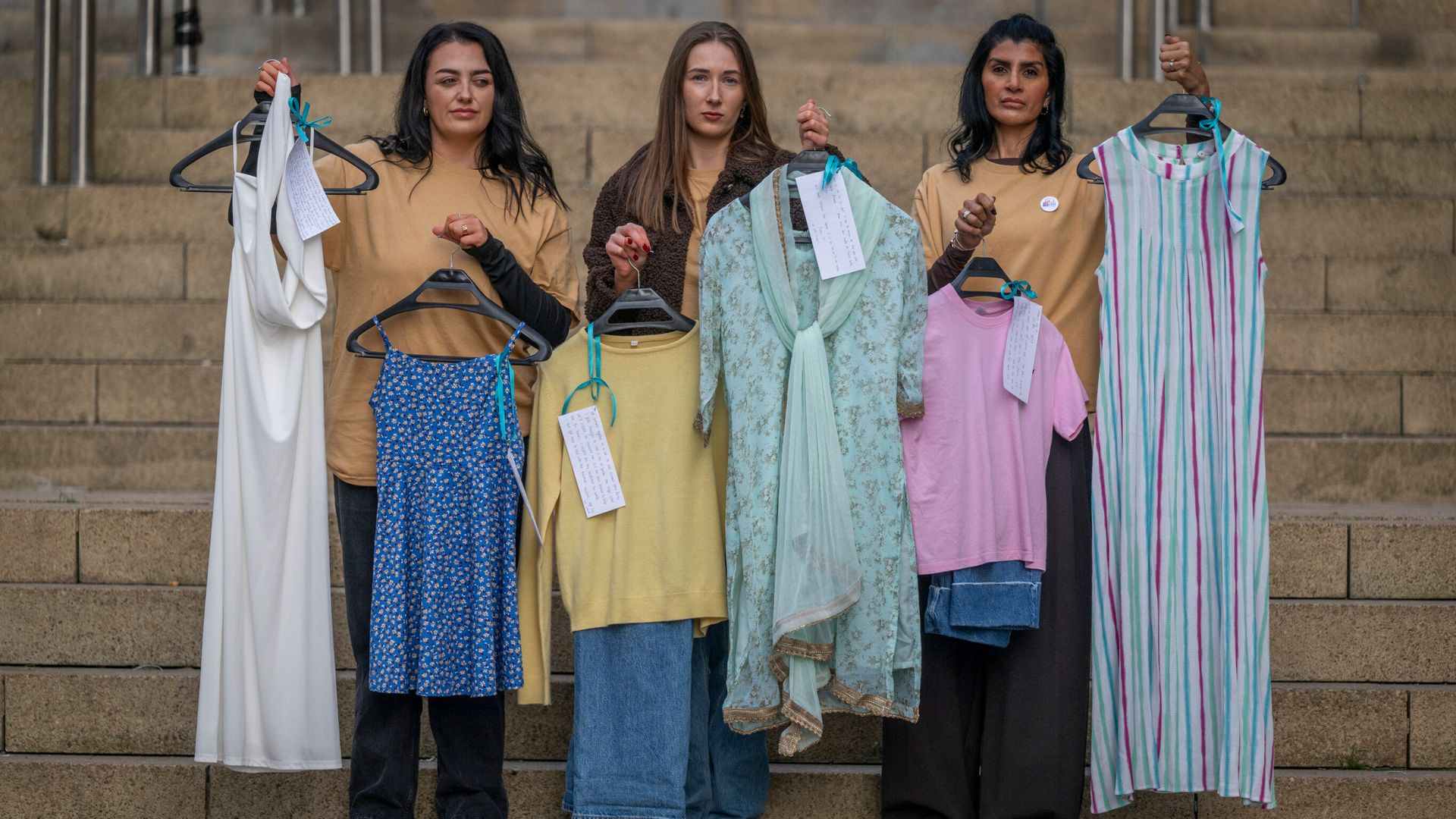
This is the precise psychological nerve targeted by the "What Were You Wearing?" exhibition—an installation that began at the University of Arkansas in 2014, inspired by Mary Simmerling’s poem of the same name, and has since traveled across continents, most recently drawing quiet, stunned crowds in community halls and civic centers. On the surface, it looks like a thrift store rack or a museum display of ordinary laundry. Underneath the fluorescent lights hang yellow sundresses, oversized flannel shirts, faded jeans, toddler overalls, and thick winter parkas. Each garment is paired with a short, anonymous placard written by a survivor of sexual violence, answering the question that almost inevitably follows their disclosure.
The Lie Woven Into the Fabric
To understand why a room full of unremarkable clothes carries such crushing emotional weight, you have to sit with the question itself. What were you wearing?
It sounds like a request for sensory detail, the kind of benign curiosity a friend might express when hearing a story about a concert or a first date. In reality, it is a trap. Embedded inside those four words is an unspoken bargain: if the victim dressed modestly, conservatively, or unattractively, she might be granted the status of a true victim; if she wore something revealing, tight, or celebratory, she somehow co-authored her own violation.
Psychologists call this the "just-world hypothesis"—a cognitive bias first identified by social psychologist Melvin Lerner in the 1960s. Humans are terrified of randomness. We want desperately to believe that the universe operates on a predictable moral ledger where good things happen to good, careful people, and terrible things happen only to those who make reckless choices. If we can convince ourselves that an assault occurred because a woman wore a short red dress to a bar at midnight, we buy ourselves a fragile illusion of safety. I don't wear dresses like that, we tell ourselves. My daughter knows better. Therefore, we are safe.
Consider a hypothetical scenario—a composite drawn from thousands of real survivor testimonies—to see how this quiet cruelty operates in real time.
Picture a twenty-two-year-old paralegal named Elena. It is a Tuesday evening in October, brisk and damp. She has just finished a ten-hour shift reviewing contract amendments, her eyes burning from spreadsheet glare. She is wearing charcoal-gray wool trousers, a faded university sweatshirt with a coffee stain near the cuff, and scuffed white sneakers. On her walk from the subway station to her apartment building, two blocks from a brightly lit grocery store, a man grabs her from behind and drags her into the recessed doorway of a closed dry cleaner.
Three hours later, sitting on crinkling exam-table paper in a hospital room while a nurse collects swabs for a forensic kit, Elena is shivering so hard her teeth click together. When the detectives arrive, they are polite, methodical, and tired. They ask about the timeline, the lighting, the assailant’s height. Then, almost as a reflex, one of them looks down at the plastic evidence bags holding her wool trousers and stained sweatshirt. Later, when Elena tries to explain what happened to an older relative over the phone, the first breath out of the relative’s mouth isn't Are you hurt? It is What did you have on?
Even when the clothing is completely unprovocative, the question still lands like a blow. It forces Elena to audit her own body as if it were a crime scene she failed to secure properly. Had she zipped her coat all the way up? Were the trousers too fitted? Did her sneakers make her look vulnerable? The burden of guilt shifts seamlessly from the person who committed the violence to the person who absorbed it.
Walking Through the Gallery of Ordinary Days
Walking through a "What Were You Wearing?" exhibition feels less like visiting an art gallery and more like stepping inside someone else’s memory—a memory they have spent years trying to scrub clean.
I remember standing in front of a similar display a few years ago, expecting to feel anger, and instead feeling an overwhelming, disorienting stillness. The air in the room was heavy, punctuated only by the scuff of shoes on linoleum and the occasional sharp intake of breath from a visitor reading a placard. There are no graphic photographs on the walls. There are no sensationalized headlines. The exhibition refuses to offer the voyeuristic spectacle that true-crime culture so often relies on. Instead, it offers radical, mundane honesty.
Beside a pair of worn blue jeans and a plain white cotton T-shirt, a card reads simply: I was walking home from my shift at the diner. My feet hurt.
Three feet away hangs a tiny, bright pink tracksuit—the size worn by a six-year-old child. No placard is needed to explain the horror of that fabric, yet the card is there anyway, detailing a Saturday afternoon in a relative's living room while cartoons played in the background.
Further down the row is a military uniform. Heavy, camouflage-patterned, rigid with starch and regulations—garments specifically engineered to erase individuality, neutralize gender, and project institutional authority. According to data from the U.S. Department of Defense, tens of thousands of active-duty service members experience unwanted sexual contact every year, proving that even the most utilitarian armor on earth does not deter a perpetrator.
And then there is the modest floral maxi dress, buttoned to the collarbone, worn to a church picnic. The oversized gray hoodie worn while studying for finals in a dorm room. The flannel pajama pants worn in a woman's own bed while her children slept down the hall.
When you stand in front of twenty or thirty of these outfits lined up side by side, the myth of the "provocative outfit" doesn't just crack—it evaporates. You realize that clothing is not a cause of sexual violence; it is merely the backdrop against which violence happens. Predators do not select targets based on fashion choices. Criminological research consistently shows that perpetrators look for opportunity, isolation, perceived vulnerability, and the likelihood that a victim will not be believed. A hemline has zero correlation with assault rates.
The Invisible Stakes of Victim Blaming
Why does this distinction matter so intensely outside the walls of a community exhibition? Because cultural myths do not stay trapped in polite conversation; they harden into institutional barriers.
According to the Rape, Abuse & Incest National Network (RAINN), out of every 1,000 sexual assaults in the United States, only about 310 are reported to police. Of those, roughly 50 lead to an arrest, and only 25 result in incarceration. That staggering attrition rate—more than 97 percent of perpetrators walking free—is driven in large part by the fear of not being believed, and the dread of public scrutiny.
When survivors anticipate being interrogated about their wardrobe, their alcohol consumption, or their decision to walk alone at night, they frequently choose silence over justice. Silence feels safer than humiliation. Yet silence comes with a brutal physiological and psychological cost. Survivors of sexual violence face dramatically elevated rates of post-traumatic stress disorder, major depressive episodes, substance abuse, and chronic physical pain. When society responds to their trauma with skepticism rooted in what they were wearing, it inflicts what trauma specialists call "secondary victimization"—a second wound that often takes longer to heal than the physical assault itself.
Even when cases do reach a courtroom, clothing remains a potent weapon for defense attorneys. High-profile trials around the world have demonstrated how easily a piece of underwear or a fitted top can be held up before a jury as implied consent. In 2018, widespread protests erupted across Ireland after a defense lawyer in a rape trial invited jurors to examine a seventeen-year-old complainant’s lace thong as evidence that she had been open to meeting someone. Women took to the streets and social media holding up their own underwear under the hashtag #ThisIsNotConsent, furious that in the twenty-first century, a piece of fabric could still be treated as a legal signature.
Shifting the Lens From Fabric to Accountability
Exhibitions like "What Were You Wearing?" succeed because they bypass intellectual debate and strike straight at human empathy. You can argue with a statistic. You can rationalize a news report from a distance. You cannot easily argue with a six-year-old's pink tracksuit or a pair of muddy gardening overalls hanging six inches from your face.
Curators of these installations—often university student advocates, local crisis centers, and community coalitions—deliberately reconstruct the outfits using donated clothes based on survivors' descriptions. This detail matters. Survivors rarely keep the actual clothes they were assaulted in; those garments are either locked away in police evidence lockers for years or burned, shredded, and thrown into dumpsters in a desperate attempt to erase the night from memory. Recreating the outfits gives the narrative back to the survivor without forcing them to surrender their physical privacy all over again.
Watching visitors move through the space reveals how quickly entrenched assumptions can unravel when confronted with tangible proof. A middle-aged father stops in front of a high school cheerleading uniform, his jaw tightening as he reads the card. Two teenage boys whisper quietly near a pair of baggy basketball shorts and a faded band tee, the casual bravado they walked in with replaced by solemn recognition. An older woman stands motionless before a conservative wool coat, wiping a tear from her cheek before anyone notices.
The exhibition works like a mirror turned outward. It forces the viewer to confront a simple, uncomfortable truth: if women and girls are assaulted in burqas and bikinis, in diapers and nursing home gowns, in combat boots and wedding dresses, then clothing was never the variable that needed fixing.
The real work begins the moment visitors step back out into the daylight. It lives in the split second before we speak when someone trusts us with a painful secret. It lives in replacing an instinctive, defensive interrogation with three words that carry no judgment, no conditions, and no hidden audit of a closet: I believe you.
Because long after the exhibition racks are dismantled and packed into cardboard boxes for the next town, the clothes remain hanging in millions of closets—waiting to be worn simply as clothes again, free from the weight of someone else's crime.