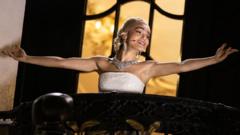
The West End is currently high on its own supply. If you read the mainstream trades, the narrative is saccharine and predictable: Rachel Zegler, the Hollywood wunderkind, has "conquered" London with an Olivier nomination for her turn in Evita. They point to the balcony scene. They point to the vocal range. They point to the box office receipts.
They are missing the point.
The Olivier nomination for Zegler isn't a celebration of a performance; it is a formal surrender of the stage to the screen. It represents the final erosion of the "theatrical craft" in favor of "star-power proximity." When a performance is heralded as groundbreaking because it mimics the cinematic close-up rather than commanding the physical room, we aren’t watching a revival of Evita. We are watching a live-action commercial for a Disney franchise.
The Myth of the "Balcony Moment"
Critics fell over themselves describing the balcony scene. They used words like "raw" and "intimate." They claimed it redefined Andrew Lloyd Webber’s Eva Perón.
It didn't.
It merely imported a filmic sensibility into a space that requires something entirely different. True theatrical performance is a feat of stamina and spatial awareness. It is about the $10^{-1}$ seconds of timing that change with every audience’s breath. Zegler’s performance, while technically proficient, was a recorded product delivered in real-time. It lacked the grit and the unpredictable danger of a theater veteran who knows that the audience in the back row isn't looking at a camera lens—they are looking at a body in motion.
I’ve sat in rooms with casting directors who are terrified of this shift. They see the writing on the wall. They’ve told me, off the record, that "talent" is now the secondary metric. The primary metric is "follower conversion." If Zegler didn't have a massive digital footprint, would this nomination even exist? No. The Olivier committee is desperate for relevance, and they are using Zegler to buy it.
The Devaluation of the West End Pipeline
The real victim here isn't the prestige of the award—it’s the ecosystem that produces stage actors.
London’s theater scene used to be a meritocracy of the boards. You trained. You did the regional tours. You took the ensemble roles. You earned the right to stand on that balcony. By parachuting in a Hollywood star for a limited-run vanity project and immediately crowning her with a nomination, the Society of London Theatre is sending a clear message to every RADA student: Don't bother with the craft. Get a Marvel contract instead.
This is "stunt casting" masquerading as "artistic discovery."
- The Problem: Short-term ticket spikes vs. long-term artistic decay.
- The Reality: High-profile nominations for film stars are a marketing expense, not a critical assessment.
- The Consequence: The "theatrical" part of musical theater is being replaced by a karaoke version of Hollywood’s aesthetic.
Eva Perón is Not a Disney Princess
Zegler’s Eva was praised for its "vulnerability." In any other context, that would be a compliment. In the context of Evita, it’s a fundamental misunderstanding of the character.
Eva Perón is a monster of ambition. She is a woman who burned through a country to warm herself. Tim Rice and Lloyd Webber didn’t write a story about a misunderstood girl; they wrote a Greek tragedy about the intoxicating power of the image.
By making Eva "relatable" and "sweet," Zegler (and the direction) gutted the play's core. They turned a political powerhouse into a TikTok-friendly ingenue. It’s a sanitized version of history for an audience that wants to feel good rather than feel challenged. If you want to see a real Eva, you look at Patti LuPone or Elena Roger—performances that were visceral, polarizing, and genuinely terrifying. Zegler’s Eva was a coffee-shop acoustic cover of a heavy metal anthem.
The Technical Trap: Why Precision Isn't Always Art
There is a common misconception that hitting every note perfectly constitutes a great performance.
It doesn't.
In a studio, perfection is the goal. In a theater, connection is the goal. Zegler is a world-class vocalist. Nobody is disputing the pipes. But the Olivier Awards are supposed to honor acting. Acting in a musical is not just about the song; it’s about what happens through the song.
Imagine a scenario where we judge a marathon runner solely on their form and not their time. That is what the critics are doing with Zegler. They are so distracted by the "perfect form" of her Hollywood-honed vocal technique that they aren't noticing she's running on a treadmill. She isn't going anywhere. She isn't taking the character on a journey. She is simply executing a series of well-rehearsed cues.
Stop Asking if She’s Good—Ask if It’s Theater
The most frequent "People Also Ask" query regarding this run is: "Is Rachel Zegler’s Evita worth the ticket price?"
The answer is yes if you want to see a celebrity in person. The answer is no if you want to see the future of the West End.
We are entering an era where the stage is becoming a physical extension of the streaming service. If we continue to reward this trend, we will lose the very thing that makes live performance vital: its independence from the screen. We are training audiences to expect a "live movie" rather than a "stage play."
- Actionable Advice for Producers: Stop chasing the IMDB credits. Hire the actor who has done 300 shows in a basement in Peckham. They are the ones who know how to hold a room without a microphone.
- Advice for Audiences: Demand more than a familiar face. Demand a performance that couldn't exist on a 4K monitor.
The Olivier nomination is a symptom of a larger rot. We are trading our cultural heritage for a few weeks of viral clips and a bump in social media engagement. If the West End wants to survive as a distinct art form, it needs to stop auditioning for Hollywood.
Zegler didn't save Evita. She just proved that the theater is now officially a subsidiary of the movie industry.