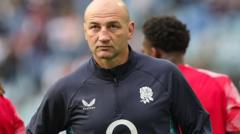
The Rugby Football Union has a long, expensive history of mistaking a lack of options for a vote of confidence. This weekend, following a historic 23-18 collapse to Italy in Rome, RFU Chief Executive Bill Sweeney reached for the familiar script. He issued a statement backing Steve Borthwick, describing a run of three consecutive defeats as "hugely disappointing" while insisting the union remains "fully committed" to the head coach. It is the kind of public endorsement that usually precedes a private execution, but in this instance, the status quo is protected by a more formidable barrier than loyalty.
Sweeney’s hands are tied by a balance sheet that cannot afford a revolution. After a 12-match winning streak that masked deep-seated structural flaws throughout 2025, England has regressed with violent speed. The loss at the Stadio Olimpico was not a freak occurrence or a bad day at the office. It was the first time in 33 meetings that England has fallen to the Azzurri, a result that leaves them staring at their worst Six Nations finish in history. If they lose to France in Paris next Saturday, Borthwick will have presided over a campaign with just a single victory. Recently making headlines in this space: Why Cancelled World Cup Send Offs Are the Best Outcome for African Football.
The Three Million Pound Problem
The primary reason Borthwick remains in his post today has less to do with his tactical "vision" and everything to do with the cost of tearing it down. Borthwick is contracted through the 2027 World Cup on a salary estimated at £700,000 per year. Dismissing him now would require a payout in the region of £1.4 million. When you factor in the dismissal of a sprawling backroom staff—including specialist coaches for the scrum, attack, and defense—the total bill for a clean slate exceeds £3 million.
For an organization that recently reported a net loss of £1.9 million and is still navigating the financial wreckage of a post-pandemic economy, that is a prohibitive figure. The RFU is not backing Borthwick because they believe he is the best man for the job. They are backing him because they cannot afford the alternative. This financial paralysis creates a dangerous vacuum where "support" is actually just a lack of leverage. More details on this are covered by Sky Sports.
A System Built on a Coin Toss
On the pitch, the "Borthwick Way" has been exposed as a high-variance gamble that has finally come up tails. Throughout the successful 2025 run, England’s strategy relied almost entirely on winning the aerial battle. They kicked more than any other elite side, banking on the hope that their chase-and-pressure game would force errors in the opposition's backfield.
It worked for a while. Players like Tommy Freeman and Immanuel Feyi-Waboso provided the athleticism to make the "lottery" of the high ball look like a calculated skill. But once Scotland, Ireland, and now Italy figured out the geometry of the English kicking game, there was no Plan B. In Rome, England held an 18-10 lead and looked comfortable. Then the errors started.
- Discipline: Yellow cards for Sam Underhill and Maro Itoje left England defending with 13 men at a critical juncture.
- Tactical Rigidity: Despite Italy’s back three handling the high ball with ease, George Ford and Fin Smith continued to kick away possession rather than testing the Italian line with ball in hand.
- The Breakdown: England’s specialist turnover threats, including Ben Earl, were neutralized by an Italian side that played with more speed and lower body height.
The result was a rudderless performance. England looked like a team that had forgotten how to play rugby without a script. When the script failed, the actors froze.
The Illusion of Progress
The most damning indictment of the current regime is the erosion of the "unwavering standards" Borthwick frequently cites in press conferences. A year ago, England were lauded for their defensive grit. Today, they are conceding points at an alarming rate—73 in just two weeks against Ireland and Italy.
There is a growing sense among former internationals and industry analysts that the soul has been ripped out of the squad. The "Elite Player Squad" (EPS) contracts, introduced with much fanfare to ensure "optimal preparation," have yet to yield a team that looks prepared for anything other than a scripted set-piece.
The RFU’s insistence that this is part of a "long-term vision" is a difficult pill to swallow when the short-term reality is a loss to the 11th-ranked team in the world. Comparisons to 2018, when England finished fifth before reaching a World Cup final 18 months later, are flawed. That 2018 side had a proven core of world-class winners; this side looks like a collection of talented individuals who are being coached out of their natural instincts.
The Road to Paris
If the RFU truly wants to support Borthwick, they need to do more than issue press releases. They need to demand a fundamental shift in philosophy. The current trajectory is not a "growth period"; it is a collapse.
France awaits in Paris. On current form, Les Bleus—powered by the terrifying physicality of Emmanuel Meafou and the genius of Antoine Dupont—could inflict a record-breaking defeat on this fragile English side. A heavy loss in "Le Crunch" would make Borthwick’s position untenable, regardless of the payout figures.
The RFU may be "fully committed" for now, but in professional sport, commitment is a currency that devalues rapidly with every defeat. The real question isn't whether Borthwick has the backing of the board, but whether he still has the ears of the players. If the dressing room has decided the system is broken, no amount of financial planning will save the coach.
England needs to decide what it wants to be. If it wants to be a team that simply avoids being sacked, it is succeeding. If it wants to be a world power, the current "support" is nothing more than an expensive delay of the inevitable.
Watch the team's body language in the first twenty minutes at the Stade de France. That will tell you more about Borthwick’s future than any statement from Twickenham ever could.