Beijing is angry, but not for the reasons its diplomats claim. When Chinese Foreign Ministry spokesperson Mao Ning took the podium on Tuesday to blast the Quadrilateral Security Dialogue meeting in New Delhi, her script was entirely predictable. She warned against the creation of exclusive small cliques and denounced bloc confrontation, using the standard rhetorical lexicon reserved for Washington and its regional allies.
But look past the boilerplate protests about exclusive groupings. The real source of Beijing's friction is not the abstract concept of a multipolar world. It is a highly specific, concrete loss of leverage in the South Pacific.
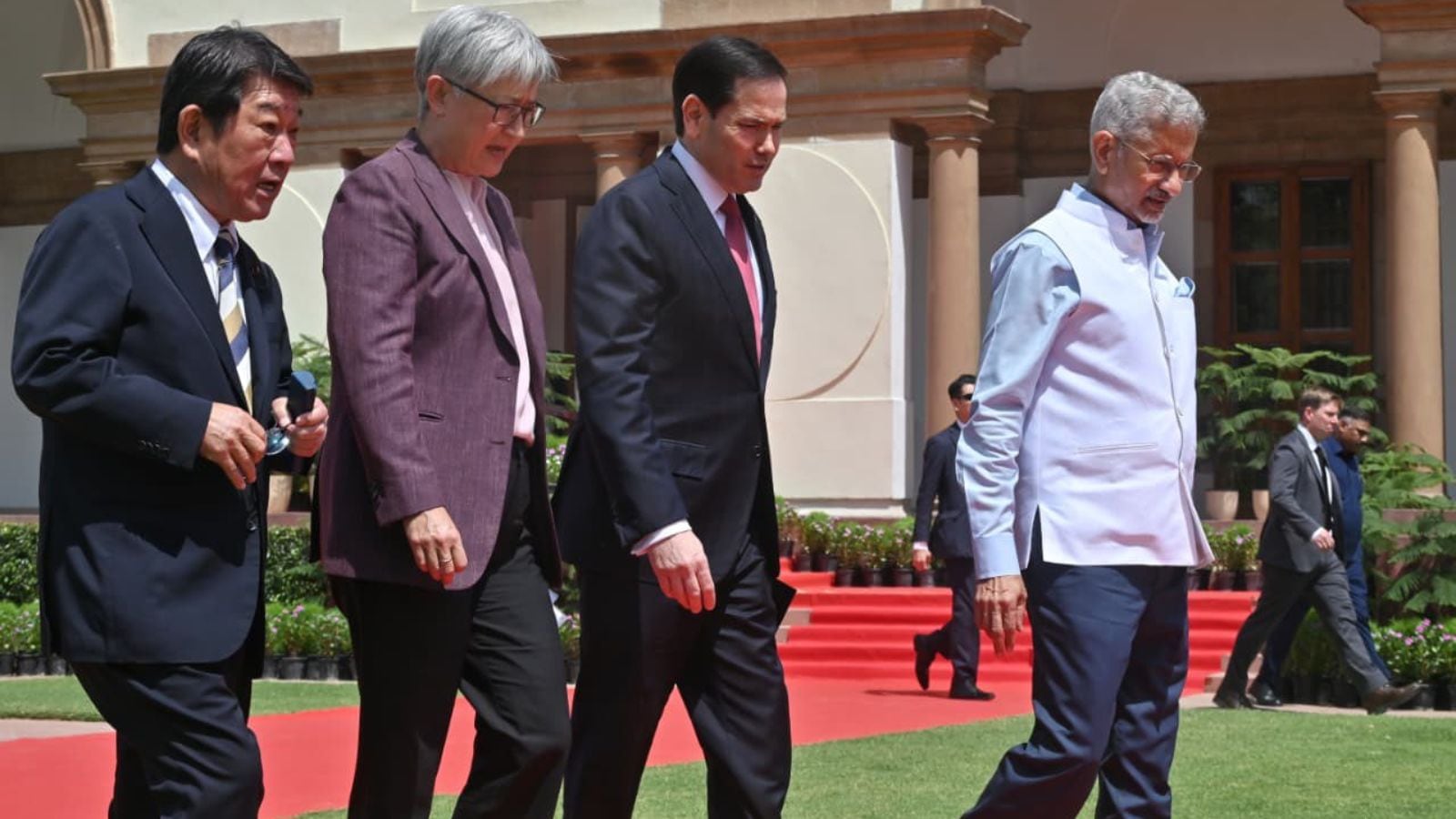
During the New Delhi ministerial gathering, U.S. Secretary of State Marco Rubio, Indian External Affairs Minister S. Jaishankar, Australian Foreign Minister Penny Wong, and Japanese Foreign Minister Toshimitsu Motegi quietly unveiled a joint deal to finance and upgrade port infrastructure in Fiji. The Quad is putting its money where its mouth is, committing millions—including a direct AUD 30 million budget support package from Canberra—to modernize Fijian maritime facilities.
This directly undercuts China. For years, Suva courted Chinese state-owned enterprises under the Belt and Road Initiative to modernize its shipyards and port networks. By stepping in with a cleaner, coordinated financing alternative, the Quad has executed a tactical poaching of a strategic maritime hub. Beijing’s furious rhetorical pushback is simply the sound of a doors closing on its security ambitions in the Pacific Islands.
The Illusion of the Consensus
Behind the unified front presented at Hyderabad House in New Delhi, the Quad is wrestling with deep internal friction. The ministerial meeting was explicitly designed to project strength, yet it occurred under a heavy shadow of institutional drift. The four maritime democracies have struggled to maintain high-level momentum. A long-delayed leaders' summit, originally stalled due to Washington's shifting domestic focus and trade friction between the U.S. and India, remains unbooked.
The grouping is a voluntary diplomatic arrangement, not an Asian NATO. It has no central secretariat, no treaty obligations, and no standing military force. While New Delhi spins this structural fluidity as a feature that allows the group to remain a nimble mechanism, it is just as easily a bug.
Without formal institutionalization, the alliance operates on the whims of political cycles in four different capitals. The strategic focus of the White House is perpetually pulled toward conflicts in Eastern Europe and the Middle East, leaving regional allies wondering if Washington can sustain a long-term commitment to the Indo-Pacific.
Weaponizing the Supply Chain
To counter the accusation that it is merely a military talking shop aimed at containment, the Quad is aggressively shifting its weight toward geoeconomics. The New Delhi meeting produced two documents that signal where the real war for regional influence will be fought: the Quad Critical Minerals Initiative framework and a joint statement on Indo-Pacific Energy Security.
"Our goal has been to turn this from a forum in which we meet and talk about problems to one where we actually do something about them," Rubio stated during the proceedings.
The shift is born out of raw necessity. China controls over 70 percent of the world's extraction and 90 percent of the refining capacity for rare earth elements essential for advanced defense systems, semiconductors, and electric vehicles. By linking India’s massive refining potential and manufacturing scale with Australian raw materials and American and Japanese capital, the Quad aims to construct an industrial supply chain entirely independent of Chinese state influence.
| Country | Strategic Contribution to the Economic Bloc |
|---|---|
| United States | High-end technology design, venture capital, consumer market demand |
| India | Industrial manufacturing scale, labor pool, refining potential |
| Australia | Abundant critical mineral reserves (Lithium, Cobalt, Rare Earths) |
| Japan | Precision engineering, advanced materials processing, development finance |
This is the exact type of economic architecture that terrifies Beijing far more than naval drills. If the Quad successfully builds non-Chinese supply ecosystems, China loses its ultimate economic leverage over Western and Asian technology sectors.
Chokepoints and Sea Lanes
The joint statement issued in New Delhi also took direct aim at maritime vulnerabilities far beyond the immediate waters of the Pacific. The ministers explicitly condemned Iran’s imposition of tolls on commercial shipping and called for an uninterrupted flow of global commerce through the Strait of Hormuz.
For energy-importing giants like India and Japan, maritime chokepoints are existential vulnerabilities. The disruption of global oil and gas markets has disproportionately hit developing Indo-Pacific economies. By broadening its scope to include the Middle Eastern shipping lanes, the Quad is signaling that its maritime domain awareness framework is no longer confined to the South China Sea.
The strategy is transparent. The four nations are attempting to build a comprehensive maritime surveillance network that tracks dark fleets, illegal fishing vessels, and naval deployments from the Persian Gulf all the way to the waters of Japan.
The Expansion Dilemma
As the alliance attempts to flex its muscles, it faces a fundamental identity crisis: whether to grow or remain a closed shop. Beijing regularly exploits the exclusive nature of the group to convince Southeast Asian nations that the Quad is a Western-dominated clique designed to force smaller countries into an unwanted Cold War-style choice.
Publicly, the Quad is trying to walk a fine line. Ministry of External Affairs Additional Secretary Nagaraj Naidu confirmed in a post-meeting briefing that the Quad continues to remain a grouping of four members, explicitly ruling out an expansion of formal membership to nations like South Korea or Canada for the foreseeable future.
Instead, the group is pursuing a hub-and-spoke model. They are keeping the core decision-making structure limited to the founding four while opening up specific projects—like critical mineral agreements and maritime tracking data—to external partners. It is a pragmatic compromise, but it risks creating a two-tier system that may alienate the very regional partners the Quad needs to secure the Indo-Pacific.
The Fijian port deal proves that targeted, transactional infrastructure investments can successfully roll back Chinese influence. The true test of the Quad will not be found in the fiery press releases issued by Beijing, but in whether the four nations can fund these infrastructure plays faster than China can build them.