The death of Ayatollah Ali Khamenei on February 28, 2026, was not the quiet fading of an old man in a hospital bed. It was a violent, high-tech decapitation strike that leveled his residence in Tehran and claimed the lives of several family members. For nearly four decades, the world waited for this vacuum, assuming that the removal of the man would trigger the collapse of the mission. Yet, as smoke still rises over the capital, the reality on the ground is far more complex than a simple regime change narrative.
While Western headlines focus on the assassination by joint Israeli-US forces, the true story lies in the immediate, mechanical response of the Iranian state. This was not a moment of paralysis. Within hours, an Interim Leadership Council was active, and the Islamic Revolutionary Guard Corps (IRGC) signaled that its command-and-control structures remained intact. The transition from one man to a system has already begun.
The Myth of the Essential Individual
We often mistake autocracies for one-man shows. While Khamenei held the final word on everything from nuclear enrichment to the "Axis of Resistance," he spent his final years bulletproofing the bureaucracy against his own inevitable absence. The 88-member Assembly of Experts is now tasked with finding a successor, but the real power has shifted toward a military-clerical hybrid that does not require a single charismatic figurehead to function.
The "Second Step" initiative, launched years ago, was designed for this exact weekend. It envisioned a younger, more ideologically rigid cohort taking the reins. This is no longer a government of revolutionary grandfathers; it is a technocratic security state. The use of advanced Fattah-2 hypersonic missiles in retaliatory strikes against regional targets just 24 hours after the assassination proves that the "head of the snake" may be gone, but the nervous system is firing perfectly.
The Successor Shortlist and the Larijani Factor
Speculation regarding who takes the throne usually lands on two names: Mojtaba Khamenei, the late leader’s son, and Ali Larijani, the former Speaker of the Parliament. However, the internal dynamics are fraught with historical baggage.
- Mojtaba Khamenei: His candidacy carries the risk of looking like a "religious monarchy," a concept the 1979 Revolution was meant to destroy. If the IRGC backs him, it is for stability, not bloodline.
- Ali Larijani: Known as a pragmatist with deep ties to the security apparatus, he was reportedly given expanded responsibilities in the days leading up to the strike. He represents a "safe" transition that could bridge the gap between hardliners and the remaining traditionalists.
- Hassan Khomeini: The grandson of the Republic’s founder represents a more moderate, though largely sidelined, path that could appeal to a restless public.
A Nation of Two Realities
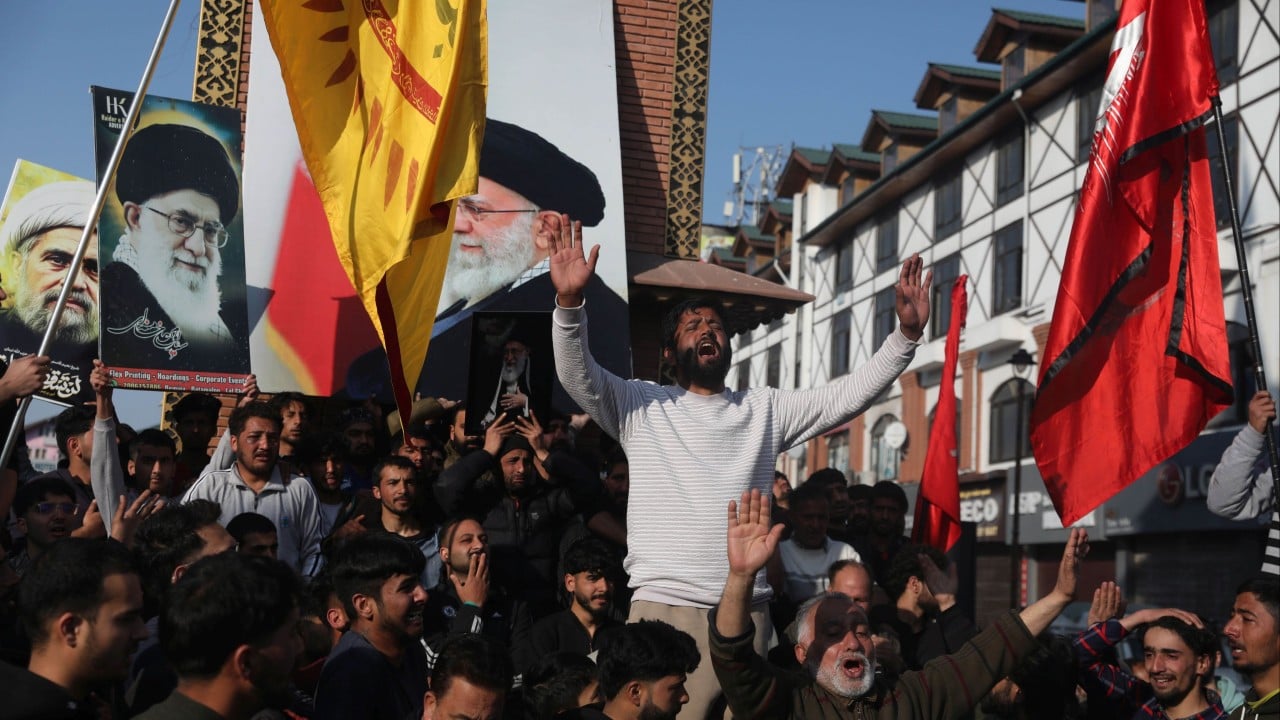
The reaction to Khamenei’s death highlights a fractured society. In some quarters of Tehran and Mashhad, there are reports of somber mourning and 40 days of official grief. In others, particularly among the youth who survived the 2025 protests where 30,000 people were reportedly killed, there is a guarded, terrifying hope.
This is the central tension. The state is more efficient at repression than ever, utilizing Chinese-style digital surveillance and AI-integrated security networks to prevent mass gatherings. The "Axis of Resistance" is also not a house of cards. Groups like Hezbollah and the Houthis operate on decentralized command structures. Their allegiance was to the office and the funding, not just the man.
The Strategic Miscalculation
There is a recurring belief in Western intelligence circles that taking out the top tier of leadership will lead to a popular uprising. History in the region suggests the opposite. Decapitation strikes often force the remaining elements of the deep state to consolidate power even more aggressively.
With the IRGC now effectively acting as a military junta, the window for diplomatic engagement has slammed shut. The interim council, featuring President Masoud Pezeshkian and Chief Justice Mohseni-Ejei, is navigating a war footing, not a reformist opening.
The Economic Weaponization of Grief
The conflict has already spilled into the Strait of Hormuz. By targeting oil tankers and global shipping routes in the wake of the assassination, Iran is reminding the world that its "asymmetric" capabilities do not depend on a Supreme Leader’s signature. They are pre-programmed responses.
The global energy market is reacting with predictable volatility. Shipping insurance rates have tripled overnight. This economic pressure is designed to force the West to the table on Iranian terms, even without Khamenei there to lead the negotiation. The regime is betting that the world’s thirst for oil will outweigh its desire for a democratic Iran.
The Digital Fortress
One overlooked factor in this transition is how the Iranian government has managed its domestic internet. Unlike the 2009 or 2022 protests, the current blackout is surgical. They aren't just turning off the lights; they are controlling the flow of information with extreme precision. This allows the state to project an image of total control while internal power struggles are settled behind the closed doors of the Assembly of Experts.
If you are waiting for a sudden collapse, you are likely looking at the wrong metrics. The survival of the Islamic Republic doesn't depend on the heartbeat of an 86-year-old man. It depends on the institutional survival of the IRGC and its ability to maintain the "Axis of Resistance" as a forward defense.
The strike on February 28 changed the face of the Iranian government, but it did not yet change the soul of its strategy. Whether the next leader is a Larijani or a Khomeini, the machinery of the state is already moving to ensure that the vacuum is filled before the public has a chance to breathe.
Watch the movements of the Assembly of Experts over the next 72 hours. Their speed in naming a successor will tell you exactly how much control the IRGC has over the clerical establishment. If a name emerges quickly, the "military junta" theory is no longer a theory; it is the new reality of the Middle East.
Would you like me to analyze the specific impact of these retaliatory strikes on global oil prices and shipping routes?