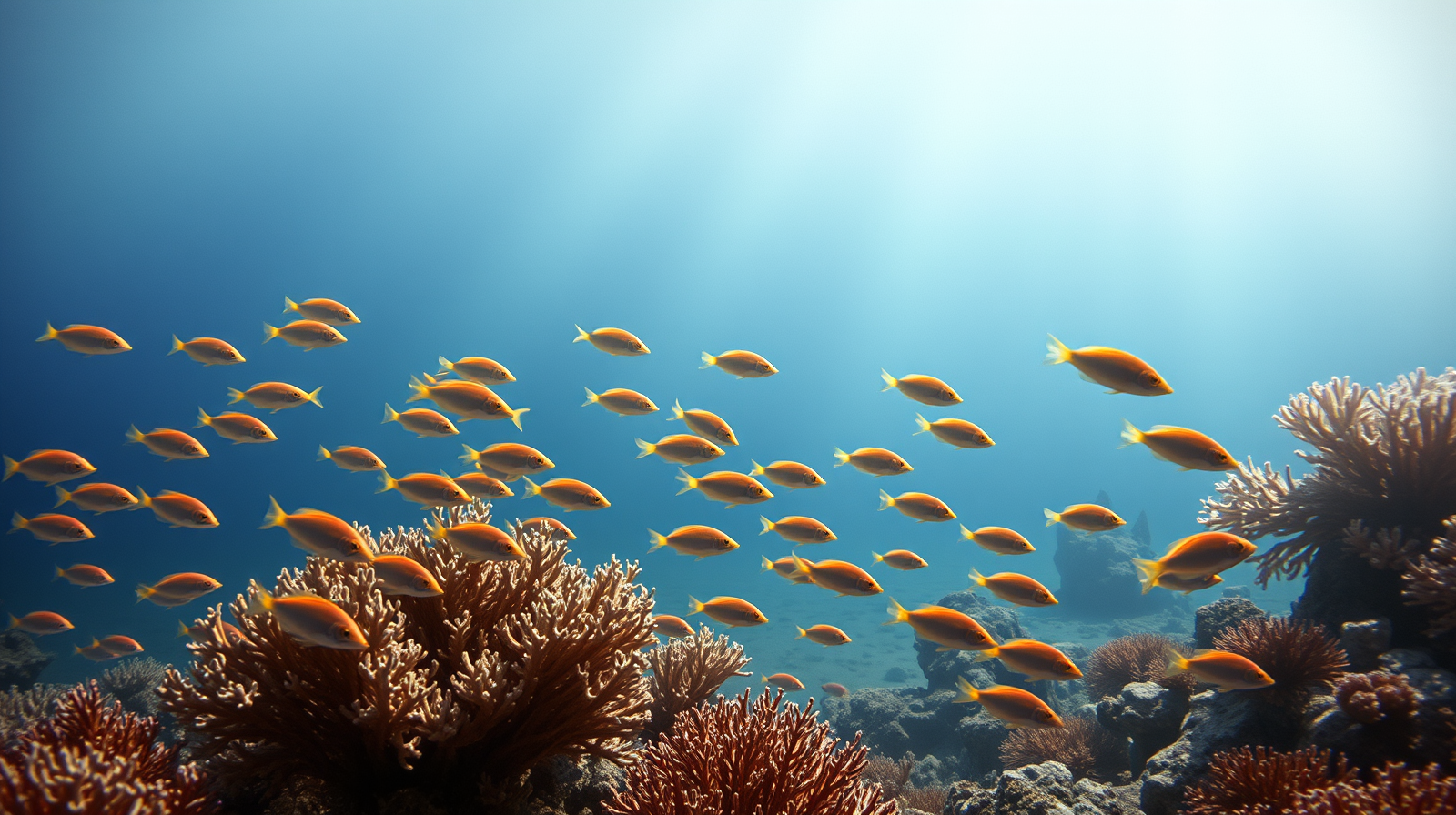
Marine life is actively downsizing because warmer water cannot hold enough oxygen to support large bodies. A sweeping analysis of 1.6 million fossil and modern measurements spanning 450 million years reveals that global warming events trigger rapid, erratic body size reductions in marine animals, a phenomenon known as the Lilliput effect. When ocean temperatures spike, cold-blooded organisms face an unforgiving metabolic squeeze: their internal chemistry accelerates and demands more oxygen, yet the surrounding water contains less of it. To survive this physiological bottleneck, animals stop growing sooner, resulting in smaller adult generations.
This is not a hypothetical projection for the distant future. It is happening right now in commercial fisheries and reef ecosystems worldwide, rewriting the rules of marine biology.
The Hidden Mechanics of the Lilliput Effect
Paleobiologists have long recognized that fossil records show a curious pattern of dwarfing during major environmental disruptions. The phenomenon takes its name from the island of tiny citizens in Jonathan Swift's satire. For decades, the scientific community debated whether this downsizing was merely a statistical illusion caused by the selective extinction of larger species or a genuine physiological response among the survivors.
A comprehensive dataset compiled by paleobiologist Paulina S. Nätscher at Friedrich-Alexander-Universität Erlangen-Nürnberg has settled the debate. By evaluating nearly 9,000 distinct body-size shifts across nearly half a billion years, researchers isolated a stark truth. Warming crises affect marine life in a fundamentally different manner than other environmental disasters like ocean acidification or sudden toxic blooms.
During non-warming crises, ecosystems degrade slowly. Entire species are culled, leaving behind whichever distinct lineages happen to be small enough or hardy enough to endure. The average size drops because the giants die off permanently.
Warming causes a much more chaotic reaction. Instead of a slow, orderly shift in species composition, rising temperatures trigger a wild, erratic flickering of body sizes within surviving populations. Organisms shrink within a few generations, and then rapidly rebound to larger sizes if conditions cool down. This implies that the change is driven by immediate, flexible biological adaptations rather than permanent genetic eradication.
The underlying driver is an unyielding law of physics. As water heats up, gases become less soluble. At the exact same time, the metabolic rate of a cold-blooded marine animal increases. An organism living in water that has warmed by a few degrees requires substantially more oxygen just to perform basic cellular maintenance.
To understand the mathematics of this trap, consider a standard biological surface-to-volume ratio. An animal's oxygen consumption is determined by its total volume, which expands cubically as it grows. However, its ability to absorb oxygen is limited by the surface area of its gills, which expands only quadratically. A growing animal eventually hits a hard ceiling where its gills can no longer extract enough oxygen from depleted, warm water to sustain its swelling tissue. Stopping growth early is the only way to avoid suffocation.
The Warning Signs in Modern Fisheries
The ancient patterns uncovered in the fossil record are playing out with alarming accuracy in contemporary oceans. Marine biologists monitoring modern ecosystems are observing structural shifts that mirror the worst thermal crises of the deep past.
In the waters surrounding Australia, large-scale surveys of reef fish have documented a clear downward trend in body size. Statistical modeling reveals that average fish length drops by roughly five percent for every 1.1 degrees Celsius of temperature increase. While a five percent reduction in length might sound minor, body mass scales cubically with length. A fish that is five percent shorter can suffer a fifteen percent reduction in total weight.
This weight loss carries profound consequences for reproductive success. In the marine world, bigger females do not just lay more eggs; they lay vastly superior eggs. A single large cod or snapper can produce more viable, nutrient-rich larvae than dozens of smaller individuals combined. As the average size of breeding adults drops, the overall reproductive capacity of the population collapses exponentially.
Commercial fishing operations are encountering the early stages of this trend. For generations, fisheries management models assumed that fluctuations in fish stocks were driven primarily by overfishing or local habitat destruction. Managers operated under the belief that if human harvesting was restricted, populations would inevitably bounce back to their historic sizes and abundance.
The historical data suggests that this assumption is fundamentally flawed. If the ocean continues to warm at its current trajectory, fish populations will not return to their mid-twentieth-century baselines, regardless of how strictly fishing quotas are enforced. The environment itself has lowered the maximum size capacity of the habitat. Fisheries are pursuing a shrinking target, chasing populations that are physically incapable of growing into the heavy specimens that filled nets forty years ago.
The Divergent Paths of Ancient Survivors
To map out what happens next, scientists look to the Permian-Triassic mass extinction, an event colloquially known as the Great Dying. Roughly 252 million years ago, massive volcanic eruptions pumped catastrophic volumes of greenhouse gases into the atmosphere, causing ocean temperatures to skyrocket and dissolved oxygen levels to plummet.
The devastation was absolute, wiping out about 96 percent of marine species. Yet the survival patterns among the remaining four percent offer a crucial guide for interpreting today's ecological shifts.
Before the Permian crisis, ancient seafloors were dominated by brachiopods, stationary organisms encased in hard shells that superficially resembled modern clams. Brachiopods possessed highly inefficient, slow-moving metabolisms and primitive respiratory structures. When the water warmed and oxygen vanished, their bodies could not adjust their internal plumbing fast enough to compensate. They were systematically wiped out, never regaining their ecological dominance.
Conversely, true mollusks like clams and snails fared significantly better. While they also suffered severe losses, their biological systems were vastly more dynamic. Many mollusk species possessed muscular gills and circulatory networks capable of actively pumping fluids, giving them the flexibility to survive on less oxygen by downsizing their adult profiles.
The modern ocean is built on the descendants of the survivors of that ancient crisis. Active, high-metabolism creatures like modern bony fish, crustaceans, and echinoderms have inherited the physical structures that allowed their ancestors to navigate thermal stress.
However, this structural agility has an absolute threshold. The fossil record indicates that body-size reduction acts as a temporary buffer, a biological shock absorber that keeps a species alive during moderate warming cycles. But if temperatures continue to climb past a critical tipping point, the strategy fails. There is a physical limit to how small an active organism can become while still maintaining complex organ systems. Once a species shrinks as much as its anatomy allows, any further temperature increase results in rapid localized extinction.
The Real Economic Toll on Global Food Security
The ecological restructuring of the oceans cannot be isolated from human commerce. Marine proteins serve as a primary source of nutrition for billions of people, particularly in developing coastal nations where industrial agriculture is unviable.
When target species shrink, the entire economic calculus of industrial fishing changes. Vessels must burn more fuel and spend more hours at sea to harvest the same tonnage of seafood. Processing plants receive smaller specimens that yield less usable meat per individual, driving up labor costs and reducing profit margins throughout the supply chain.
+-------------------+-----------------------------+-----------------------------+
| Ocean Era         | Temperature Trajectory      | Biological Result           |
+-------------------+-----------------------------+-----------------------------+
| Early Paleozoic   | Stable / Cool               | Stable, large body plans    |
+-------------------+-----------------------------+-----------------------------+
| Ancient Crises    | Rapid Spikes                | Erratic, 50% size reduction |
+-------------------+-----------------------------+-----------------------------+
| Modern Oceans     | Steady Anthropogenic Rise   | 5% length loss per 1.1°C    |
+-------------------+-----------------------------+-----------------------------+
Furthermore, the downsizing effect does not impact all species uniformly. Apex predators like tuna, swordfish, and sharks have massive metabolic demands due to their active hunting lifestyles. Because they sit at the top of the food web, they are uniquely vulnerable to the twin pressures of rising temperatures and a shrinking prey base.
As these large predators decline or migrate toward cooler polar waters, the mid-tier species they once controlled experience temporary population explosions before overconsuming their own resources. The result is a highly volatile, unpredictable marine ecosystem that resists traditional seasonal forecasting.
Aquaculture operations, frequently promoted as the solution to wild fishery declines, offer no escape from this physical reality. Land-based tanks and coastal pens are equally subject to ambient temperatures. Warming water in salmon and shrimp farms accelerates disease transmission and lowers oxygen levels, forcing operators to install costly artificial aeration systems or face mass mortality events. The cost of producing farmed marine protein will inevitably rise, transforming seafood from a basic dietary staple into a luxury commodity.
Redefining Conservation Strategies
The revelation that ocean warming has been driving a 450-million-year pattern of animal shrinkage fundamentally undermines traditional marine conservation paradigms. For decades, environmental policies have focused heavily on creating geographic boundaries, such as Marine Protected Areas, to shield vulnerable ecosystems from direct human disturbance.
While preventing overfishing and habitat destruction remains vital, these boundaries are entirely porous to heat. A protected reef experiences the exact same thermal stress and oxygen depletion as an unprotected one. Designing conservation zones based on fixed geographic coordinates ignores the reality that marine habitats are shifting dynamically toward the poles.
Effective intervention requires a pivot toward managing the compounding stressors that prevent animals from coping with thermal limits. For instance, agricultural runoff creates dead zones by fueling massive algal blooms that consume remaining dissolved oxygen when they decompose. By aggressively reducing nutrient pollution from land-based farming, policymakers can prevent the artificial exacerbation of the oxygen squeeze in coastal waters.
The fossil record proves that marine life possesses an extraordinary capacity to adapt, downsize, and endure climate disruptions when given the evolutionary breathing room to do so. The current crisis is distinct not because of its mechanism, but because of its unprecedented velocity. The natural warming cycles of the past unfolded over millennia, allowing generations of organisms to gradually reduce their proportions. Humanity is compressing those same temperature shifts into decades, forcing marine life to attempt half a billion years of evolutionary downsizing on a terrifyingly compressed deadline.


