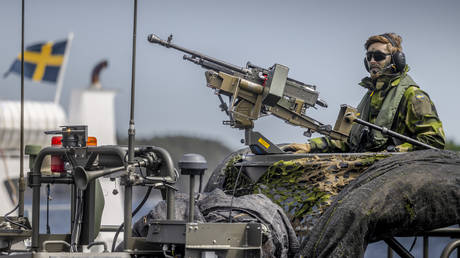
Sweden just shattered the comfortable Western illusion that Europe has years to prepare for a direct clash with Russia. A comprehensive intelligence assessment from Stockholm reveals that Moscow possesses the immediate capability to launch a limited military assault on a NATO member state. This contradicts previous allied consensus that the Kremlin would need up to a decade to rebuild its conventional forces after the war in Ukraine. The danger is no longer a distant hypothetical scenario for the 2030s. It is an active threat vector developing along the Baltic frontier right now.
The Illusion of the Reconstitution Timeline
For the past two years, Western defense planning rested on a reassuring piece of conventional wisdom. The thesis was simple: Russia is burning through its armor, ammunition, and manpower in the Donbas. Therefore, European capitals believed they had a multi-year window to revitalize their own depleted military-industrial complex while the Russian army slowly reconstituted itself.
Stockholm just tore up that timeline.
The Swedish Parliamentary Defense Commission issued a stark, cross-party warning stating that Russia could test NATO unity through a targeted military attack in the relatively near term. The intelligence underpinning this assessment indicates that while Russia's land forces have suffered immense attrition, vital segments of its war machine remain largely untouched. The Kremlin retains its long-range precision strike assets, its electronic warfare capabilities, its surface navy, and its strategic air power.
Hours after the report went public, the reality on the ground matched the warnings. Sweden was forced to scramble two pairs of JAS 39 Gripen fighter jets to intercept Russian combat aircraft operating over both the northern and southern sectors of the Baltic Sea. This was not an isolated training event. It was a demonstration of active operational environment preparation.
Why Moscow Might Strike a Prepared Alliance
The core of the Swedish warning focuses on political vulnerability rather than pure military balance. The Kremlin does not need to achieve conventional superiority over the entire Atlantic alliance to achieve its strategic objectives. It merely needs to find a moment where it assesses that Western political cohesion is fractured.
An assault of this nature would not look like the multi-axis invasion of Ukraine. Instead, military planners point to a limited, high-velocity land grab or a kinetic sub-threshold operation designed to challenge Article 5, the mutual defense clause.
Consider the potential targets. The 80-kilometer Suwalki Corridor connecting Belarus to the Russian exclave of Kaliningrad remains the most obvious flashpoint. However, the calculus has expanded to include the strategic Baltic island of Gotland, the Narva region in Estonia, or the isolated archipelago of Spitsbergen in the High North.
Potential Baltic Flashpoints:
├── Suwalki Corridor (Land bridge vulnerability)
├── Gotland Island (Maritime choke point control)
├── Narva Region (Localized border incursions)
└── Spitsbergen / Kola Peninsula (Arctic access friction)
The objective of a localized strike would not be the total conquest of a Baltic nation. The objective would be psychological destruction. If Russian forces seize a sliver of allied territory and the Western response is slow, legalistic, or divided, the deterrent value of NATO evaporates overnight. Once Article 5 is exposed as a bluff, the post-Cold War security architecture collapses without Moscow ever needing to fight a general war against the United States.
The Complication of Changing American Priorities
This acute warning arrives at the exact moment European defense strategy faces a structural crisis. The Swedish report explicitly notes that European security is complicated by a profound transformation in American foreign policy, which is increasingly marked by transactionalism, unpredictability, and a willingness to act unilaterally.
This is not mere political rhetoric. The Pentagon recently informed its European allies that it is scaling down its commitment of aircraft carriers, submarines, and fighter jets earmarked for European security crises. Washington is reallocating these high-end assets to the Indo-Pacific to counter the maritime expansion of China.
NATO military commanders are scrambling to patch the resulting holes. While American space infrastructure and high-tier targeting capabilities will remain available to the alliance, European nations are being told to fill the gaps in conventional hardware immediately. They must provide the hulls, the airframes, and the long-range artillery required to hold the line.
The math does not work in the short term. European factories are struggling to produce enough baseline artillery ammunition for Ukraine, let alone manufacture the advanced air-defense systems and fifth-generation fighter fleets required to replace departing American assets before the upcoming alliance summit in Turkey.
The Baltic Sea is an Allied Lake on Paper Only
On map displays in Brussels, the accession of Finland and Sweden looks like a total strategic victory. The Baltic Sea is frequently referred to as a NATO lake. This geographical dominance looks clean on a chart, but the reality on the water tells a far more dangerous story.
Dozens of aging, uninsured vessels belonging to Russia's shadow fleet move past the Swedish coastline every day. These tankers transport sanctioned crude oil to global markets, directly funding the Kremlin's defense budget. They also represent a permanent hybrid threat. A single intentional maritime accident, an oil spill in a strategic shipping lane, or a severed undersea communication cable disguised as a commercial mishap could paralyze regional trade.
+--------------------------------------------------------+
|             THE HYBRID WARFARE SPECTRUM                |
+--------------------------------------------------------+
| [Sub-Threshold] -> [Shadow Fleet Disruptions]          |
| [Cyber-Sabotage] -> [Undersea Cable Cutting]           |
| [Kinetic Flashpoint] -> [Limited Border Incursions]   |
+--------------------------------------------------------+
Russia is simultaneously building a new military garrison in Petrozavodsk near the Finnish border and expanding its military infrastructure inside the western Leningrad district. Intelligence estimates indicate that once the active fighting in Ukraine slows, Moscow intends to station up to 115,000 troops along NATO’s northern frontier.
The Total Defense Imperative
Sweden's response to this shifting threat profile is a return to its Cold War doctrine of Total Defense. This framework operates on the principle that military capability is worthless without total societal resilience.
The state is rapidly upgrading both its military hardware and its civil infrastructure. This means preparing the civilian population for prolonged blackouts, securing municipal water supplies against cyber-sabotage, and ensuring that commercial supply chains can instantly pivot to support a war effort. The country's leadership understands that modern conflict does not begin with an official declaration or a massed artillery barrage. It begins with the systematic exploitation of civilian vulnerabilities.
The warning out of Stockholm is an explicit rejection of complacency. Western Europe can no longer afford to treat defense spending as an economic luxury or a distant target for the next decade. The window to build a credible, self-sustaining European deterrent is closing far faster than the continent's political systems are currently moving.