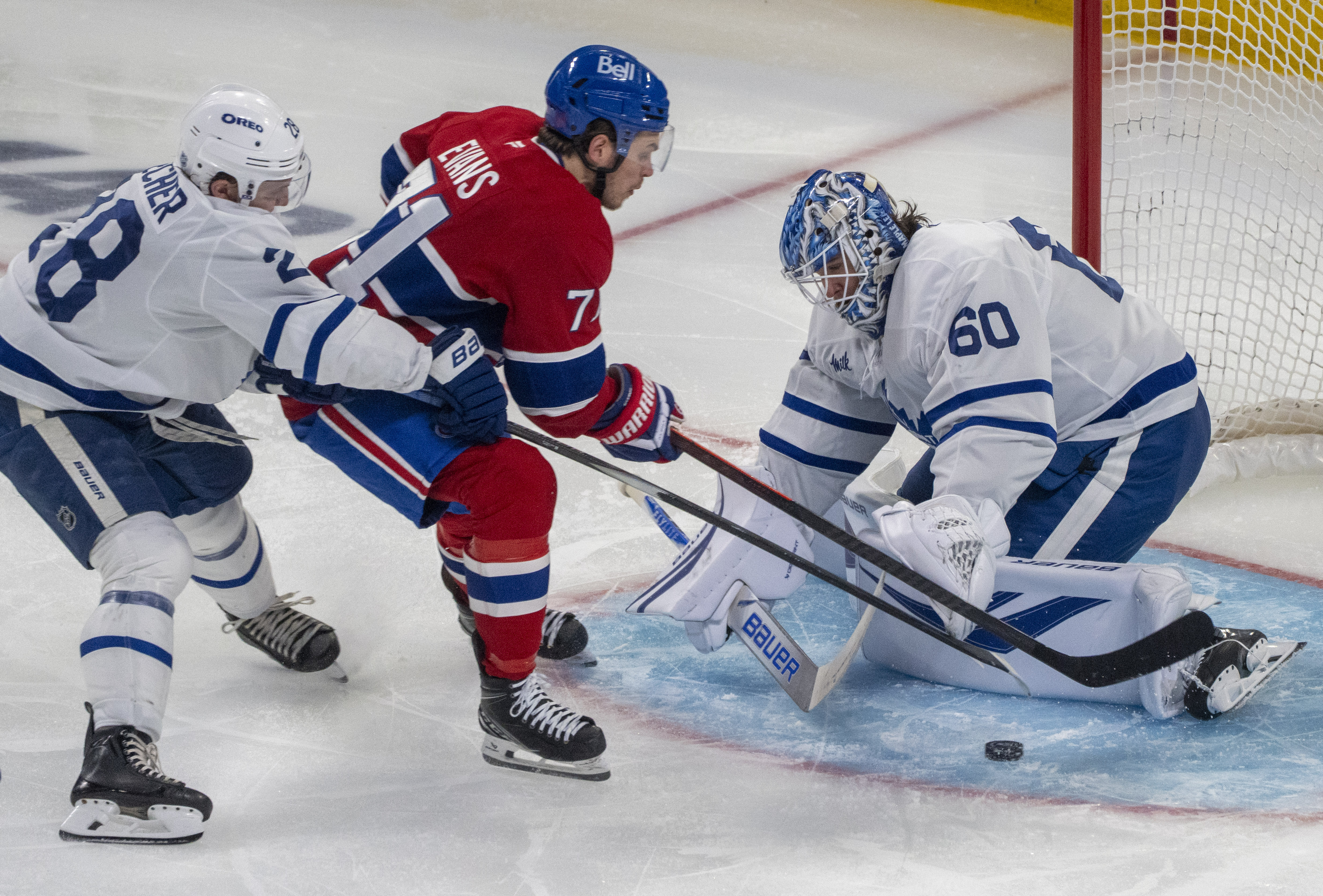
The air inside the Bell Centre doesn't just sit; it vibrates. It’s a heavy, oxygen-thin soup of inherited anxiety and tribal desperation. When the Toronto Maple Leafs cross the border into Quebec to face the Montreal Canadiens, the game is never just about two points in the standings. It is a collision of ghosts. It is an argument between two cities that has been raging since before the invention of the overhead projector.
On this particular Saturday night, the atmosphere felt different. Brittle. The Maple Leafs arrived with the swagger of a team that finally believed its own press clippings, while the Canadiens took the ice as a collection of young men trying to figure out if they belonged in the frame of such a massive portrait. Recently making headlines in related news: The Mohamed Salah Decision Matrix Liverpools Financial and Sporting Equilibrium.
Then the puck dropped. The noise became a physical weight.
The Anatomy of a Siege
For the first twenty minutes, it wasn't a hockey game. It was a survival exercise. Toronto moved the puck with a terrifying, rhythmic precision, their passes snapping like whipcracks across the frozen surface. They hemmed Montreal into their own zone, turning the Canadiens' defensive end into a shooting gallery. Additional insights on this are detailed by Yahoo Sports.
Consider the plight of a young defenseman in this moment. You aren't thinking about the score. You are thinking about the gap between your skates and the most dangerous goal-scorer in the league. You are breathing in the scent of melted ice and smelling your own adrenaline. Every time the Leafs cycled the puck, the tension in the building ratcheted up a notch.
But the scoreboard remained stubbornly blank.
This is where the narrative of "superiority" begins to fray. In sports, as in life, there is a specific kind of exhaustion that sets in when you do everything right and nothing happens. Toronto fired shot after shot. They hit posts. They forced spectacular, desperate saves. They dominated the geometry of the rink. Yet, as the period wound down, the "better" team was heading to the locker room with nothing to show for their brilliance but tired legs.
The Momentum of the Unlikely
The second period shifted the tectonic plates of the game. It started with a whisper and ended with a roar.
Montreal has a way of finding goals that feel like accidents but are actually the result of pure, unadulterated grit. It’s the "Wilde" element—named not just for the chaos of the game, but for the unpredictable nature of a rebuilding roster. When the Canadiens finally broke the deadlock to make it 1-0, the sound in the arena wasn't just a cheer. It was an exhale.
The goal wasn't a masterpiece of tactical execution. It was a scramble. A puck squirted loose, a stick found a gap, and suddenly the invincible juggernaut from Ontario looked human.
The psychology of a 1-0 lead in a rivalry game is a fragile thing. For the Leafs, it was an insult. They responded by redoubling their efforts, eventually clawing back a goal to tie it. For a few minutes, the universe seemed to have corrected itself. The giants had woken up. The natural order was restored.
But Montreal didn't flinch.
There is a specific kind of power in having nothing to lose. While Toronto played with the heavy burden of "should," Montreal played with the frantic energy of "could." They regained the lead on a play that defied the analytical spreadsheets. It was a transition goal that relied more on instinct than instruction. 2-1.
The Wall of Red
As the third period began, the story shifted from an offensive battle to a psychological thriller. The hero of the night wasn't a goal-scorer. It was the man standing between the pipes, draped in red, white, and blue.
To watch a goaltender "in the zone" is to watch a man standing in a different dimension of time. To the fans, the puck is a blur. To the goalie, it is a slow-moving sphere of black rubber that he can see rotating in mid-air. He isn't reacting to the shot; he is anticipating the intention of the shooter.
Toronto threw the kitchen sink at the Montreal net. They pulled their goalie late in the game, creating a six-on-five advantage that felt like a permanent power play. The puck lived in the Montreal crease. It danced on the goal line. It struck pads, masks, and crossbars.
The Canadiens’ defenders weren't just playing hockey anymore. They were shot-blocking machines, throwing their bodies in front of hundred-mile-an-hour projectiles with a disregard for their own safety that bordered on the religious. It was a masterpiece of collective suffering.
The Empty Net and the Final Truth
With seconds remaining, the puck cleared the zone. A lone Montreal forward chased it down, sliding it into the yawning, empty Toronto net to seal the 3-1 victory.
The final score tells you Montreal won. The statistics tell you Toronto outshot them, out-chanced them, and controlled the puck for twice as long. If you only looked at the data, you would call this a fluke. An anomaly. A glitch in the matrix.
But data doesn't account for the soul of the Bell Centre. It doesn't measure the way a young team grows two inches taller when they realize they can withstand the best the world has to offer and come out on the other side.
Toronto left the ice looking like men who had tried to solve a riddle that had no answer. Montreal left like survivors of a storm they had somehow learned to steer.
In the cold Montreal night outside the arena, the fans spilled onto the streets, their breath visible in the freezing air. They weren't talking about expected goals or puck possession metrics. They were talking about the hit in the corner, the save in the second, and the way it feels to beat the "best" team in the league when nobody expected you to survive the first ten minutes.
The game is over, the ice is being resurfaced, and the ghosts have retreated into the rafters to wait for the next time these two sweaters meet. Toronto still has the stars, the stats, and the expectations. But for one Saturday night in Quebec, Montreal had the only thing that actually matters when the lights go down.
They had the lead when the clock hit zero.