The air in Budapest during the early spring carries a specific weight. It is thick with the scent of roasted coffee from the grand cafés and the metallic tang of the Danube, a river that has watched empires rise, crumble, and reinvent themselves for a thousand years. On the surface, the city is a postcard of Mitteleuropa charm. But if you sit long enough in a wooden booth at a local pub, away from the neon lights of the ruin bars, you hear a different frequency. You hear the pulse of a nation that believes it has found a blueprint for the future by looking firmly at the past.
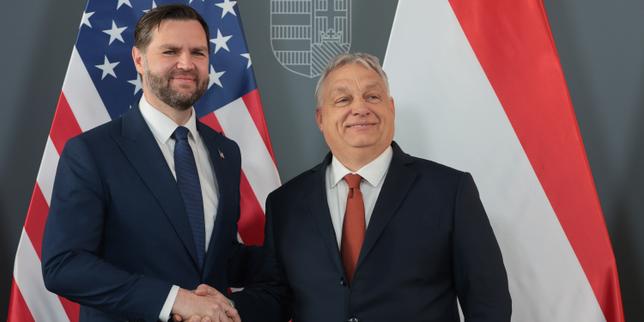
It was into this atmosphere that J.D. Vance stepped.
He didn't come as a mere tourist or a diplomat going through the motions of a dry bilateral meeting. He arrived as a scout. For the American Senator and vice-presidential hopeful, Hungary isn't just a small landlocked nation in Central Europe; it is a laboratory. It is a place where the theoretical arguments of the American right-wing are being tested in the real world, with real laws and real consequences.
The Mirror Across the Atlantic
To understand why a politician from Ohio finds himself so at home in the shadow of the Hungarian Parliament, you have to look past the policy papers. You have to look at the grocery store.
Think of a hypothetical father in a suburb of Cincinnati. Let’s call him Mark. Mark feels the world he grew up in—a world of stable manufacturing jobs, predictable social norms, and a sense of national cohesion—is evaporating. He sees the institutions he once trusted becoming alien to him. When Mark looks at the news, he feels lectured rather than represented.
Now, cross the ocean. Consider Gábor, a father in a small town outside Budapest. Gábor shares that same haunting feeling of displacement. He worries about his children’s future in a globalized economy that seems to favor the nomad over the rooted. He feels the pressure of a shifting cultural landscape that he didn't vote for and doesn't understand.
This shared anxiety is the bridge.
When Vance praises Viktor Orbán, he isn't just talking about a foreign leader. He is talking to Mark. He is telling Mark that there is a way to use the power of the state to protect a specific way of life. In Vance's eyes, Hungary has stopped playing defense. While conservative politicians in the West often complain about cultural shifts, Orbán’s government has actively moved the pieces on the board.
The Architecture of Belonging
The "Hungarian Model" that Vance champions isn't built on traditional small-government philosophy. In fact, it’s the opposite. It is the use of robust state intervention to favor the family unit.
Consider the logistics of a home. In Hungary, the government offers substantial financial incentives—loans that are forgiven if a couple has three or more children. It is a direct, unapologetic attempt to engineer a baby boom and preserve the national identity through demographics rather than immigration.
Vance sees this as a masterstroke. He looks at the dwindling birth rates in the United States and the social isolation of the "lonely crowd" and sees a solution in the Hungarian treasury. It’s a radical departure from the Reagan-era "the government is the problem" mantra. Here, the government is the architect. It is the shield.
But this architecture has shadows.
Critics argue that this protection comes at a steep price: the erosion of independent institutions. To build this unified national vision, the Hungarian government has tightened its grip on the media, the courts, and academia. For many in the European Union, this isn't a blueprint; it’s a warning sign of a "managed democracy" where the playing field is permanently tilted.
The tension is palpable. You feel it in the way young professionals in Budapest talk about their future—some grateful for the stability, others feeling the walls of their country slowly closing in.
The Strategy of the Outsider
Vance’s visit wasn't just about policy; it was about positioning. By aligning himself with Orbán, he is signaling a break from the old guard of the Republican party. He is embracing a "National Conservatism" that prioritizes the border, the family, and the nation-state over the borderless flow of capital and labor.
It is a high-stakes gamble.
By leaning into the Hungarian example, Vance is leaning into the controversy. He is daring his critics to call him an illiberal. In the current American political climate, being called "dangerous" by the establishment is often a badge of honor for a certain segment of the electorate. It proves you are doing something different.
There is a certain irony in an American politician seeking inspiration from a country whose language is so notoriously difficult and whose history is so uniquely tragic. Hungary is a nation that has been occupied by Mongols, Ottomans, Nazis, and Soviets. That history has baked a survivalist instinct into the national DNA. They are hyper-aware of their own fragility.
Vance is tapping into that same sense of American fragility—the feeling that the "American Dream" is no longer an inevitability, but a flickering candle that needs a heavy hand to keep it from blowing out.
The Invisible Stakes
Why does this matter to someone who will never visit the Danube?
Because the conversation Vance is having in Budapest is the same conversation happening in town halls across the United States. It’s about the soul of the state. Is the government a neutral referee in a vast market, or is it a parent with a preference?
If Vance and his allies successfully transplant the Hungarian model, it would mean a fundamental shift in how Americans interact with their government. We are talking about a move toward "industrial policy," where the state picks winners in the economy to ensure national self-sufficiency. We are talking about a move toward "cultural policy," where the tax code is used to reward certain lifestyles and penalize others.
It’s a vision of a world that is more secure, perhaps, but also more controlled.
As the sun sets over the Buda Hills, the Parliament building glows a bright, honeyed gold against the darkening sky. It is a magnificent sight, designed to project power and permanence. It looks like it has always been there and always will be.
Vance left Budapest with more than just notes. He left with a narrative. He sees a world where the "forgotten man" is no longer forgotten because the state has decided to remember him—at any cost.
The question that remains, echoing off the ancient stone walls, is whether a model built for a small, homogeneous nation of ten million can survive the turbulent, sprawling complexity of three hundred and thirty million Americans. Or if, in the attempt to build a shield, you accidentally build a cage.
The red ties and the sharp suits of the politicians will eventually fade from the headlines. But the ideas they traded in those gilded rooms are now in the wind. They are crossing the Atlantic, tucked into the luggage of a Senator who believes he has seen the future, and that it looks like a city that refused to change.
In the quiet hours of the Budapest night, the Danube continues its indifferent crawl toward the sea, carrying the weight of everyone’s expectations, and the silent, heavy reality of what it takes to actually hold onto a world that is trying to slip through your fingers.