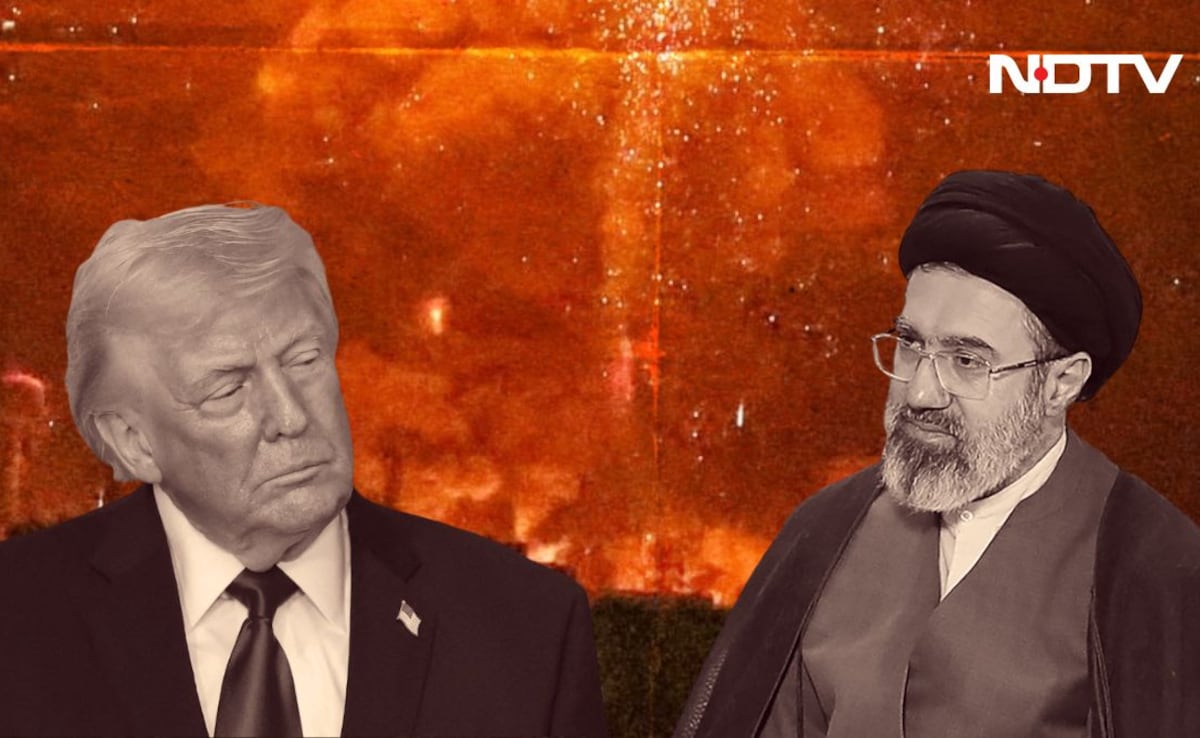
The headlines are screaming about "very serious" revenge. They paint a picture of Mojtaba Khamenei as a fire-breathing radical ready to torch the regional status quo to avenge a slight. This is a fundamental misunderstanding of how the deep state in Tehran actually functions. Most Western analysts are treating a complex succession chess match like it’s a Michael Bay movie.
Stop looking at the rhetoric. Look at the balance sheet of power.
The lazy consensus suggests that Mojtaba’s rejection of a ceasefire is a sign of impending regional war. In reality, it is a sophisticated internal branding exercise. When a leader in his position talks about "revenge" against the U.S. and Israel, he isn't speaking to the Pentagon or the Knesset. He is speaking to the IRGC’s mid-level commanders—the men who will decide if he actually inherits his father’s throne.
The Succession Trap
The Western media loves a "madman" narrative. It’s easy to sell. It fits into a neat box of Middle Eastern tropes. But Mojtaba Khamenei is a bureaucrat of the highest order. He has spent decades mastering the internal machinery of the Office of the Supreme Leader. Men who survive that long in the shadows do not blow their inheritance on a tactical whim.
The "revenge" narrative serves three distinct internal purposes that have nothing to do with actual military engagement:
- Vetting the Loyalist Core: By taking a hardline stance, Mojtaba forces every other potential successor to either follow his lead or look weak. He is setting the ideological "floor."
- Leverage for the Next Nuclear Round: The threat of an unpredictable heir is a classic negotiating tactic. If the West thinks the next guy is "serious about revenge," they are more likely to offer concessions to the current guy to keep the lid on.
- IRGC Buy-in: The Islamic Revolutionary Guard Corps is not a monolith. It’s a conglomerate with guns. To lead them, you must prove you are the ultimate guarantor of their ideological and financial interests. You don't do that by talking about de-escalation.
Why the "Ceasefire Push" is a Red Herring
The competitor reports make it seem like Mojtaba is the sole obstacle to peace. This is a massive oversimplification of Iranian foreign policy. No single individual—not even the Supreme Leader's son—unilaterally dictates the geopolitical trajectory of the Islamic Republic without a consensus from the Supreme National Security Council.
The "ceasefire" being discussed isn't a peace treaty; it’s a pause. In the IRGC’s playbook, a pause is only useful if it allows for re-arming. If Mojtaba is "rejecting" it, he is likely signaling that the current terms don't offer enough of a strategic advantage to the "Axis of Resistance."
I’ve watched analysts miss this point for twenty years. They see a "No" and think "War." In Tehran, a "No" is usually just a request for a better price.
The Math of Asymmetric Deterrence
Let’s look at the actual physics of a "revenge" strike. If Iran truly wanted a direct, high-kinetic confrontation with the U.S., they would have stayed on the trajectory of the April 2024 drone and missile barrage. Instead, they’ve reverted to the "shadow war" of attrition.
Why? Because the cost-benefit analysis doesn't support a total war.
Imagine a scenario where Tehran launches a decapitation strike against a major Western asset. The immediate result isn't "revenge"—it's the systematic dismantling of the Iranian energy infrastructure. Mojtaba knows this. The IRGC generals know this. Their primary goal is the survival of the clerical system.
The formula is simple:
$$D = \frac{R \times C}{V}$$
Where $D$ (Deterrence) is equal to $R$ (Rhetoric) multiplied by $C$ (Capability), divided by $V$ (Vulnerability).
Right now, Iran’s vulnerability to internal economic collapse is high. Therefore, they must inflate the $R$ (Rhetoric) to maintain the illusion of $D$ (Deterrence). Mojtaba is just the loudest voice in that inflation cycle.
The Professionalism of Performance
The "very serious" label is a masterpiece of psychological operations. If you tell the world you are "very serious," the world spends its time trying to talk you down. It puts you in the driver's seat of the news cycle.
The mistake most observers make is ignoring the Deep State inertia. The Iranian regime is a massive, slow-moving bureaucracy. It doesn't do "emotional revenge." It does calculated, multi-generational geopolitical maneuvering.
If Mojtaba were actually planning a catastrophic escalation, he wouldn't be leaking his intentions to "reports" that find their way into Western news aggregators. Real Iranian operations—like the 1994 AMIA bombing or the complex logistics of the Houthi blockade—happen in the dark, with zero prior chest-thumping.
When they shout, they aren't hitting. When they hit, they are silent.
What the "People Also Ask" Sections Get Wrong
People are asking: "Is Mojtaba Khamenei more radical than his father?"
The answer is: He's more exposed.
Ali Khamenei had the revolutionary credentials of 1979. He didn't need to prove he was a "hardliner." Mojtaba is a "nepo-baby" in a system that prides itself on struggle. He has to overcompensate. His "radicalism" is a costume.
Another common query: "Will this lead to World War III?"
No. It leads to a more expensive oil market and higher insurance premiums in the Red Sea. The "Great Power" conflict is too expensive for all parties involved. This is about regional hegemony and the survival of a dynasty, not an apocalyptic endgame.
The Real Danger (And It Isn't the One You Think)
The real danger isn't that Mojtaba is a "madman." The danger is miscalculation.
If the U.S. and Israel take his "revenge" rhetoric at face value and launch a preemptive strike, they validate his narrative. They give him the very "struggle" credentials he lacks. They essentially crown him.
The smart play isn't to fear the rhetoric. It's to ignore the noise and watch the money. Is the IRGC moving assets? Are the proxy banks in Dubai and Istanbul seeing massive outflows? That’s where the truth lives.
Right now, the money is staying put. The assets are in a defensive crouch. The only thing that is "exploding" is the word count of pundits who don't understand that in Persian politics, the loudest man in the room is usually the one with the least to lose by talking.
Stop Falling for the Script
The competitor's piece wants you to feel a sense of dread. It wants you to think we are on the precipice of a global shift because one man used the word "revenge."
I’ve seen this movie before. In 2020, after Soleimani. In 2024, after the Damascus consulate strike. Every time, the "experts" predict the end of the world. Every time, the regime chooses survival over pride.
Mojtaba Khamenei is a pragmatist wrapped in a radical’s cloak. He is using the U.S. and Israel as props in his own coronation ceremony. He isn't rejecting a ceasefire because he wants a war; he’s rejecting it because he hasn't finished using the "threat of war" to consolidate his power at home.
The "revenge" isn't coming for Washington. It's directed at his rivals in the halls of Tehran.
Don't mistake a campaign speech for a declaration of war.