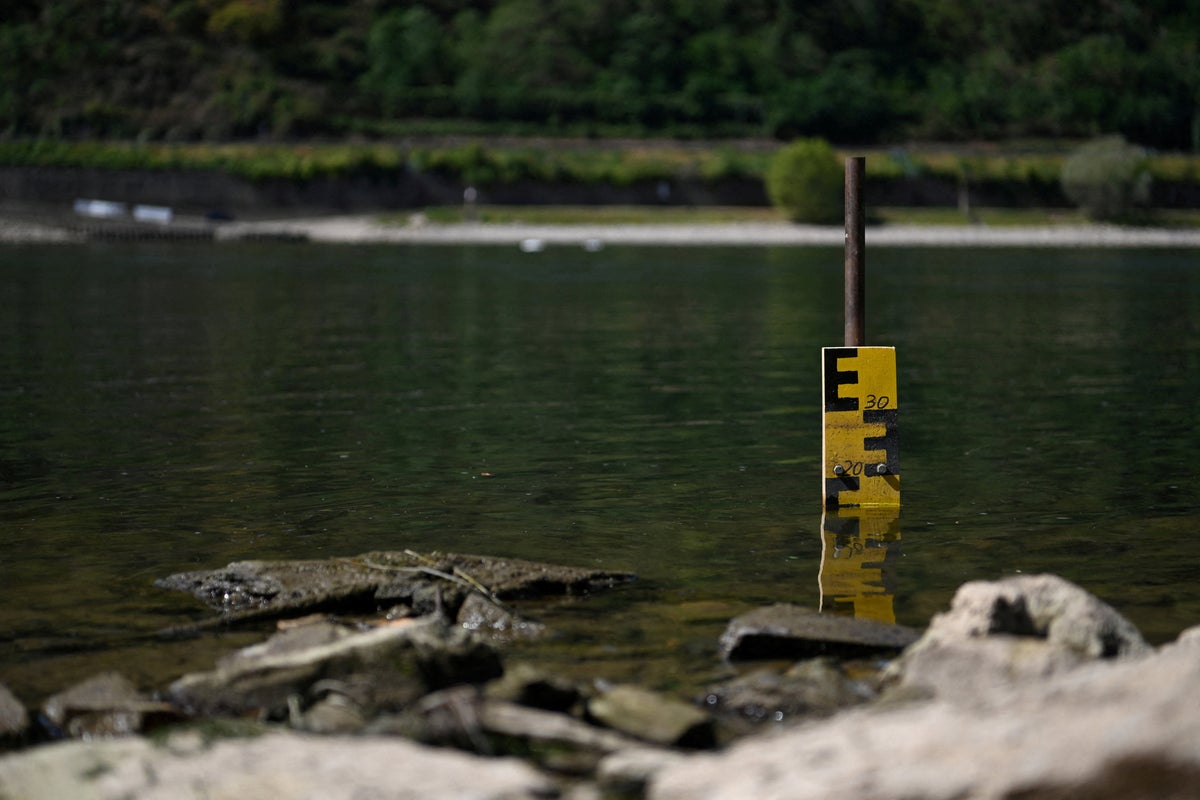
Inland water transportation relies on a fragile margin of hydrological stability. When precipitation temporarily alleviates a drought in the Rhine catchment basin, the immediate journalistic response typically frames the event as a binary recovery: water levels rise, shipping resumes, supply chains heal. This perspective misdiagnoses the systemic mechanics of European fluvial logistics. A brief upward tick in gauge readings at key bottlenecks like Kaub does not restore operational equilibrium. Instead, it masks a compounding structural vulnerability where intermittent rainfall provides only a superficial buffer against chronic low-water regimes.
The Hydrographic Mechanics of the Rhine Basin
The Rhine functions as a high-capacity industrial conveyor belt connecting the ARA ports of Amsterdam, Rotterdam, and Antwerp to Germany's industrial core. Its navigability is governed by a complex function of alpine snowmelt, glacial runoff, and distributed rainfall across distinct sub-catchments including the Neckar, Main, and Moselle rivers.
When sustained dry periods depress the water table, the riverbed morphology dictates severe operational constraints. The Middle Rhine, particularly the bottleneck around Kaub, features shallow rocky ledges that restrict vessel draft long before upper or lower sections experience critical constraints. Precipitation events alter this dynamic unpredictably. A localized storm system over the Black Forest or the Swiss Alps delivers a pulse of water that travels downstream as a distinct hydrological wave.
This wave introduces three distinct operational anomalies for commercial operators:
- The Transit Lag: The time differential between precipitation falling in catchment zones and its arrival at critical navigational bottlenecks introduces forecasting friction.
- The Surge Distortion: Rapidly rising water can create localized velocity spikes, complicating maneuverability and requiring vessels to reduce speed or ballast down differently, offsetting the theoretical capacity gains of deeper water.
- The Receding Tail: Post-rain discharge curves frequently exhibit sharp drop-offs. Without sustained, multi-week precipitation patterns, a temporary crest dissipates rapidly, returning the system to sub-optimal draft conditions within days.
Relying on a single gauge reading to evaluate shipping health is an analytical error. The true operational capacity of the Rhine is a nonlinear function of depth, velocity, vessel deadweight tonnage utilization, and terminal queue times.
The Cost Function of Partial Draft Constraints
Commercial barge operators do not experience low-water events linearly. The relationship between water depth and freight capacity is governed by an exponential cost function. When the water level at Kaub drops below specific thresholds, standard push-towing units cannot load to maximum displacement.
A vessel experiencing a draft restriction of thirty percent does not merely lose thirty percent of its cargo capacity; its operating economics deteriorate across multiple interdependent variables:
- Unit Economics Inflation: Fixed operational expenditures—vessel depreciation, crew wages, insurance, and base fuel consumption—remain largely static regardless of cargo weight. Spreading these fixed costs over a reduced tonnage payload drives the per-ton transport cost sharply upward.
- Fleet Multiplication Requirements: To move an equivalent volume of bulk commodities, chemicals, coal, or finished steel during low-water conditions, operators must deploy a larger number of specialized shallow-draft vessels. Because the total pool of shallow-draft tonnage is finite, capacity constraints trigger severe spot-market rate surges.
- Fuel Efficiency Degradation: Navigating restricted channels requires precise propulsion management. Countering stronger currents or maneuvering through narrowed navigational corridors increases fuel consumption per ton-kilometer transported.
Industrial clients dependent on continuous feedstock delivery—particularly chemical plants in Ludwigshafen and steel mills in the Ruhr valley—absorb these cost premiums or face production curtailments. The economic damage extends far beyond the logistics sector, translating into margin compression for downstream manufacturing and energy generation.
Systemic Adaptation Failures and Modal Shift Limits
The persistence of shipping disruptions despite periodic rainfall highlights a broader failure of modal substitution and infrastructure adaptation. When Rhine transport stumbles, logistics managers look to alternative corridors: rail freight and heavy goods vehicle trucking.
These alternatives face severe structural bottlenecks:
- Rail Network Congestion: The German rail network, managed by DB Netz, suffers from chronic capacity saturation, delayed infrastructure modernization, and a high density of mixed-traffic lines where high-speed passenger trains share tracks with slow freight convoys. Injecting displaced barge volumes into the rail network quickly triggers gridlock.
- HGV Driver Deficits: Shifting bulk chemical or coal volumes from 2,000-ton barges to trucks requires an unfeasible number of commercial vehicle units and drivers. The structural shortage of licensed truck drivers in Central Europe creates an immediate ceiling on road-based mitigation strategies.
- Terminal Handling Capacities: Inland ports and intermodal terminals are engineered for specific modal splits. A sudden, forced migration from water to rail or road overwhelms gate capacities, storage yards, and handling equipment, creating secondary bottlenecks that rival the original river constraint.
Physical infrastructure improvements on the Rhine itself, such as deepening specific channel sections or constructing targeted regulatory structures, face stringent environmental regulations, high capital costs, and long implementation timelines. Consequently, industrial actors operate in an environment where adaptation options are constrained by regulatory friction and physical limitations.
The Strategic Industrial Calculus
Managing logistical risk in the Rhine corridor requires shifting from reactive contingency planning to structural supply chain redesign. Enterprises dependent on this waterway can no longer treat low-water events as anomalous weather anomalies; they must model them as baseline operational variables with high probability distributions.
To insulate operations from hydrological volatility, industrial procurement and logistics leadership must decouple inventory strategy from just-in-time fluvial delivery models. This entails maintaining higher safety stocks of critical raw materials at plant sites during meteorological windows of high water, establishing multi-sourcing frameworks that bypass vulnerable river miles, and redesigning product formulations to accommodate alternative chemical precursors that do not rely on barge transit. Operators who continue to view temporary rain-induced rises in water levels as a return to normalcy will remain exposed to the structural volatility of Europe's primary inland waterway.