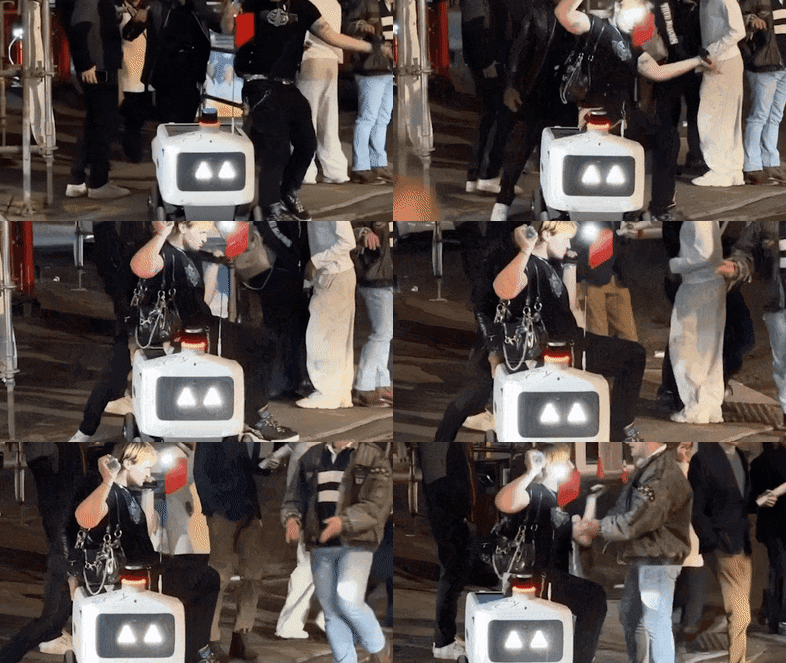
They get flipped, kicked, shoved into snowbanks, and occasionally squared up against commuter trains. For years, the media narrative surrounding autonomous delivery robots has played out like a slapstick comedy crossed with a techno-optimist fever dream. The conventional wisdom peddled by PR agencies and venture capital pitch decks insists that these mechanical coolers rolling down suburban sidewalks represent the bleeding edge of last-mile logistics.
It is absolute nonsense. In related updates, take a look at: Decoding Cephalopod Dynamic Camouflage Architecture and Performance Constraints.
I have watched logistics budgets evaporate into the ether while executives chase shiny autonomous objects, desperate to say they are innovating. The lazy consensus says that sidewalk robots will replace human couriers because they lack labor overhead, don't demand health insurance, and never call in sick. This ignores the brutal physics, economics, and human behavior of the physical world.
The Physics Problem Nobody Wants to Calculate
Let us look at the fundamental mechanics of deployment. A four-wheeled cooler trundling along at four miles per hour is not an autonomous marvel; it is a mobile traffic cone with a battery pack. The Next Web has provided coverage on this important issue in great detail.
The core premise of the robot delivery thesis rests on scaling software while marginalizing hardware costs. The pitch assumes that once autonomy software matures, fleets of pods will operate with near-zero marginal cost. This ignores reality. Sidewalks are not pristine digital grids. They are chaotic, obstacle-laden environments governed by the unpredictable physics of stray dogs, toddlers on scooters, unshoveled winter snow, and curbs that defy standard computer vision models.
When a human delivery worker encounters a flight of stairs or a gated apartment complex with a broken buzzer, they solve the problem in seconds. They text the resident, walk up three flights, and complete the drop-off. When a sidewalk robot encounters the exact same scenario, it halts, broadcasts a plaintive digital beep, and demands remote human intervention.
Industry data reveals a dirty secret that marketing brochures omit: remote intervention rates for urban sidewalk bots can require human supervisors for a significant percentage of trips. You have not eliminated labor; you have simply moved the worker from a bicycle seat into a call center cubicle, staring at multiple monitor screens to manually steer stranded robots out of drainage ditches. That is not automation. That is remote-control babysitting with extra steps.
Unit Economics Built on Sand
Venture capitalists love to talk about labor arbitrage. If you do not have to pay a human minimum wage plus tips, your margins expand. But let us run actual balance sheet math instead of daydreaming about sci-fi futures.
A commercial-grade autonomous delivery unit carries a hefty upfront capital expenditure. Hardware durability in public spaces is atrocious. When a machine costs thousands of dollars to manufacture, equip with LIDAR, cameras, and compute modules, vandalism is not an anomaly; it is a line item. Teens flipping delivery bots onto their roofs for social media content are not rare outliers. They are a predictable tax on operating hardware in public spaces without armed guards.
Compare this capital outlay to the traditional human-powered model. A gig worker supplies their own depreciation asset: a bicycle, a scooter, or a used sedan. The platform bears zero maintenance risk for a cracked axle or a blown transmission. When a robot breaks down or gets stolen, the replacement cost hits the corporate balance sheet directly.
Furthermore, carrying capacity tells the true story of operational inefficiency. A sidewalk bot carries a couple of burritos and an iced coffee. Its volumetric efficiency is dismal. A human on an e-bike can haul multiple insulated bags containing orders for an entire family or a small office building. The throughput disparity makes sidewalk robots a novelty act for sterile corporate campuses or master-planned communities, but an absolute financial sinkhole in dense urban grids where delivery density actually matters.
The Human Factor You Can Not Patch Away
There is a psychological laziness in assuming humans will naturally adapt to sharing pedestrian infrastructure with autonomous metal boxes.
Urban planners spent decades trying to reclaim sidewalks for human foot traffic, pushing motorized vehicles onto asphalt where they belong. Now, tech companies expect pedestrians, wheelchair users, and children to dodge autonomous coolers clogging up narrow concrete corridors. The public pushback is real, and it is growing. Cities from San Francisco to European capitals have enacted strict permitting, speed caps, and outright bans on sidewalk bots because residents treat them as municipal litter.
Imagine a scenario where a delivery bot blocks a curb ramp for a wheelchair user during rush hour. The software registers an immovable object, pauses, recalculates, and inches forward by two centimeters. Meanwhile, the human whose path is blocked is left stranded. This is not a frictionless future. It is friction outsourced to the most vulnerable sidewalk users.
The real breakthrough in last-mile efficiency did not come from artificial intelligence algorithms trying to navigate a city sidewalk on four tiny wheels. It came from the humble e-bike.
What Actually Works
If you want to understand where logistics is winning, look at micro-mobility adoption in dense cities. E-bikes bypass traffic gridlock, utilize existing bike lanes, require minimal capital investment, and leverage human intelligence to handle complex drop-off environments. They offer speed, high payload capacity, and adaptability that no autonomous cooler can touch.
The obsession with autonomous delivery bots is a symptom of a tech sector allergic to boring operational excellence. Software companies want to write code that scales infinitely, but the physical world does not bend to silicon timelines. Logistics is a grind of margins, weather, traffic, and human behavior.
Stop funding mechanical novelties that get knocked over by middle schoolers. Fix the routing algorithms for human fleets, pay couriers fair rates that reduce churn, and embrace the e-bike as the apex predator of urban delivery.
The sidewalk is for people. Leave the freight on wheels designed for the road.