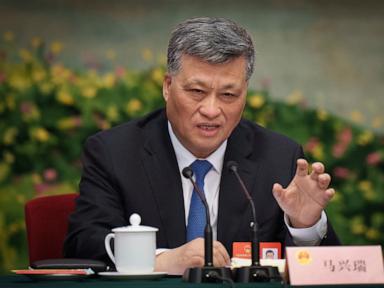
The fluorescent lights in a Shenzhen conference room hum at a frequency that makes your teeth ache after midnight.
For years, that hum was the soundtrack of ambition in southern China. I remember sitting across from mid-level aerospace suppliers in Guangdong back in 2015, watching their hands tremble slightly as they slid thick, unlabelled manila envelopes across polished mahogany tables. They weren't trembling out of fear. They were trembling out of hope. Because back then, the man sitting at the apex of that pyramid was Ma Xingrui—the brilliant, chain-smoking rocket scientist who had put China’s Jade Rabbit rover on the moon and was now supposed to turn Guangdong into the Silicon Valley of the East.
He was supposed to be different.
That is the lie we always tell ourselves when a technocrat takes the throne. We look at an engineer’s resume—doctorates in mechanics, decades leading the China Aerospace Science and Technology Corporation, the calm, calculating demeanor of a man who understands orbital trajectories—and we assume that physics makes a man immune to greed. You cannot bribe gravity. You cannot negotiate with thermodynamics. Surely, a man who spent his life calculating the exact thrust required to escape Earth’s atmosphere wouldn't risk his legacy for stacks of cash and favors.
We were wrong. Completely wrong.
When Chinese prosecutors formally charged former Politburo member Ma Xingrui with taking bribes, the wire reports treated it like another routine line item in Beijing’s endless anti-corruption ledger. A few terse paragraphs. A mention of his tenure in Guangdong and his later, heavily scrutinized stint as the Communist Party chief of Xinjiang. A clinical summary of "illegally accepting massive amounts of money and property."
Cold. Dry. Forgettable.
If you read those wire reports and moved on to the sports page, you missed the real story. The downfall of Ma Xingrui isn't just another bureaucratic purge in a faraway capital. It is a masterclass in how absolute authority rots even the sharpest minds, and how the invisible taxes of corruption eventually land on the shoulders of ordinary people who will never see the inside of a Politburo chamber.
The Architecture of a Technocrat
To understand the magnitude of this collapse, you have to understand who Ma Xingrui was before the handcuffs clicked shut.
In the rigid ecosystem of Chinese politics, most leaders rise through the Party Youth League or through decades of managing provincial economies, mastering the dark arts of patronage and ideological conformity long before they ever touch real power. Ma was an outsider. Born in 1959 in Heilongjiang, he was a creature of laboratories and launchpads. By his thirties, he was a professor. By his forties, he was the chief commander of China’s lunar exploration program.
When I first encountered his work while covering Asia’s supply chain shifts a decade ago, foreign executives spoke about him with a mixture of relief and awe. Finally, they thought, someone who speaks the language of data rather than slogans. When he was appointed governor of Guangdong in 2016—the first non-career politician to hold the post in decades—the business community threw a quiet party. Guangdong is the factory floor of the world, an economic juggernaut whose GDP rivals that of South Korea or Russia. Putting a rocket scientist in charge felt like handing the keys of a Formula One car to the engineer who designed the engine.
Think of a state-run economy like a massive, pressurized hydraulic system. In theory, capital flows through steel pipes—state banks, municipal budgets, infrastructure grants—directly to the pistons that drive growth. For a while, Ma seemed to be tightening the valves. He pushed tech innovation, slashed red tape for private manufacturers, and projected an image of relentless, almost ascetic efficiency.
But here is the trap of unchecked power: when one man holds the wrench to every valve in the system, the pressure eventually finds a crack.
The Invisible Tax on the Factory Floor
Let’s step away from Beijing’s Great Hall of the People for a moment and construct a hypothetical scenario—one grounded in the exact mechanics that prosecutors now allege defined Ma’s tenure.
Imagine a man named Lin. He isn't a billionaire. He owns a mid-sized precision-tooling factory in Dongguan, employing three hundred workers who machine aluminum casings for electric vehicle batteries. In 2018, Lin wants to expand. He needs land-use approvals, an environmental clearance, and a line of credit from a provincial state-owned bank.
On paper, Lin’s company meets every criterion. His safety record is spotless. His balance sheet is healthy. Yet, for eight months, his paperwork sits in a drawer at the municipal bureau, gathering dust. Nobody says no. Nobody asks for a bribe directly. The system simply stops moving.
Then, at a late-night banquet, a "consultant"—perhaps a distant cousin of a deputy director, or a former classmate from an aerospace institute—pulls Lin aside. The consultant doesn't threaten him. He smiles, pours a glass of fiery baijiu, and explains that the provincial leadership is deeply committed to supporting "patriotic entrepreneurs," provided those entrepreneurs understand how to show gratitude to the people clearing the path.
The price of moving Lin’s folder from the bottom of the drawer to the top of the desk? Two million yuan in "advisory fees" funneled through a shell company in Hong Kong, plus a 15 percent silent equity stake for a shell entity tied to senior provincial officials.
Lin pays it. What choice does he have? If he refuses, his bank loans dry up, tax inspectors suddenly find irregularities in his 2014 filings, and his competitors swallow his market share by Christmas.
Now, trace the ripples of that single transaction. To pay that invisible tax, Lin delays raises for his three hundred machinists. He buys cheaper, slightly less reliable coolant for his CNC machines. He passes a 4 percent price hike onto the battery manufacturer, who passes it onto the automaker, who passes it onto a family buying a sedan in Europe or Southeast Asia.
Corruption isn't a victimless crime committed by men in dark suits trading watches in VIP rooms. It is friction. It is sand poured into the gears of human effort. When prosecutors state that Ma Xingrui "abused his positions to seek benefits for others in business operations, project contracting, and cadre selection," they are describing thousands of Lins, bleeding quietly so that a handful of men at the top could amass fortunes they couldn't spend in three lifetimes.
From the Launchpad to the Frontier
If the story ended in Guangdong, it would be a tragic tale of a technocrat seduced by the boomtown wealth of the Pearl River Delta. Instead, it took a far darker turn.
In late 2021, Beijing tapped Ma for one of the most sensitive, high-stakes jobs in the country: Communist Party Secretary of Xinjiang.
The international headlines focused almost exclusively on the geopolitical firestorm surrounding the region—the sweeping security apparatus, the human rights condemnations, the Western sanctions on Xinjiang cotton and polysilicon. What received far less attention was the sheer river of state cash pouring into the region under the banner of "stability maintenance" and infrastructure development.
I remember talking to logistics operators in Central Asia around that time, people moving freight across the Khorgos dry port on the Kazakhstan-China border. They were stunned by the scale of the spending. Billions of yuan were being deployed at breakneck speed to build railways, industrial parks, energy grids, and high-tech surveillance networks.
In normal governance, massive public spending comes with massive oversight—auditors, opposition politicians, investigative journalists, independent courts. In Xinjiang under emergency security protocols, speed was everything, and scrutiny was treated as disloyalty.
Consider what happens when you combine an opaque, security-obsessed bureaucracy with an ocean of emergency state funding and a leader who already knows how to work the levers of patronage. You get an environment where contracts worth hundreds of millions are handed out behind closed doors, where state-owned enterprises act as personal piggy banks, and where loyalty is purchased in bulk.
At the time, outside observers wondered if Ma’s appointment to Xinjiang—followed by his elevation to the 24-member Politburo in October 2022—meant he was being groomed for the Standing Committee, the supreme ruling council of China. He looked untouchable. He had survived the transition from scientist to provincial boss, navigated the ideological minefields of Beijing, and stood at the right hand of paramount power.
Why, then, did the floor suddenly vanish beneath his feet?
The Paradox of the Anti-Corruption Purge
Whenever a titan of this magnitude falls in Beijing, the immediate question from the outside world is always the same: Was it really about the money, or was it politics?
Let’s be completely honest here. Anyone who claims to know the exact internal deliberations of the Central Commission for Discipline Inspection (CCDI) is guessing. The inner workings of Zhongnanhai are a black box, and admitting that uncertainty is the only honest way to analyze Chinese politics.
Yet, looking at over a decade of behavioral patterns since Xi Jinping launched his sweeping anti-corruption campaign in 2012, a clear truth emerges: the money and the politics are inseparable.
In a one-party system without independent checks and balances, corruption isn't an anomaly; it is the operating system. Because nearly every official who rises to the top has had to compromise along the way—accepting favors, turning a blind eye to subordinates, building networks of mutual protection—almost everyone has a dossier sitting in a vault somewhere in Beijing.
For years, that dossier acts like a leash. As long as you deliver results, maintain stability, and stay completely aligned with the center, the dossier stays locked. The moment you falter—or the moment your faction grows too independent, or your economic numbers miss the mark, or a subordinate cracks under interrogation in an unrelated probe—the key turns in the lock.
Look at the recent wave of purges across China’s defense and aerospace sectors. Over the past two years, generals from the Rocket Force, defense ministers, and top executives from the very aerospace conglomerates Ma Xingrui once led have vanished from public view, later surfacing in disciplinary announcements stripped of rank and party membership.
In 2023 and 2024, investigations into the military-industrial complex exposed systemic rot in missile procurement and satellite launches—allegations of inflated contracts, substandard components, and kickbacks that allegedly reached the highest echelons of the defense establishment. Ma spent his formative decades running that exact ecosystem. When investigators began pulling the loose threads on aerospace executives he had mentored, promoted, and worked alongside for thirty years, those threads inevitably led straight back to his door.
You can hide a bank account in a shell company. You cannot hide twenty years of shared career trajectories.
The Human Toll of the Fall
There is a visceral, almost Shakespearean terror to watching a Chinese Politburo member fall.
In Western democracies, a disgraced politician resigns, hires a fleet of white-collar defense attorneys, writes a self-serving memoir, and eventually surfaces as a cable news commentator or a lobbyist. Their fall is noisy, public, and survivable.
In Beijing, the fall is silent, total, and absolute.
First, a man simply stops appearing on the evening news. State media quietly scrubs his name from recent archives. Then comes the terse announcement of "serious violations of discipline and law"—the Party’s euphemism for corruption and political disloyalty. For months, the accused disappears into liuzhi, an extrajudicial detention system where investigators hold suspects in isolation, without access to lawyers or family, breaking down their psychological defenses until a full confession is signed.
By the time the prosecutors announce formal charges—as they just did with Ma Xingrui—the trial is merely a formality. Conviction rates in such cases hover above 99.9 percent. The once-all-powerful chief of Guangdong and Xinjiang, the man who commanded rocket launches and presided over millions of lives, will likely spend the rest of his days inside Qincheng Prison, the maximum-security facility nestled in the hills north of Beijing built specifically for fallen elites.
I think back to that night in Shenzhen in 2015, and the nervous factory owners clutching their manila envelopes. Many of those small businesses didn't survive the brutal economic headwinds of the past few years. They were crushed by debt, shifting global supply chains, and the lingering drag of a system where capital flowed to the well-connected rather than the deserving.
They paid the price for a game they never asked to play.
And what about the rocket scientist? The tragedy of Ma Xingrui isn't that he lacked brilliance. He possessed an intellect capable of guiding machines across hundreds of thousands of miles of dark space to land softly on the lunar surface.
Yet, given absolute authority over earthly treasures, he couldn't navigate the simplest moral gravity of all. He forgot that when you build a system with no guardrails, even the best engineer eventually drives off the cliff.