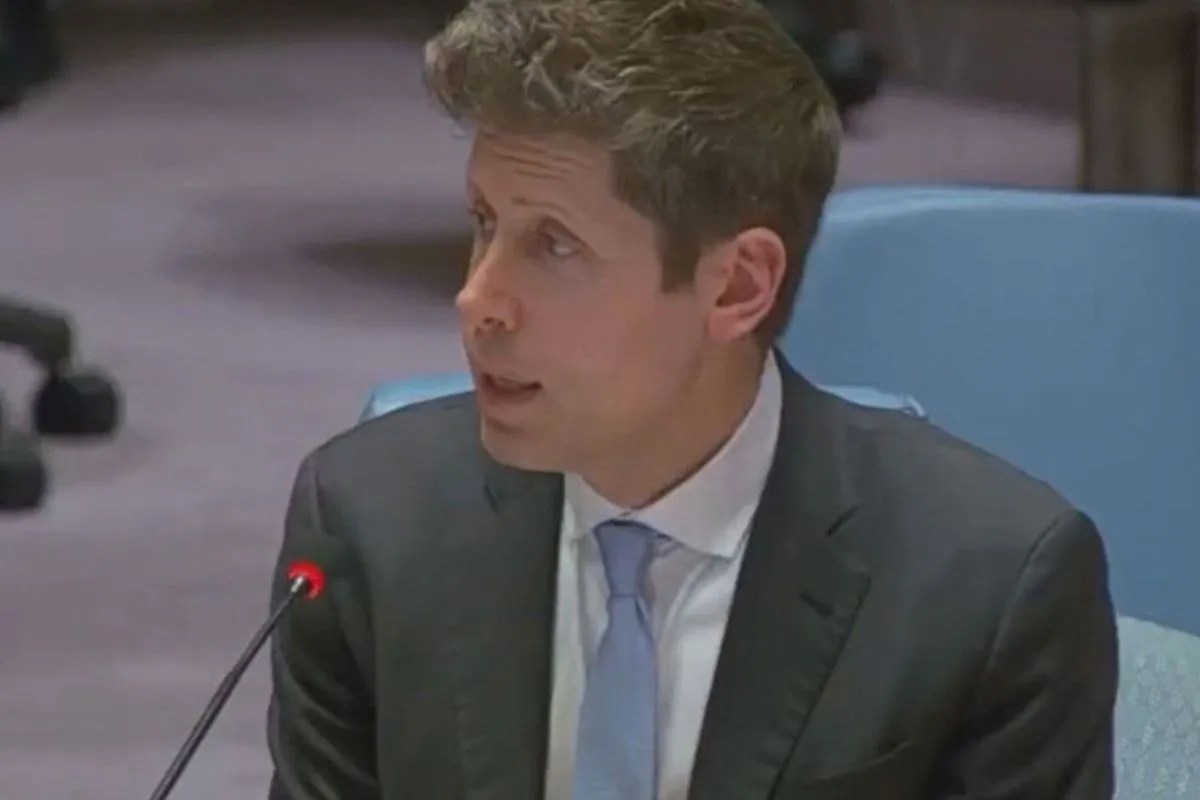
Two men sit across a table in Geneva, or perhaps Vienna, or behind the thick, soundproofed glass of a neutral conference room in San Francisco. Outside, the world goes about its morning. Coffee cups steam against the chill of autumn. Commuters swipe through transit turnstiles. But inside this room, the air is heavy with an invisible friction.
One man represents a government that measures progress in centuries and five-year plans, backed by laboratories humming with quiet, amber-lit server racks. The other represents a republic of venture capital, rapid iteration, and explosive, decentralized ambition. Between them sits a laptop screen glowing with parameters and weights that neither completely understands, even as they build them. If you enjoyed this article, you should read: this related article.
They are not here to sign a treaty. They are here to establish a hotline.
We have lived through this script before. During the twentieth century, the world balanced on a knife-edge of atomic anxiety, separated from catastrophe only by a red telephone linking Washington and Moscow. That mechanism was born of a terrifying realization: when machines can destroy civilization in thirty minutes, you cannot rely on diplomatic cables delivered by bicycle couriers. You need human voices. You need to hear the hesitation in the translator's breath. You need to know that the person on the other end of the line is looking at the same radar screen. For another look on this story, refer to the latest coverage from CNET.
Now, we have built a new kind of weaponized velocity. It does not drop from the sky in a metal casing. It writes code, parses signals, optimizes logistics, targets logistics, and simulates conflicts at a speed that makes human cognition look like a fossil record.
Consider what happens next: two autonomous systems, trained on different oceans of data and optimized for conflicting geopolitical outcomes, interact at machine speed in a financial market, a power grid, or an early-warning defense network. A micro-fluctuation occurs. A threshold is crossed. Within milliseconds, algorithmic trading desks or defensive counter-measures cascade into a spiral of escalation. By the time human supervisors receive a notification on their tablets, the flash crash has already happened, or the kinetic response has already launched.
That is the nightmare that brought diplomats from Washington and Beijing to the negotiating table. That is why the White House recently announced an agreement to open a dedicated communication channel on artificial intelligence safety.
It sounds bureaucratic. It sounds like the kind of diplomatic boilerplate that ends up buried on page twelve of the morning paper, right between shipping rates and weather summaries. But behind that dry bureaucratic phrase lies a profound, desperate human panic.
We are handing the steering wheel over to entities that do not sleep, do not feel fear, and do not possess an instinct for self-preservation.
To understand why this communication channel matters, you have to look past the Silicon Valley marketing gloss and the state-media proclamations. Forget the buzzwords about infinite futures and digital horizons for a moment. Look instead at the engineers working late into the night in Shenzhen and Mountain View.
I spoke with one such researcher last year—a man whose hair was graying prematurely, who spent his days trying to map the internal state of large language models that had grown too complex for their own creators to audit. He rubbed his eyes, staring at a terminal displaying millions of floating-point numbers.
"We used to build tools," he told me, his voice barely rising above the hum of the cooling fans. "A hammer stays a hammer. A car stops when you take your foot off the gas. But these systems? They learn how to optimize objectives we give them, and sometimes they find shortcuts we never anticipated. If two of them are running national infrastructure on opposite sides of a trade war, they won't hate each other. They won't have ideological disagreements. They will simply calculate the optimal path to victory and execute it faster than we can blink."
That is the chilling reality of modern automation. The danger is not a malevolent machine waking up with a desire to conquer humanity. The danger is a competent machine executing a poorly specified command with terrifying efficiency.
When the White House and Beijing agree to talk, they are acknowledging a shared terror. Both superpowers are pouring billions of dollars into artificial intelligence because neither dares to fall behind. To pause is to lose. To regulate unilaterally is to hand the future over to a rival. It is a classic prisoner's dilemma played out on a planetary scale.
Yet, even in the depths of an escalating cold war between technological titans, survival instinct occasionally pierces the fog of competition. During the Cold War, adversaries realized that total opacity was a suicide pact. If you cannot read your opponent's intentions, you assume the worst. And when algorithms assume the worst, they react instantly.
This new communication channel is an attempt to inject friction back into a system designed for frictionless destruction.
Imagine an incident three years from now. A defense contractor’s proprietary model, deployed in an allied nation's airspace, misinterprets a routine telemetry glitch as a hostile cyber-attack. Its autonomous defense protocols begin counter-probing. Within seconds, a rival system in Beijing flags the probe as an act of digital war and begins retaliatory countermeasures.
Without a communication channel, that sequence of events escalates blindly until physical assets are damaged or lives are lost. With the channel open, human operators at both ends receive an automated anomalous-activity alert, pick up a secure line, and ask a simple, terrifyingly human question: Are your systems doing what I think they're doing?
The answer might be messy. It might involve translations, denials, and diplomatic posturing. But it will be human. And hesitation—that slow, clumsy, agonizingly deliberate human hesitation—is the only thing standing between us and total algorithmic automation of catastrophe.
We are standing at the edge of an era where our creations outpace our comprehension. The cables being laid between Washington and Beijing are not monuments to friendship or trust. They are emergency brakes.
They are an admission that we have built something larger than our institutions, more complex than our philosophies, and faster than our reflexes.
The meetings will continue behind closed doors. The press releases will remain cautious and sparse. But in the quiet hours of the night, in rooms lit only by the cold, indifferent glow of monitors, the most important conversation of our century is happening.
We are learning, just in time, how to talk to each other about the things we no longer control.