The wind in the Sahara does more than move sand. It polishes. It scours. It acts as a relentless eraser, scrubbing the record of human history until only the hardest, most stubborn fragments remain. For seven millennia, a small patch of African earth held its breath, guarding a secret that defies every map we have ever drawn of our own origins.
When archaeologists brushed away the final layers of dust at a site tucked within the vastness of the desert, they didn't just find bones. They found a crisis.
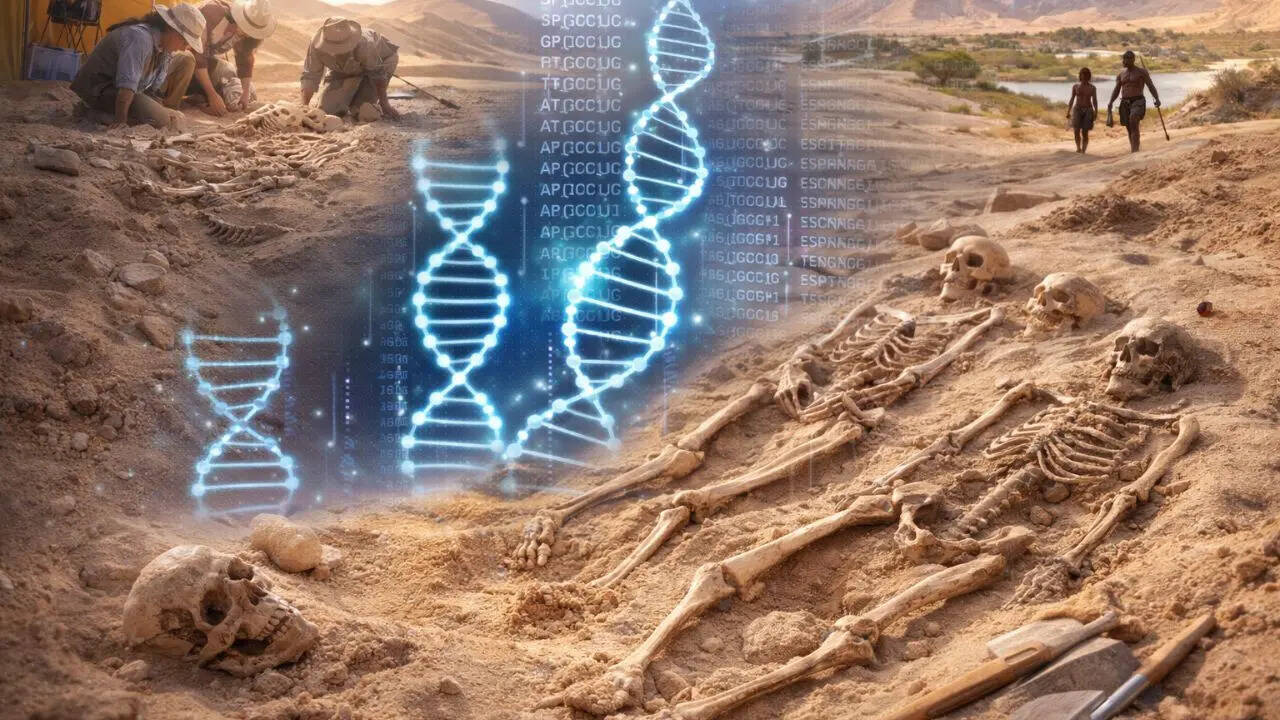
Buried in the scorching grit were skeletons dating back 7,000 years. They were laid to rest with a level of care that suggests a society of profound tenderness and ritual. But when the laboratory results came back, the genetic code didn't match the neighborhood. It didn't match the migration patterns. It didn't match the story we’ve been telling ourselves about who lived where, and when.
These people are ghosts in our own DNA.
The Green Mirage
To understand the weight of this find, you have to discard the image of the Sahara as a void of rolling dunes and skeletal camels. Seven thousand years ago, this was the "Green Sahara." It was a sprawling garden of high grasses, deep permanent lakes, and roaming hippos. Imagine a Neolithic family—let’s call them the first settlers of the basin—standing on a shoreline that is now a thousand miles from the nearest well.
They were witnesses to a world in transition. They lived during a window of time when the Earth’s tilt allowed monsoons to reach deep into the interior of Africa, turning a wasteland into a paradise. But as the climate shifted and the rains retreated, these people were squeezed into smaller and smaller pockets of life.
Eventually, they vanished.
We expected their bones to tell us they were the ancestors of the modern inhabitants of the Nile Valley or the nomadic herdsmen of the Sahel. Instead, the genetic sequencing revealed a "ghost population." Their DNA contains markers that don't align with any known ancient or modern group in the region. It is as if a vibrant, complex civilization was air-dropped into the desert, flourished for centuries, and then evaporated without leaving a trace in the bloodlines of those who followed.
The Language of Teeth and Stone
Archaeology is often a cold science, measured in carbon dating and isotope analysis. But when you look at these skeletons, the coldness melts away. One particular find haunts the researchers: the remains of a woman and two children, their arms intertwined in an eternal embrace.
This wasn't a mass grave of casual disposal. This was a testament to grief.
To the scientists in the lab, these are samples numbered and cataloged. But to anyone who has ever felt the grip of a child’s hand, these are people who faced the slow-motion apocalypse of a drying world together. They watched the lakes turn to salt. They watched the grass yellow and fail to return. They died in a world that was literally blowing away.
The mystery of their "unknown DNA" creates a massive friction in our understanding of human movement. Usually, genes flow like water, following the path of least resistance across continents. We can track the spread of farming or the thundering hooves of conquering tribes by looking at how genetic markers bleed into one another over centuries.
These Saharan skeletons break that flow. They represent a biological island.
Think of it like finding a perfectly preserved, high-tech city in the middle of a medieval forest. The tools found near the bodies—delicate pottery and sophisticated stone implements—hint at a culture that was thriving, not just surviving. Yet, their genetic signature ends abruptly. They are a dead-end branch on a tree we thought we had already mapped.
The Invisible Stakes of a Cold Case
Why does a 7,000-year-old cold case matter to us now, sitting in climate-controlled rooms with the world’s knowledge in our pockets?
It matters because it humbles our certainty. We like to believe that history is a straight line leading directly to us. We see ourselves as the inevitable winners of the evolutionary lottery. But these "ghosts" prove that entire branches of the human experience can be snuffed out so completely that we don't even know their names.
The Sahara discovery forces us to confront the reality of "lost lineages." It suggests that the African continent—the cradle of everything we are—was far more diverse and genetically complex than our current models allow. We are missing chapters. Perhaps entire volumes.
Consider the technical hurdle of extracting this information. In the blistering heat of the desert, DNA degrades at an accelerated rate. It breaks into tiny, jagged puzzles. Scientists had to use advanced enrichment techniques, essentially "fishing" for human sequences among a sea of microbial noise.
What they caught was a riddle.
If these people weren't the ancestors of the local populations, where did they come from? Some theories suggest a far more ancient, deep-rooted population that remained isolated for millennia. Others wonder if they represent a back-migration from a place we haven't considered yet. Every answer leads to three more questions, and every question makes our grip on the past feel a little more slippery.
The Weight of the Silence
There is a specific kind of silence that exists in the deep desert. It is heavy. It feels like a physical pressure against your eardrums. Standing at a site like this, you realize that the earth is a palimpsest—a parchment that has been written on, scraped clean, and written on again.
We are currently the top layer of text.
The skeletons in the Sahara remind us that the environment is the ultimate arbiter of history. These people didn't fail because they weren't smart enough or strong enough. They didn't vanish because of a lack of culture or community. They vanished because the rain stopped coming.
The DNA "puzzle" isn't just a biological curiosity for academics to debate in journals. It is a mirror. It asks us how much of our own story will remain when the wind eventually decides to move the sand over us. Will we be the ancestors of a thriving future, or will we be the "ghost DNA" that some future intelligence tries to decode 7,000 years from now?
The scientists will continue to sequence. They will compare these samples to every known database from the Levant to the Cape. They might find a match in a remote village in the mountains, or they might confirm that this lineage truly died in the dust.
But the mystery itself is the point.
It serves as a necessary reminder that the world is bigger than our maps and older than our stories. Beneath the dunes of the Sahara, there are people who loved, who mourned, and who built worlds, and they are currently laughing at our attempts to categorize them.
They remain there, tucked into the strata of the earth, holding onto their secrets with bone-white fingers. They don't need us to solve them. They only need us to remember that they were here, and that they were us.
The sun sets over the basin, casting long, distorted shadows across the excavation pits. The wind begins its nightly work, shifting a few grains of sand, slowly burying the truth once again.
It is a patient kind of hiding.