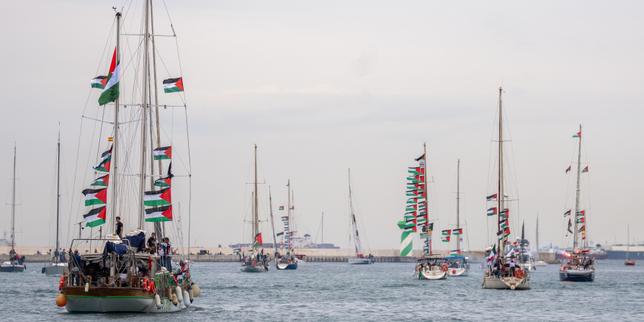
The Mediterranean is a deceptive mirror. On a clear afternoon, the water looks like hammered glass, a peaceful blue that stretches until it meets the horizon in a seamless blur. But for those aboard the Global Sumud, the beauty was secondary to the vibration beneath their feet. It was the steady, rhythmic thrum of an engine carrying more than just passengers. It was carrying a promise.
They were a few dozen souls on a small vessel, a speck in the vastness of international waters. Among them were fifteen French citizens—teachers, activists, retirees—who had traded the comfort of their homes for the cramped quarters of a humanitarian flotilla. They weren't soldiers. They didn't have armor. They had crates of medicine and bags of flour.
Imagine the smell of salt air mixing with the scent of cheap coffee in the galley. There is a specific kind of tension that settles into the bones when you are a hundred miles from shore, heading toward a place the world has largely turned its back on. You track the GPS coordinates like a heartbeat. You watch the radar. You wait for the moment the horizon changes.
The Shadow on the Radar
The shift didn't happen gradually. It happened with the sudden, sharp intrusion of steel against the waves. When the Israeli navy intercepted the Global Sumud, they weren't just stopping a boat. They were halting a narrative of intervention.
The international waters—that legal "no man's land" where sovereignty is supposed to be a suggestion rather than a rule—became the stage for a confrontation that has played out many times before, yet never loses its jagged edge. The militants on board knew the risks. They had signed waivers. They had called their families. Still, the reality of hooded figures and the cold gleam of weaponry in the middle of the dark sea is a visceral shock that no amount of political conviction can fully numb.
One of the French volunteers, a man whose hands were more accustomed to turning the pages of a textbook than gripping a railing in fear, watched as the boarding party took control. There is a silence that follows the shouting. A heavy, ringing quiet that settles over a deck once the engines are cut. The boat, stripped of its forward motion, begins to drift. It becomes a floating cage.
Fifteen Lives in Limbo
The arrest of fifteen French nationals transformed a local blockade into a diplomatic headache. These aren't just statistics; they are people with passports and rights that suddenly feel very flimsy when weighed against the "security imperatives" of a nation at war.
Consider the mechanics of an arrest at sea. You are processed. Your phone—your link to the world, your evidence, your digital memory—is confiscated. You are no longer an activist with a name; you are a security risk in a jumpsuit. The French consulate in Tel Aviv begins the frantic, bureaucratic dance of locating their citizens, ensuring they aren't being mistreated, and navigating the thorny path of "administrative detention."
The irony is thick enough to choke on. The Global Sumud—Sumud being the Arabic word for steadfastness—was meant to deliver relief to a population trapped in a strip of land where the sky is a ceiling. Instead, the deliverers found themselves trapped in a different kind of enclosure. The flour stayed in the hold. The bandages remained in their plastic wrapping. The steadfastness was diverted to a prison cell.
The Invisible Stakes
Why do they do it? Why does a retired nurse from Lyon or a student from Montpellier risk a permanent black mark on their record and the very real threat of physical harm?
It isn't for the glory. There is very little glory in being dehydrated and interrogated in a room with no windows. They do it because of the unbearable weight of doing nothing. We live in an era where we can watch a catastrophe in 4K resolution on our phones while eating dinner. That cognitive dissonance—the gap between the horror on the screen and the peace in our living rooms—becomes a psychic wound for some.
The flotilla is an attempt to bridge that gap. It is a physical manifestation of the idea that borders are human inventions and that the sea should be a highway for help, not a wall of salt. But the Mediterranean has a long memory. It has seen empires rise and fall, and it has swallowed more secrets than we care to count.
A Collision of Realities
The Israeli military sees a provocation. They see a breach of a blockade designed to starve a militant group of resources. In their eyes, the Global Sumud is a Trojan horse, even if the only things inside are ibuprofen and rice. They see a line in the water that cannot be crossed without consequences.
The activists see a moral emergency. They see two million people caught in a vice, and they see their own silence as complicity. To them, the blockade isn't a security measure; it is a slow-motion strangulation. When these two realities collide in the middle of the night, the explosion isn't always literal. Sometimes it’s just the sound of a heavy door locking.
The fifteen French citizens now face a choice that isn't really a choice. Sign a paper admitting guilt and be deported. Refuse and stay. It is a test of the very "steadfastness" the boat was named for. Back in France, their families wait for a crackly phone call. They check the news feeds, looking for a glimpse of a familiar face in the blurred footage of the docking at Ashdod.
The Echo of the Engine
The Global Sumud is now a prize of war, bobbing at a pier, its mission unfulfilled. The supplies will likely sit in a warehouse, caught in a legal limbo that mirrors the fate of its crew. The news cycle will move on. A new headline will flicker across our screens, and the fifteen Frenchmen will eventually find their way back to Paris or Marseille, carrying the smell of the sea in their jackets and a new hardness in their eyes.
But the questions remain, floating like debris after a wreck. Who owns the water? Does a passport protect you when you step into a conflict that has no interest in your nationality? Is a bag of flour a weapon if it’s delivered by someone the state didn't invite?
The sea doesn't answer. It only carries the sound of the waves hitting the hull, a relentless, repeating reminder that while humans build walls and draw lines, the water eventually wears everything down to sand. The mission failed, if you measure success by the delivery of cargo. But if success is measured by the refusal to look away, the Global Sumud is still sailing, even if it’s currently tied to a dock.
The water remains blue. The horizon remains far. And somewhere in a cell, a man who used to teach history is realizing that he is now a very small, very cold part of it.