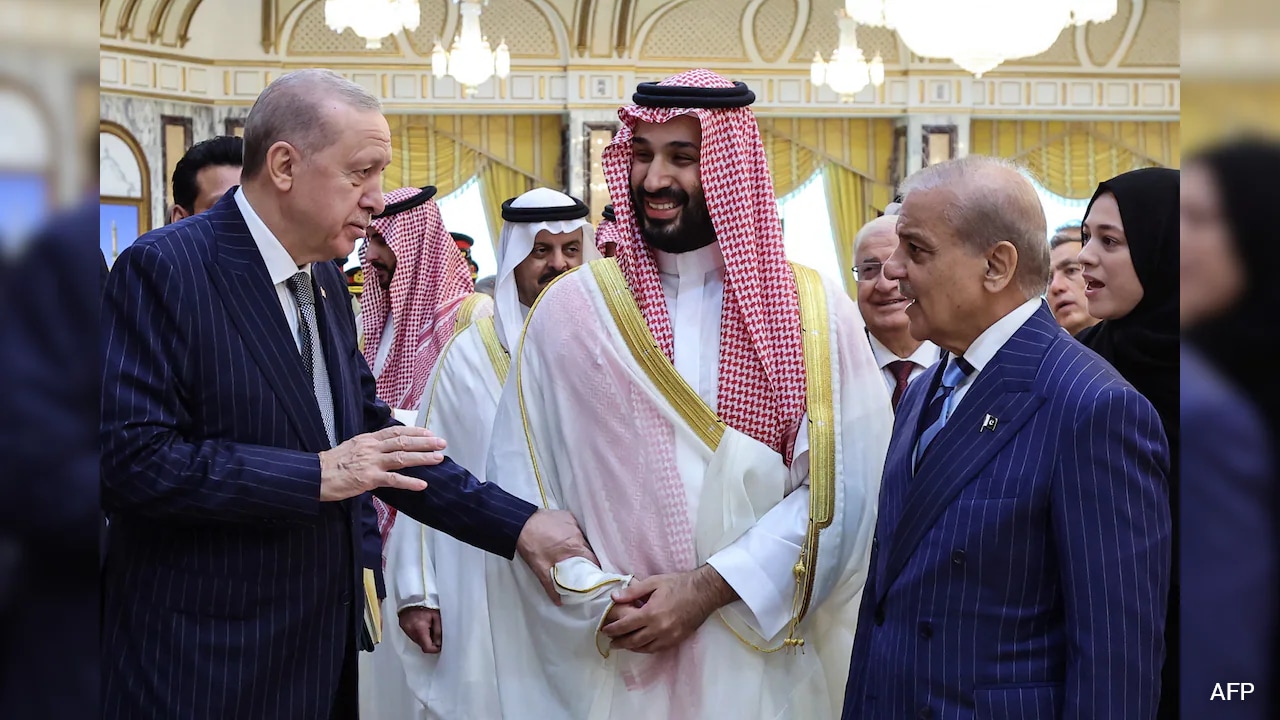
Every desk pundit in New Delhi is currently hyperventilating over a phantom alliance. The lazy consensus dominating foreign policy columns insists that a tripartite axis linking Riyadh, Ankara, and Islamabad represents a four-pronged strategic nightmare for India. They point to defense memos, handshakes at multilateral summits, and shared religious rhetoric, spinning it into an encirclement doctrine designed to keep New Delhi awake at night.
It is a narrative built on lazy analysis, historical amnesia, and a fundamental misunderstanding of how modern middle powers actually operate.
I have spent the better part of two decades watching strategic analysts fall into the same trap. They look at a map, draw lines between capitals with a ruler, and assume that shared grievances translate into coherent military capability. They treat sovereign states as static chess pieces rather than volatile economic entities driven by self-preservation and domestic survival.
The idea that Saudi Arabia, Turkey, and Pakistan constitute a unified bloc capable of shifting the balance of power in South Asia or the Middle East ignores the structural contradictions tearing each of these nations apart.
The Myth of Transnational Islamic Solidarity
Let us dismantle the core premise of the panic. The underlying assumption of the Saudi-Turkey-Pak narrative is ideological cohesion. Analysts love to talk about ummah politics as if statecraft stopped evolving in the fourteenth century.
Realism teaches us a simpler lesson. States do not have permanent friends; they have permanent interests. When you look at the balance sheets, the domestic pressures, and the geopolitical ambitions of Riyadh, Ankara, and Islamabad, the alliance dissolves into a bundle of competing contradictions.
Turkey under Recep Tayyip Erdogan wants to resurrect neo-Ottoman influence, positioning itself as the intellectual and political leader of the Sunni Muslim world. This brings Ankara into direct ideological competition with Saudi Arabia, where Crown Prince Mohammed bin Salman has systematically dismantled religious fundamentalism at home while positioning the kingdom as a beacon of moderate, nationalistic modernization. Riyadh spent billions over decades exporting radical Islamism; today, it actively suppresses the Muslim Brotherhood network that Ankara openly shelters and champions.
To imagine that these two capitals share a synchronized foreign policy vision requires a suspension of geopolitical disbelief. They are frenemies at best, locked in a silent, bitter contest for regional hegemony.
And then you have Pakistan.
The Economic Reality of Pakistan
Pakistan is not a strategic asset in this trilateral equation; it is a financial black hole.
When people speak of the Pakistan factor in this supposed alliance, they imagine a nuclear-armed military machine ready to project power alongside its Middle Eastern and Mediterranean partners. The reality on the ground is starkly different. Islamabad is perpetually weeks away from sovereign default, kept on life support by emergency International Monetary Fund bailflows and bilateral life rafts from Beijing and Riyadh.
Saudi Arabia has stopped writing blank checks. For years, Islamabad took Riyadh's financial assistance for granted, assuming that its status as the world's only Islamic nuclear power guaranteed perpetual patronage. That era is dead. Crown Prince Mohammed bin Salman made it clear that economic partnership now requires structural reform, fiscal discipline, and a return on investment. Riyadh does not want geopolitical liabilities; it wants foreign direct investment, tech hubs, and Vision 2030 integration.
India is Saudi Arabia’s strategic economic partner in Asia, not Pakistan. Trade between New Delhi and Riyadh sits in the tens of billions of dollars, anchored by energy security, supply chain diversification, and massive institutional investments from the Public Investment Fund into Indian infrastructure and tech startups.
To suggest that Riyadh would jeopardize its multi-billion-dollar stake in the Indian growth story to appease a bankrupt Islamabad is to misunderstand the ruthless pragmatism driving modern Saudi foreign policy. Money talks. Empty anti-India rhetoric does not balance a national budget.
Ankara and the Illusion of Global Reach
Turkey presents a different puzzle, but the outcome for Indian security is largely the same. Erdogan has mastered the art of transactional diplomacy. Ankara sells drones to whoever can pay, offers fiery rhetorical support for various Islamist causes when it suits domestic electoral cycles, and negotiates transactional bargains with Moscow, Washington, and Brussels simultaneously.
Turkey's defense industry has made genuine strides, particularly in unmanned aerial vehicles. But manufacturing tactical hardware does not translate into blue-water projection or the capacity to alter strategic realities thousands of miles away in South Asia. Turkey’s economy is battling chronic inflation, currency depreciation, and deep structural imbalances. Erdogan cannot project sustained power into the Eastern Mediterranean, let alone underwrite Pakistan's military posture against a conventional powerhouse like India.
When Turkey engages with Pakistan, it is primarily an arms export pitch. Islamabad buys Turkish hardware because its traditional Western suppliers have imposed restrictions and its domestic defense manufacturing is constrained by capital shortages. It is a commercial transaction, not a blood oath.
If New Delhi played its cards right—and Indian diplomacy has proven remarkably adept at compartmentalizing bilateral friction—Ankara’s outreach to Islamabad matters very little to Indian security architecture.
Why India Wins the Structural Game
The panic over this trilateral alignment stems from a static view of Indian foreign policy. Pundits assume India is isolated or reactive. The truth is precisely the opposite.
India has executed a masterclass in multi-alignment, proving that a major power can simultaneously maintain deep security ties with the United States, strategic energy partnerships with Russia, economic integration with the Gulf monarchies, and cooperative frameworks with Israel.
Look at the Middle East. India is part of the I2U2 grouping alongside Israel, the UAE, and the United States. This framework connects the Western edge of the Indian Ocean to the Mediterranean through high-tech agriculture, water security, maritime domain awareness, and supply chain resilience. The United Arab Emirates—Saudi Arabia’s closest regional competitor and primary partner—is deeply integrated into India’s economic and security orbit through a Comprehensive Economic Partnership Agreement.
By anchoring itself to the primary economic engines of the Gulf, India has effectively neutralized any potential pan-Islamic containment strategy. Riyadh and Abu Dhabi have far more skin in the game with New Delhi than they ever will with a destabilized Islamabad.
The Geography of Power
Geography remains undefeated in international relations.
Pakistan is geographically tethered to South Asia, locked into a permanent security dilemma with its eastern neighbor while facing an increasingly hostile western border with the Taliban-controlled Afghanistan it spent decades trying to engineer. The Durand Line remains a bleeding wound. Tehrik-i-Taliban Pakistan fighters regularly decimate Pakistani security forces. A state fighting a multifront internal insurgency and staring down economic collapse does not project power outward. It implodes inward.
Turkey is anchored in Eurasia and the Middle East, consumed by European Union accession politics, Syrian refugee spillovers, Kurdish separatism, and Eastern Mediterranean energy disputes.
Saudi Arabia is focused on Gulf security, post-oil economic transformation, and managing its complex balancing act between Washington and Beijing.
None of these nations have the bandwidth, the ideological unity, or the material resources to construct a durable anti-India coalition. They are separate actors pursuing divergent, often contradictory, national interests.
The next time an analyst tries to sell you the narrative of a tripartite encirclement closing in on New Delhi, check their baseline assumptions. They are looking at shadows on a wall, confusing rhetorical noise for structural reality. The real story of modern Asian geopolitics is not the consolidation of new blocs against India. It is the ruthless, transactional unravelling of old ones.