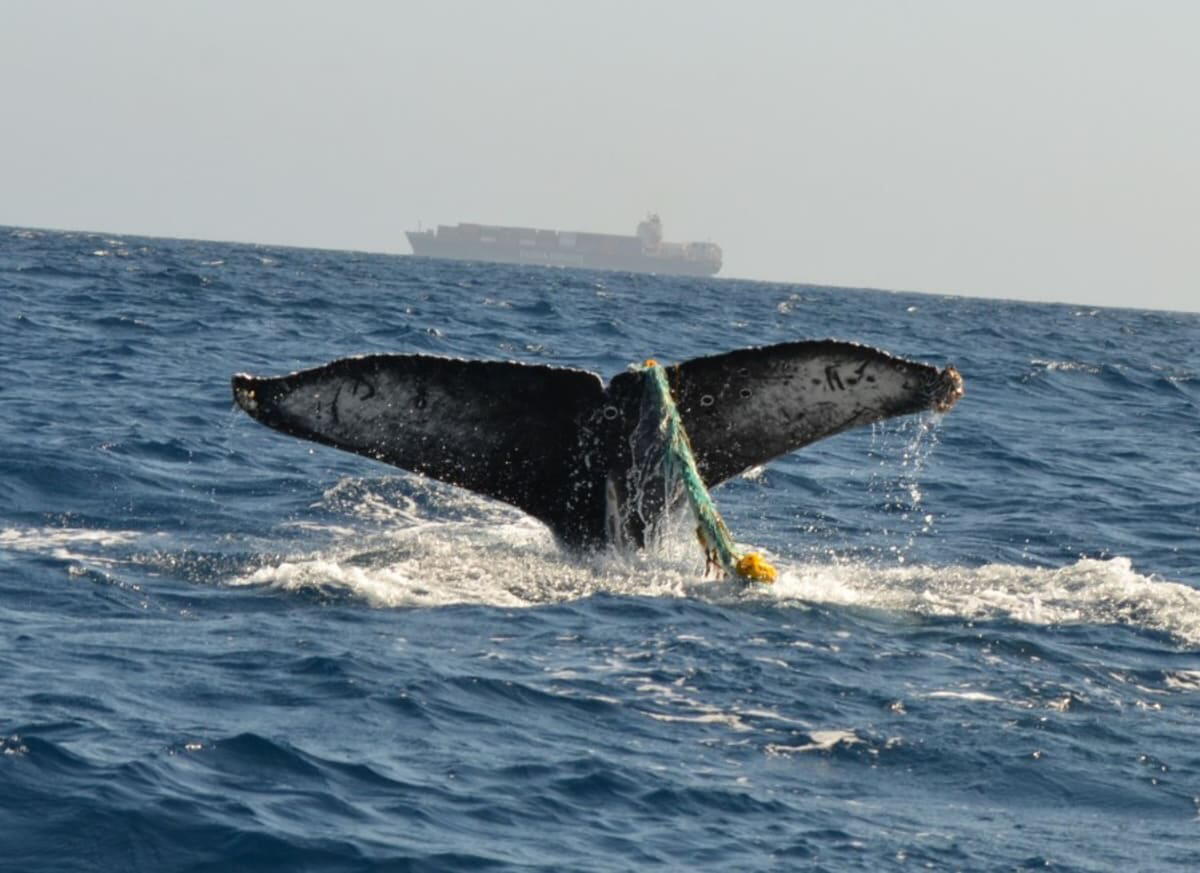
Every time a headline pops up about a humpback whale wrapped in commercial fishing gear near San Pedro, the internet loses its collective mind. Conservation groups flood social feeds with dramatic stills of braided nylon cutting into barnacle-encrusted skin. Activists demand immediate emergency interventions, emergency funding, and emergency public outrage.
It is the easiest moral panic money can buy.
Here is what the headlines leave out while they chase your clicks. The frantic rescue operations we celebrate as victories for marine conservation are masking a structural failure in how we manage oceans, and worse, they are teaching marine mammals to adopt lethal habits.
I have spent two decades looking at marine resource policy and watching well-meaning coastal organizations treat symptom management as actual stewardship. We are spending hundreds of thousands of dollars on high-stakes, Hollywood-style disentanglements while ignoring the bureaucratic incentives that make gear abandonment profitable in the first place.
The Feel Good Trap of Emergency Rescues
Let us get terms straight. Entanglement response is a specialized branch of marine wildlife management involving trained entanglement response teams deploying specialized cutting poles, telemetry, and small boat maneuvers to slice lines off distressed whales. It is dangerous work. The operators deserve respect for their bravery.
But bravery does not equal a long-term strategy.
When a humpback gets tangled off the Southern California coast, the immediate public demand is simple: cut the line. When the whale swims away, the crowd cheers. The non-profit fundraises off the footage for a month. Everyone goes home feeling like they saved the ecosystem.
Nothing changed.
The gear is still drifting. The pot fisheries are still operating under outdated spatial rules. The whale, having survived once, often learns a catastrophic lesson. Animals remember pain and relief. Whales that encounter static fishing lines repeatedly do not necessarily learn to avoid them; they learn that human vessels bring chaotic interactions. More importantly, every saved whale goes right back out into an ocean choked with miles of unclaimed trap lines, waiting for the next roll of the dice.
We are running an ambulance service at the bottom of a cliff and calling ourselves civil engineers.
The Economics of Lost Gear
Commercial crab and lobster fisheries operate on a tragedy of the commons model that everyone acknowledges in private and ignores in public policy. Drop a string of pots, mark the buoys, and hope vessel traffic or rogue currents do not sever your surface lines. When a line gets cut by a passing container ship or a heavy storm, the pots and hundreds of yards of sinking groundline settle on the bottom or drift in mid-water column.
This is ghost gear. It kills silently, year-round, capturing everything from sablefish to apex predators.
Yet, fisheries management agencies treat gear loss as an acceptable externality of coastal commerce. Fishermen lose gear because the current spatial management forces too many traps into too little real estate. When vessels crowd the migration lanes off San Pedro, gear conflicts are mathematically guaranteed.
If we actually wanted to solve whale entanglements, we would not be funding more carbon-fiber poles for rescue squads. We would be changing the liability structure of commercial fishing. Make the manufacturers and license holders fully financially responsible for every foot of synthetic line they deploy, tracked via mandatory RFID tags or serialized buoys. If a string of gear is abandoned, hit the permit holder with a fine that makes losing equipment economically unviable.
Instead, we rely on volunteer rescuers to cut the knots after the fact, funded by donations driven by viral tragedy porn.
The Uncomfortable Downside of Our Approach
Let us be completely candid about the flaw in this contrarian take. If you stop rescue operations tomorrow, whales die in agony. That is an undeniable, brutal reality. No reasonable person wants to watch a majestic cetacean slowly drown in monofilament and polypropylene lines.
That is the trap. The emotional immediacy of a single suffering animal will always override systemic policy discussions. When a whale is dying in front of a coastal city, you cannot tell the public to look at the macro-level statistical data on gear density. You have to grab a knife and go cut it.
I admit it. Letting an entangled whale die to make a political point about fisheries reform is morally indefensible.
However, pretending that saving that single whale solves the underlying crisis is intellectually dishonest. We are treating the patient’s fever with ice packs while ignoring the systemic infection. Every dollar spent on an emergency offshore deployment is a dollar not spent on transitioning coastal fisheries to ropeless fishing technology—acoustic-release traps that stay on the bottom until the fisherman pings them to the surface.
The technology already exists. Ropeless systems have been tested, proven, and operationalized in select fisheries on the East Coast to protect North Atlantic right whales. Why are they not mandatory in California waters? Because legacy commercial lobbies resist the capital costs of re-tooling, and state regulators lack the political spine to force the transition.
The Real Question Nobody Is Asking
People ask: How can we make whale rescue teams faster and better equipped?
That is the wrong question. It accepts that entanglements are an inevitable tax on marine life, a permanent cost of doing business off our shores.
The question we should be asking is: Why are we still using vertical lines in the twenty-first century to harvest seafood in high-traffic marine mammal corridors?
As long as we accept surface lines as a baseline reality, we will be writing obituaries for humpbacks near San Pedro year after year, punctuated by brief moments of self-congratulatory theater when a rescue team manages to snip a line before the animal sinks.
Stop funding the rescue circus. Force the transition to ropeless gear, penalize lost lines out of existence, and stop confusing a successful extraction with actual conservation.


