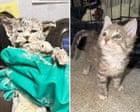
The media machine loves a sticky kitten. You have seen the headlines. A small creature gets trapped in a bucket of adhesive, a hero arrives, the internet swoons, and a bond is supposedly forged in the fires of trauma. It is the perfect, bite-sized narrative designed to trigger your empathy centers and keep you scrolling. It is also a lie that masks a massive, systemic failure in how we handle domestic animal populations.
We are addicted to the "rescue" narrative because it requires zero effort from the observer. You click, you feel a hit of dopamine, you move on. Meanwhile, the actual mechanics of animal welfare continue to collapse under the weight of performative sentimentality.
The Myth of the Traumatic Bond
People conflate survival with soulmates. When an animal is pulled from a life-threatening situation, the immediate aftermath is not a fairy tale of instant loyalty. It is a state of acute cortisol overload. Animals, particularly felines, are masters of stress-induced behavioral modification. What the public interprets as a "bond" is often just a desperate survival response from a creature that has been terrified and requires a source of stability.
I have spent years watching shelters burn through resources trying to force these "hero" narratives into reality. They invest hundreds of hours and thousands of dollars into one high-visibility, "difficult" case, while ignoring fifty stable, healthy animals that are actually adoptable. This is the opportunity cost that nobody mentions. Every hour spent playing nurse to a single victim of bad luck is an hour stripped from a standard animal that will eventually be euthanized because it was not "viral" enough to warrant a feature story.
Why Your Empathy Is Being Mismanaged
The industry relies on your weakness for the tragic. It is easier to sell a sad story than a boring, effective policy. If an organization can get you to cry, they can get you to donate. That money rarely goes toward infrastructure, spay-neuter programs, or meaningful policy shifts. It goes toward the marketing of the next tragic video.
Imagine a scenario where we stopped celebrating the rescue of the one and started holding institutions accountable for the thousands. We prioritize the exception to the rule because the rule is too hard to fix. The rule is that our cities are overrun with unmanaged cat populations, and until we change the way we approach population control, the "stuck in a bucket" stories will never stop.
The average person thinks they are helping by sharing these videos. They are actually participating in a distraction campaign. By focusing on the dramatic, you are letting the municipalities and the major non-profits off the hook. If the problem is "solved" by a hero with a jar of solvent, there is no pressure to solve the root cause.
The Economics of Martyrdom
Look at the math. A high-profile animal rescue can cost five times the amount of a standard intake. The labor is specialized, the medical bills are inflated, and the PR value is high. If I run a non-profit, I want that kitten. It guarantees funding.
Contrast that with a trap-neuter-return (TNR) program. It is messy, it is quiet, it involves outdoor work, and it is rarely photogenic. It does not get shares on social media. But it actually prevents the next five hundred kittens from ever hitting the bucket in the first place.
The industry is biased toward the reactive. We pay for the ambulance at the bottom of the cliff rather than building a fence at the top. This is not kindness; it is bad accounting. When you applaud the rescue, you are applauding the failure of the system that allowed the situation to exist in the first place.
Brutal Realities of Animal Behavioral Health
True expertise in animal behavior dictates that we should be looking at the environmental stressors that drive urban wildlife into these situations. A cat in a bucket is a cat navigating an environment designed for humans, not for animals. Urban planning is fundamentally anti-fauna.
Instead of romanticizing the recovery process, we need to acknowledge the reality of physiological damage. Many of these animals never fully recover their behavioral stability. We are setting up well-meaning humans for failure, dumping traumatized animals into households that are ill-equipped to handle the resulting behavioral outbursts. This is how cycles of abandonment begin again.
Abandon the Sentiment
Stop searching for the next tear-jerker. Stop rewarding the content creators who profit from animal trauma. If you want to make a genuine dent in this issue, ignore the individual story entirely.
Target the organizations that treat animal control like a PR exercise. Demand transparency in their intake vs. output ratios. Look at the data on how many resources are funneled into "hero" cases versus community-wide sterilization efforts.
The next time you see a post about a miracle rescue, ask yourself: Why are they showing you this? What are they trying to distract you from? There is no shortage of animals in need. The shortage is in the level of intellect we bring to the problem. Stop feeding the machine that survives on your tears and start demanding the structural changes that actually save lives.
The cat does not need a viral post. It needs a society that stops creating traps for it. Until we pivot to systemic prevention, we are just watching the same horror movie on a loop and calling it a rescue mission.