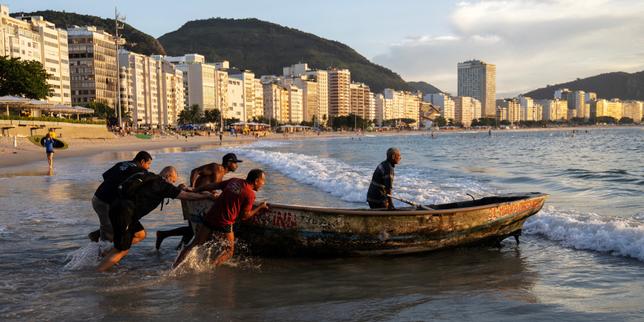
The romanticized narrative of the traditional artisanal fisherman is one of journalism’s favorite crutches.
Every few years, a major outlet visits the colônias de pescadores of Rio de Janeiro—like Copacabana’s Z-13 or the communities tucked inside Guanabara Bay—to write a eulogy. They point to the oil tankers, the plastic soup of the bay, the encroaching luxury high-rises, and the graying hair of the men mending nets on the sand. The tone is always the same: a tragedy of cultural erasure, a call to freeze these communities in time, and an implicit demand for government subsidies to keep a dying industry on life support. If you found value in this article, you should check out: this related article.
It is a beautiful sentiment. It is also completely wrong.
The assumption that we must "save" these traditional fishing colonies in their current form is a failure of economic logic and environmental reality. Trying to preserve 19th-century artisanal fishing methods in a 21st-century megacity of thirteen million people is not preservation; it is slow, subsidized cruelty. For another look on this development, see the latest update from NBC News.
If we actually care about the people inside these communities rather than using them as a picturesque backdrop for tourists, we need to stop trying to save the colonies. We need to help them transform or disband.
The Romantic Myth of the Guanabara Bay Bounty
Let us look at the cold, hard ecology.
For decades, the narrative has been that big industry and state neglect destroyed a thriving, self-sustaining ecosystem. While industrial pollution is a massive, undeniable culprit, the "lazy consensus" ignores a simpler truth: the fish are not coming back to sustainable commercial levels anytime soon, and no amount of local activism will change the physical limitations of Guanabara Bay.
The bay drains a watershed of over 4,000 square kilometers, home to thousands of unlicensed factories and millions of people without basic sanitation. To believe that artisanal fishing can remain a viable, primary economic engine for thousands of families in this environment is a delusion.
I have spent years analyzing urban coastal economies, and the pattern is identical worldwide. When a fishery collapses due to urban pressure, pouring money into "preserving the heritage" of fishing does two things:
- It traps younger generations in a declining, low-yield, hazardous profession out of familial obligation.
- It misallocates capital that could be used for transition training, education, and modern aquaculture.
Artisanal fishing in Rio is no longer a viable career; it is a high-risk gamble with diminishing returns. The fish caught in the inner bay are frequently exposed to heavy metals and coliform bacteria. Forcing a community to rely on selling these catches to survive is a public health hazard masked as cultural conservation.
The "Econ vs. Culture" False Dichotomy
The debate is usually framed as a battle between cold, capitalist development and warm, community heritage. Developers want the prime waterfront real estate; the fishermen want their ancestral docks.
But this framing misses the real economic mechanics at play. The colônias are not failing simply because developers are greedy. They are failing because their internal economic model is obsolete.
The Subsistence Trap
Artisanal fishing relies on a highly fragmented supply chain. A single fisherman goes out on a small wooden boat, burns expensive fuel, catches a modest haul, and sells it to a middleman (the atravessador) or directly to a local market.
- The Scale Problem: They cannot compete with industrial fleets on price, nor can they guarantee the consistent volume required by modern supermarkets or high-end restaurants.
- The Capital Problem: Because their income is highly volatile and informal, these fishermen lack access to formal credit. They cannot upgrade to safer, more efficient vessels or invest in cold-chain logistics.
- The Risk Factor: One bad storm, one oil spill, or one broken motor can push a family into poverty.
By fighting to keep these colonies exactly as they are, activists are advocating for the preservation of systemic financial vulnerability.
Dismantling the Frequently Asked Questions
When you challenge this status quo, the same emotional arguments invariably surface. Let’s address them directly.
"If the colonies close, won't we lose a vital piece of Rio's history?"
History belongs in museums and active cultural centers, not in the daily struggle of a worker trying to feed their family on a catch that shrinks every year. We do not demand that coal miners keep mining with pickaxes to preserve "Appalachian heritage." We should not expect Rio’s coastal communities to fish with hand-cast nets in polluted waters just to keep Copacabana looking authentic for travel bloggers.
"Aren't artisanal fishermen the best guardians of the marine environment?"
This is a noble-savage trope that does not hold up under scrutiny. While many fishermen possess deep ecological knowledge and care for the sea, desperation changes incentives. When fish stocks dwindle, the temptation to use illegal, destructive methods—like fine-mesh nets that catch juveniles, or fishing in protected marine reserves—skyrockets. Poverty is the enemy of conservation, not its partner.
The Path Forward: Disrupt, Don't Preserve
If the goal is to improve the lives of the people who inhabit these colonies, the solution is not to fight a losing battle against urbanization and ecological shifts. The solution is to pivot.
1. Shift from Extraction to Stewardship
Instead of paying subsidies to keep fishermen hunting for non-existent fish, the state should employ them directly in environmental remediation. They know the currents, the bays, and the coastline better than anyone. They should be paid living wages to run plastic recovery fleets, monitor water quality, and manage mangrove restoration projects. This preserves their connection to the water while providing stable, safe, and ecologically constructive employment.
2. Transition to Micro-Aquaculture and Tourism Cooperatives
The waterfront space occupied by these colonies is incredibly valuable. Rather than letting developers seize it entirely, or leaving it as run-down shacks, the colonies should be legally restructured into community-owned tourism and aquaculture hubs.
- Offshore Aquaculture: Transitioning from wild-catch to sustainable, open-ocean shellfish farming.
- Experiential Tourism: Transforming historic docks into managed seafood markets where the community runs the restaurants, the boat tours, and the educational centers directly, capturing the high-margin retail spend of tourists rather than the pennies offered by wholesale fish middlemen.
3. Aggressive Educational Off-Ramps
We must stop measuring the success of a fishing colony by how many young people follow their parents into the boats. A successful transition means the next generation has the skills to become marine biologists, maritime lawyers, engineers, or software developers.
The most painful truth about Rio’s fishing colonies is that their survival depends on their children leaving the nets behind.
To save Rio’s coastal communities, we must first let go of the fantasy of the eternal fisherman. The sea has changed. The city has changed. The economic realities have changed. Continuing to romanticize a grueling, dangerous, and dying trade does not make you an ally of the fisherman. It makes you an accomplice to their stagnation.
Stop trying to fix the old colonies. Build the infrastructure for what comes next, or get out of the way.