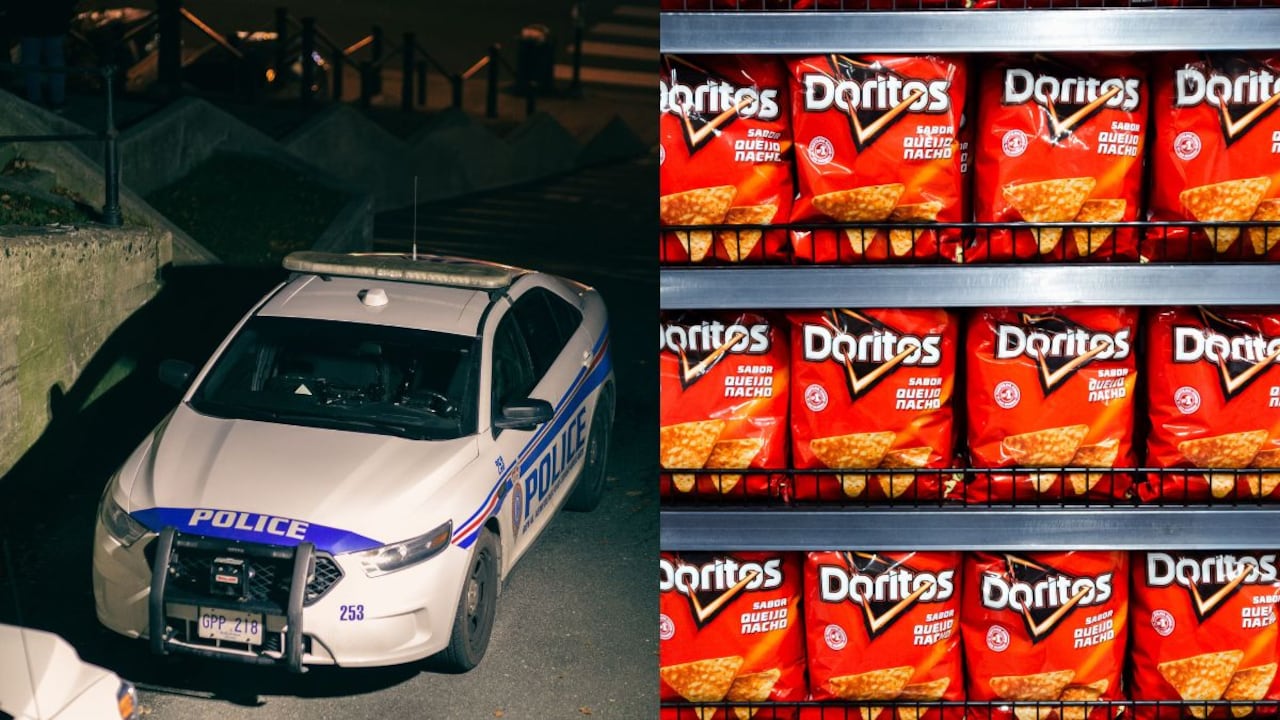
Imagine standing outside your high school after football practice, eating a snack with your friends, and suddenly looking down the barrel of eight police cruisers' worth of drawn guns. That isn't a dystopian movie pitch. It actually happened to 16-year-old Taki Allen outside Kenwood High School in Baltimore County, Maryland, all because a school AI gun detection system confused a crumpled bag of Doritos with a firearm.
You probably heard about the viral outrage when the story broke in late 2025, and honestly, the details only get worse the closer you look at them. When automated surveillance tools fail in public schools, teenagers don't just get an awkward apology. They get forced to their knees, placed in handcuffs, and searched at gunpoint while law enforcement treats a routine snack break like an active shooter emergency.
How a Bag of Chips Triggered an Armed Police Response
Around 8 p.m. on October 20, 2025, Taki Allen finished football practice at Kenwood High School and sat outside with a group of teammates. He ate a bag of Doritos and tucked the empty, crumpled foil pouch into his pocket, leaving one corner sticking out while his hands rested nearby. That specific visual—shiny, angular packaging held near a student's waist—was enough to trip the school district's AI weapon detection cameras.
Within minutes, armed Baltimore County police officers swarmed the campus. Officers ordered Allen to get on his knees, put him in handcuffs, and searched him thoroughly before realizing the "weapon" was just leftover snack trash.
Here is where the story takes a bizarre turn that most surface-level news reports glossed over. According to reporting by WBAL-TV and statements from Baltimore County Public Schools (BCPS), the third-party vendor behind the software, Omnilert, actually reviewed the automated alert and canceled it after human analysts determined there was no gun. Yet the school's own safety team never saw or acted on that cancellation, or police had already been dispatched based on the initial alert before the correction registered. By the time anyone sorted out the miscommunication, a 16-year-old student had already been traumatized in front of his peers.
Why Computer Vision Struggles With Everyday Objects
If you've ever worked with computer vision models or evaluated security tech, this failure shouldn't surprise you at all. AI weapon detection doesn't "know" what a gun is the way a human brain does. It doesn't understand context, weight, or material composition.
Instead, these algorithms scan video frames for pixel patterns, edges, shadows, and geometric silhouettes that statistically resemble training images of handguns and rifles. Under low-light conditions—like an 8 p.m. parking lot lit by harsh sodium-vapor or LED floodlights—a metallic, folded Doritos bag creates sharp specular highlights and dark shadows. To an algorithm trained to prioritize recall over precision, a dark, L-shaped or angular object held near a hip looks close enough to a pistol grip to fire an alarm.
Security vendors face an impossible mathematical trade-off known as the precision-recall dilemma:
- High sensitivity (high recall) catches almost every real threat, but it floods human monitors with false alarms triggered by umbrellas, musical instrument cases, binders, water bottles, and foil snack bags.
- High specificity (high precision) cuts down on embarrassing false positives, but it risks missing a concealed or partially obscured weapon—a liability no school district or tech vendor wants on its hands.
Vendors almost always dial sensitivity way up. They'd rather have police swarm a teenager eating chips a hundred times than miss one actual firearm. That business incentive shifts the entire physical and psychological risk onto students.
The Human-in-the-Loop Myth in School Surveillance
Every major AI security company—whether it's Omnilert, ZeroEyes, or Evolv—sells school boards on the exact same reassurance. They promise a "human-in-the-loop" safeguard, claiming trained analysts verify every alert within seconds before police are ever called.
In theory, that sounds reassuring. In practice, it collapses under real-world pressure.
When an alert flashes across a security operations center screen, a human reviewer has roughly three to five seconds to make a call. Studies on human vigilance in automated monitoring consistently show that operators suffer from automation bias—the psychological tendency to trust a computer's warning over their own eyes, especially when the stakes involve potential violence. If a grainy, zoomed-in thumbnail shows a blurry dark shape in a student's hand and an AI box highlights it in red with a "92% Firearm Confidence" tag, a minimum-wage or mid-level monitor is heavily pressured to escalate it rather than risk being the person who ignored a real threat.
Worse still, communication pipelines between third-party monitoring centers, school resource officers, district security offices, and 911 dispatchers are notoriously fragmented. Even when a remote analyst flags an alert as a false positive—as happened at Kenwood High School—local administrators or officers who already received the initial ping may still roll units because nobody has a unified protocol for standing down an active weapon alert.
False Positives Aren't Isolated Glitches
Baltimore County isn't an outlier. Across the United States, school districts have poured hundreds of millions of dollars into AI camera overlays and millimeter-wave scanners since 2022, often bypassing rigorous independent testing because administrators feel desperate to show parents they're doing something about school safety.
Look at the track record when researchers and journalists actually audit these deployments:
- The IPVM and independent testing findings: Surveillance industry research group IPVM has repeatedly documented how camera-based gun detection struggles with low resolution, motion blur, and common school items. In controlled evaluations, everyday objects—from staplers to cell phones held sideways—regularly generate false alerts.
- The Evolv Technology scrutiny: Even physical walk-through AI scanners haven't escaped trouble. In 2024, the Federal Trade Commission (FTC) took action against Evolv Technology over deceptive marketing claims regarding its AI weapons scanners, after districts like New York City and Utica reported systems failing to catch actual knives while flagging thousands of harmless metal binders, Chromebooks, and lunchboxes.
- Disproportionate impact on students of color: Civil rights organizations, including the ACLU, have pointed out that false weapon alerts don't play out equally across demographics. When an AI misfires in a predominantly Black or Hispanic school, police responses tend to be faster, heavier, and far more aggressive—turning a software glitch into an armed confrontation.
A false alarm isn't a harmless technical hiccup. When armed officers respond to a "gun on campus" dispatch, they arrive expecting a lethal threat. Their adrenaline is maxed out, weapons are unholstered, and any sudden movement by a confused teenager—like reaching into a pocket to pull out the very bag of chips the police think is a gun—can turn fatal in half a second.
What School Boards and Parents Need to Demand Right Now
If your local school district already uses AI gun detection or is currently reviewing vendor bids, polite trust isn't going to protect kids from becoming collateral damage to bad algorithms. Administrators often sign multi-year contracts based on slick vendor demos conducted in brightly lit conference rooms with replica firearms, completely unaware of how the system behaves on a rainy Tuesday evening outside a gym.
Parents, educators, and school board members should push for concrete guardrails before another student ends up in handcuffs:
- Mandatory public reporting of false positive rates: Require vendors and district safety offices to publish quarterly numbers showing total alerts generated versus actual weapons recovered. If a system triggers 50 false alarms for every real incident, the community deserves to see that ratio.
- Strict verification protocols before armed dispatch: Prohibit automatic 911 escalation from raw AI alerts. Require dual verification—meaning both a trained remote analyst and an on-site administrator must visually confirm a weapon before armed police are summoned with lethal-force posture.
- Clear stand-down communication channels: Audit the exact dispatch workflow between the software vendor, school security, and local police so a canceled alert immediately reaches officers in the field, preventing the exact communication breakdown that happened in Baltimore County.
- Independent red-team testing: Before renewing any contract, test the cameras under real campus conditions—nighttime lighting, crowded hallways, hoodies, backpacks, foil wrappers, and sports gear—rather than accepting vendor-supplied accuracy statistics.
Technology vendors love selling the illusion of effortless safety, promising that a software patch on existing security cameras can stop school shootings before they start. Until these systems can reliably tell the difference between a Walther PPK and a crumpled bag of Nacho Cheese Doritos, treating every algorithmic hunch as an armed emergency puts the very students they claim to protect directly in the line of fire.