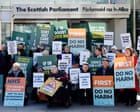
Holyrood didn't just vote against a bill; they voted for a monopoly on pain.
The recent decision by the Scottish Parliament to reject the legalisation of assisted dying is being framed by opponents as a victory for "the sanctity of life" and a safeguard for the vulnerable. That is a sanitized lie. In reality, this vote ensures that the most harrowing, undignified ends remain the only legal option for the terminally ill.
We are told that palliative care is the answer. We are told that "slippery slopes" lead to the state purging the disabled. We are told that doctors must only heal. These arguments aren't just tired; they are intellectually dishonest.
The Palliative Care Myth
The most common weapon used by MSPs and religious lobby groups is the idea that "gold-standard palliative care" renders assisted dying unnecessary. This is the "lazy consensus" of the medical establishment.
I have spent years navigating the corridors of healthcare policy, and I can tell you exactly what that "gold standard" looks like in the final weeks of bone cancer or motor neurone disease (MND). It looks like a patient drowned in midazolam and morphine until they are a breathing corpse, unable to recognize their family, yet still physically reacting to the agony of their body breaking down.
Palliative care is magnificent for many, but it has a ceiling. For a significant percentage of patients, pain cannot be managed without total sedation. We call it "terminal sedation." It is assisted dying by another name, just slower, messier, and stripped of the patient's agency.
To suggest that a syringe driver is a substitute for autonomy is an insult to the intelligence of every person facing a terminal diagnosis. When Parliament votes against assisted dying, they aren't choosing life; they are choosing a specific, prolonged method of death that suits their moral comfort zone while ignoring the patient’s sensory reality.
The False Compassion of the "Slippery Slope"
Opponents love to point at Canada’s MAID (Medical Assistance in Dying) program as a cautionary tale. They claim that if you let a 60-year-old with terminal lung cancer end their life, you’ll eventually be euthanizing people for being poor or depressed.
This is a logical fallacy designed to frighten the public into submission. It ignores the fundamental principle of legislative safeguards.
The proposed Scottish bill was not a free-for-all. It required:
- Two independent doctors to confirm a terminal diagnosis.
- A determination of mental capacity.
- A self-administered life-ending medication.
By rejecting this, the Scottish Parliament has effectively said they do not trust doctors to be doctors, and they do not trust citizens to be adults. They have prioritized a hypothetical future risk over the very real, current, and agonizing present of their constituents.
Imagine a scenario where we applied "slippery slope" logic to any other liberty. We wouldn't allow surgery because it might lead to state-mandated organ harvesting. We wouldn't allow morphine because it might lead to state-sponsored addiction. We regulate these things because the benefit to the individual outweighs the theoretical risk to the collective. Why is death the only area where we allow the "what-ifs" of the fearful to dictate the "must-hos" of the suffering?
The Economic Cowardice of the Status Quo
Let’s talk about the thing no one wants to mention: the cost of the status quo.
Keeping a terminally ill patient in a high-intensity clinical setting against their express will is not just cruel; it is an astronomical waste of resources. This isn't an argument for "killing the expensive," as the activists would scream. It is an argument for resource autonomy.
If a patient wants to go, and the medical necessity for them to stay is zero because the outcome is fixed, why are we forcing the NHS—an institution already buckling under its own weight—to facilitate a three-month decline that the patient never asked for?
We are effectively subsidizing trauma. We are paying for the beds, the drugs, and the staff hours required to keep someone alive against their will, while thousands of people who want to live are stuck on waiting lists for hip replacements and cardiac scans.
The Moral Narcissism of the "Pro-Life" Lobby
The opposition to assisted dying is often rooted in a brand of moral narcissism that prioritizes the "clean hands" of the observer over the "broken body" of the sufferer.
Religious groups argue that life is a gift that cannot be discarded. Fine. If that is your belief, do not seek an assisted death. But by lobbying to keep it illegal for everyone, you are forcing your private theology onto the public square. You are demanding that an atheist with terminal bowel cancer suffer in accordance with your interpretation of a divine plan.
That isn't "pro-life." It is pro-dogma.
The medical profession is also guilty here. The Hippocratic Oath—or the modern versions of it—is often cited as a barrier. "First, do no harm." Is it not harm to watch a patient's skin break into pressure sores while they scream through a haze of ineffective opioids? Is it not harm to force a daughter to watch her father starve to death because he can no longer swallow?
The definition of "harm" used by the Scottish Parliament is purely biological. It ignores the psychological, emotional, and existential harm of a forced ending.
The Dignity in Exit
The term "Dignity in Dying" has been co-opted and sanitized, but we need to reclaim the grit of it.
Dignity is not about a nice room and some flowers. It is about the ability to say: "This is where my story ends." It is about the power to gather your children, say your goodbyes while you still have your mind, and go out on your own terms.
By voting this down, MSPs have ensured that for many Scots, the final memory their loved ones have will be a traumatic one. It will be the sound of the "death rattle"—a physiological reality of the body losing the ability to clear secretions—which palliative care often fails to mask. It will be the sight of a person reduced to a collection of failing organs.
The Reality of the "Underground"
What the Scottish Parliament ignored is that assisted dying already happens in Scotland. It just happens in the shadows, or it happens in Switzerland for those who can afford the £15,000 price tag.
If you are wealthy and mobile, you can fly to Zurich. If you are poor, you are stuck with a plastic bag, a bottle of hoarded pills, or a leap from a bridge.
The current law doesn't stop people from dying. It just ensures that those without means die in lonely, violent, and frightening ways. It ensures that family members who help their loved ones are treated like criminals, hauled into police stations for the "crime" of compassion.
I’ve seen families destroyed by the legal aftermath of a mercy killing. I’ve seen people forced to die months earlier than they wanted to, simply because they had to make the trip to Dignitas while they were still physically strong enough to board a plane.
The Scottish Parliament had the chance to bring this out of the shadows and regulate it. They chose to keep it subterranean.
The Misunderstanding of Vulnerability
The most "noble" argument used by the opposition is the protection of the disabled and the elderly. They fear "pressure" from families who want an inheritance or a state that wants to clear hospital beds.
This patronizes the disabled community. It suggests that they are uniquely incapable of making their own healthcare decisions. If a disabled person has a terminal illness and wants to end their suffering, why should their disability negate their right to autonomy?
The "vulnerability" argument is a shield used by those who are uncomfortable with the reality of death. It allows them to feel like heroes protecting the weak, while they are actually acting as jailers for the suffering.
The Truth About Public Opinion
Poll after poll shows that the vast majority of the Scottish public—upwards of 70%—supports a change in the law.
The MSPs who voted against this are not representing their constituents. They are representing their own fears, their own religious biases, and the loud, well-funded minority of the medical lobby.
This was a failure of representative democracy. It was a moment where the "political class" decided they knew better than the people who actually have to live (and die) with the consequences of these laws.
Stop Asking if We Should Legalize It
The question isn't "Should we legalize assisted dying?" The question is "By what right does the state claim ownership over my exit?"
We have legalized the right to refuse treatment. You can choose to stop dialysis. You can choose to stop chemotherapy. You can choose to starve yourself to death in a hospice. The state recognizes your right to die by omission.
But the moment you ask for a commission—for a way to make that inevitable end swift and painless—the state suddenly discovers a "moral" objection. This is a distinction without a difference. It is a legal quirk that serves no one but the bureaucrats.
The Scottish Parliament had a chance to lead the UK into a more enlightened, compassionate era. Instead, they retreated into the safe, warm embrace of the status quo.
They didn't save lives. They just extended deaths.
If you are facing a terminal diagnosis in Scotland today, your government has a very clear message for you: your pain is a price they are willing to let you pay for their moral comfort.
Next time an MSP talks about "compassionate Scotland," ask them why they voted to keep the "death rattle" as a mandatory part of the Scottish experience. Ask them why they think a doctor’s conscience is more important than a patient’s agony.
The battle for autonomy doesn't end with this vote. It just gets uglier.
Buy a plane ticket to Switzerland while you still can. Because in the eyes of the Scottish Parliament, you don't own your body; the state does, right until the very last, agonizing breath.
Go tell your representative that your life—and your death—is not their political playground.