The afternoon sun in Italy does not just illuminate; it heavy-scents the air. It bakes the ancient stone of central piazzas until they radiate a comforting, timeless warmth. You smell espresso, diesel exhaust, and the sweet, sharp tang of ripening citrus from a nearby market stall. It is a sensory blanket that convinces you, if only for an hour, that the world is a fundamentally safe place.
Then comes the sound.
It is a noise that strips away centuries of civilization in a fraction of a second. The violent roar of an engine revving past its limit. The high-pitched, metallic shriek of rubber tearing against asphalt. It is a sound that makes the heart drop into the stomach before the brain can even process what is happening.
On a quiet street corner, four people were doing what millions of us do every single day. They were walking. They were probably arguing about where to eat lunch, or laughing at a joke, or checking a map on a phone. They were completely exposed.
When a vehicle becomes a weapon, the human body has no defense.
The Fragility of the Sidewalk
We live with an unwritten social contract. We step off the curb only at designated stripes. We trust that the white paint possesses a magical, protective power. Drivers stay on the blacktop; pedestrians stay on the stone. It is a fragile equilibrium that keeps our cities functioning.
But that equilibrium is an illusion.
Consider the sheer physics of the modern automobile. A standard sedan weighs roughly two tons. When moving at even moderate city speeds, it carries a kinetic force that the human frame was never evolved to withstand. When that force deviates from its lane—whether through medical emergency, a sudden mechanical failure, or a moment of catastrophic human error—the results are immediate and devastating.
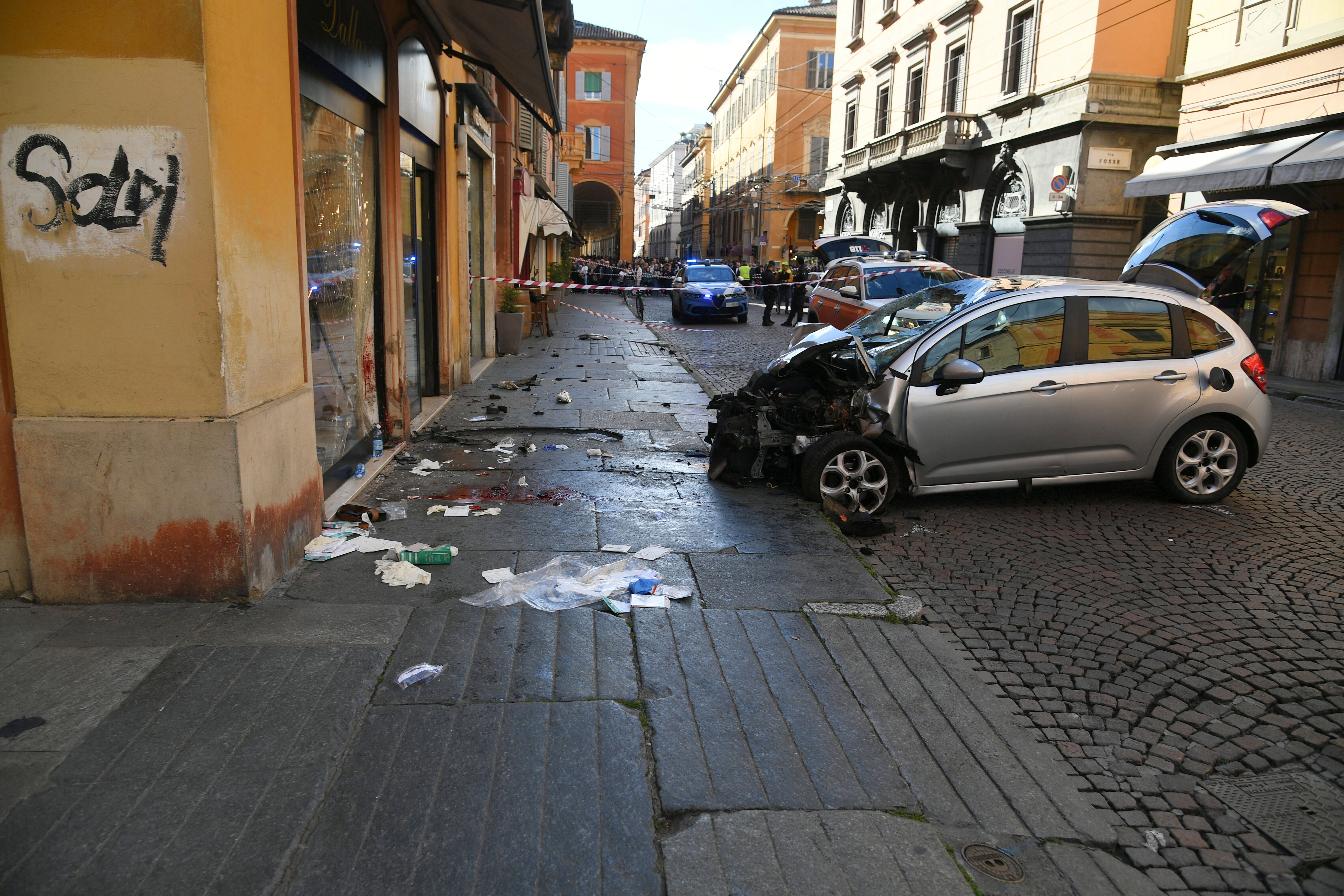
In Italy, a driver veered off the road. In an instant, the mundane became a war zone.
Four individuals, whose names were not immediately splashed across the international news wires but whose lives are every bit as complex and vivid as yours, were struck down. They did not just receive injuries. They were broken. Now, inside the sterile, fluorescent-lit rooms of an Italian hospital, they are fighting for their lives.
The phrase "fighting for life" is used so often in journalism that it has lost its teeth. We read it and picture a dramatic movie scene with a flatlining monitor. The reality is much grittier, much more agonizing. It is a quiet, desperate battle fought in the microscopic spaces between labored breaths. It is the sound of a ventilator clicking over and over. It is a family sitting in a waiting room, staring at the scuffed linoleum floor, waiting for a doctor to walk through the doors with an expression that will alter their universe forever.
The Ripple Effect of an Instant
An accident like this never happens to just the people on the pavement.
The impact radiates outward like a stone dropped into a still pond. Think of the witnesses. The barista who was wiping down an outdoor table. The shopkeeper who looked up just in time to see the blur of metal. They are left with images that will play on a loop behind their eyelids every time they try to sleep for the next six months.
Then there is the driver. Reports often paint these figures as faceless villains, but the truth is usually far more tragic and complicated. Unless malice is proven, the person behind the wheel is often a normal citizen who made a mistake, or suffered a sudden blackout, or lost control on a slick patch of road. They wake up from the shock to find themselves the architects of a nightmare. The weight of that realization is a different kind of life sentence.
Emergency responders in European cities face a unique challenge during these crises. The very things that make Italian towns beautiful—the narrow, winding cobblestone streets, the historic arches, the dense crowds of locals and tourists—become logistical nightmares when every second dictates whether a heart keeps beating.
Ambulances must navigate tight corridors designed for horses and carts, their sirens echoing wildly off medieval stone walls. Passersby must transform instantly from spectators into first responders, applying pressure to wounds and holding the hands of strangers who are slipping into shock.
The True Cost of Mobility
We are obsessed with speed and convenience. We build our societies around the automobile, carving up our ancient spaces to accommodate the desire to get from point A to point B three minutes faster. We accept a certain level of danger as the price of admission for modern life.
But events like this force a uncomfortable question: Is the price too high?
Every year, thousands of pedestrians are injured or killed on global roadways. We look at the statistics as dry data points, a necessary cost of doing business in a connected world. We only wake up to the horror when the statistic gets a face, or when the blood is spilled on a street we recognize.
The four people currently in that Italian hospital are not statistics. They are someone’s children. They might be someone’s parents, or partners, or best friends. Their sudden absence has left four gaping holes in the fabric of their respective worlds back home.
As the sun sets over Italy, the police tape is taken down. The debris is swept away. The stained asphalt is washed clean by the city maintenance crews. Traffic begins to flow again, cars rolling over the exact spot where lives were shattered just hours prior. The city moves on because it must.
But in the intensive care unit, the machines continue to hum, measuring out the distance between hope and grief, one heartbeat at a time.