From five hundred miles above the earth, the Black Sea looks like a splash of spilled ink on a dusty table.
If you zoom in close enough on the port of Novorossiysk, the ink resolves into concrete piers, breakwaters, and the sharp, gray outlines of warships. On a normal day, these shapes are clean. They are geometric. They represent order, authority, and the heavy hand of state power.
But on a Tuesday morning in mid-July, the geometry broke.
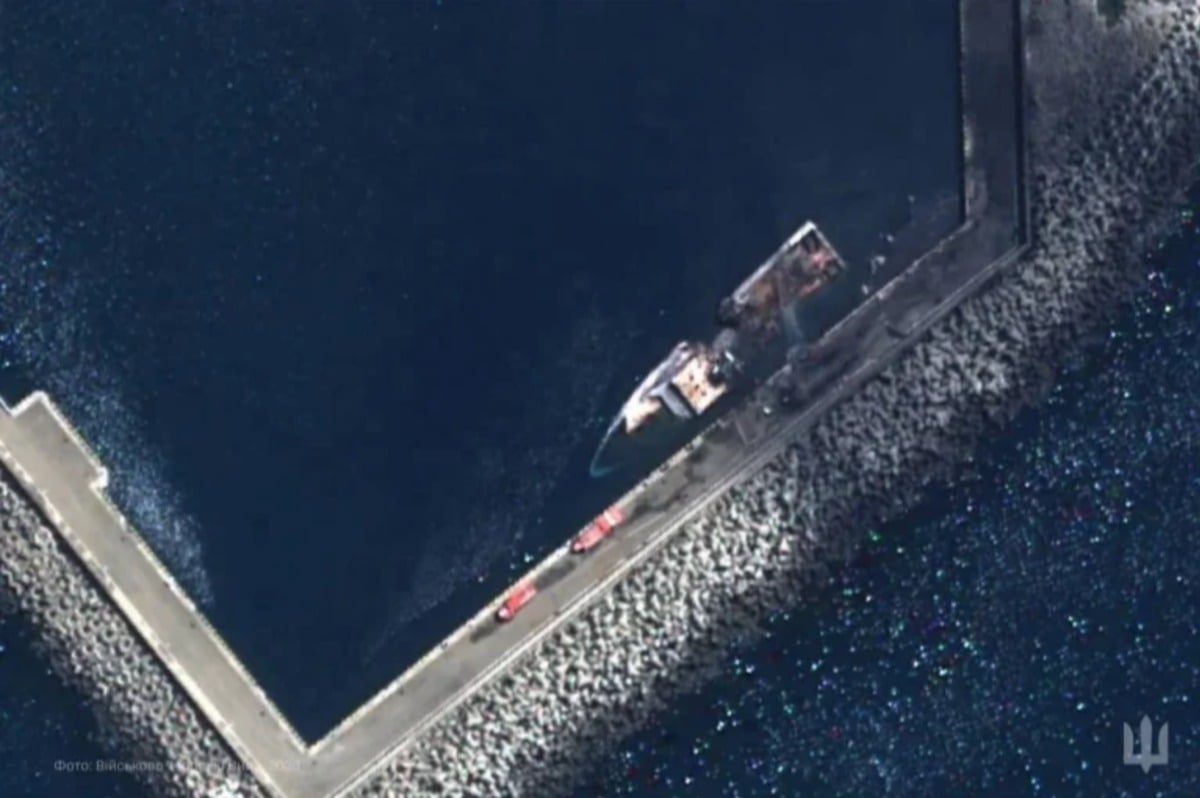
A new satellite image, captured from the cold silence of orbit and shared by the Ukrainian Navy, revealed a shape that did not belong. It was a dark, irregular smudge, slumped sideways against a concrete quay. It looked like a dying animal trying to climb out of the water.
That smudge was the Izumrud.
To a military analyst, the image is a data point. It is a confirmation of a successful strike, a checkmark on a target list, a subtraction from a naval order of battle. But to understand what that dark smudge actually means, you have to look past the pixels. You have to go back eight years, to a cold November morning in the shallow waters of the Kerch Strait, when the men aboard that very ship believed they were untouchable.
The Debt in the Shallows
November 25, 2018.
The wind off the Sea of Azov carries a bite that gets inside your teeth. Three small Ukrainian vessels—two light armored gunboats and a tugboat—were trying to pass through the Kerch Strait, heading from Odesa to Mariupol. They were operating under international maritime law, navigating a narrow bottleneck that Russia had decided, unilaterally, to lock down.
Suddenly, the horizon filled with steel.
Among the Russian ships closing the trap was the Izumrud, a modern, sixty-two-meter border patrol ship operated by the FSB. It was fast, boasting a helipad and rapid-fire cannons, designed specifically to bully smaller vessels. The Russian ships did not just block the passage; they hunted. They rammed the tiny Ukrainian tugboat, the metal screaming as hull ground against hull. Then, they opened fire.
Imagine standing on the deck of a wooden-walled tug, hearing the deafening crack of thirty-millimeter shells tearing through your bulkheads. You are outgunned, outmaneuvered, and entirely trapped. Six Ukrainian sailors fell wounded. The rest were captured, bound, and flown to Moscow to face show trials in a foreign courtroom.
On that day, the crew of the Izumrud likely felt a sense of easy triumph. They had asserted dominance. They had drawn a line in the water and dared anyone to cross it. They went home to medals and quiet promotions, secure in the belief that the Black Sea belonged to them, and that the weak have no recourse against the strong.
They forgot that the sea has a way of keeping accounts.
The Quiet Sting of the Sargan
Eight years later, the equation of power has changed so radically that the naval textbooks of 2018 read like ancient history.
For centuries, naval warfare was a rich man's game. To rule the waves, you needed shipyards, steel mills, and billions of dollars to build floating fortresses. If you did not have a massive fleet, you simply did not play. Ukraine’s navy was effectively neutralized in the opening days of the full-scale invasion. By all traditional rules of war, Russia should have controlled every wave from Odesa to Georgia.
Instead, they are hiding.
The weapon that found the Izumrud near Novorossiysk was not a towering destroyer or a stealth submarine. It was the Sargan-3000.
Think of it not as a ship, but as a guided missile that happens to float. It is low-slung, dark, and made of composites that absorb radar waves rather than reflecting them. It sits so deep in the water that from a distance, it looks like nothing more than a stray log or the crest of a breaking wave. It does not sleep, it does not complain, and it does not feel fear.
To understand how a Sargan-3000 defeats a heavily armed patrol ship, consider a bear trying to fight a swarm of hornets. The bear is incredibly strong. It has claws that can crush bone. But those claws are useless against fifty tiny, buzzing threats coming from every direction at once. The bear cannot see them all. It cannot swat them all. Eventually, one gets through.
That is what happened in the dark hours near Novorossiysk. The Izumrud was equipped with advanced surveillance radar and rapid-fire guns meant to shred incoming threats. But those systems were designed to fight the weapons of the past—fast-moving jets or high-flying missiles. They were blind to a shadow skimming the black water at thirty knots, carrying hundreds of pounds of high explosives directly toward their waterline.
The impact was not just a physical explosion. It was a psychological shockwave.
The Safe Harbor That Wasn't
Novorossiysk was supposed to be the sanctuary.
When Ukrainian naval drones began turning the harbors of occupied Crimea into burning traps, the Russian military did what any sensible force would do: they retreated. They pulled their valuable ships back, away from Sevastopol, moving them hundreds of miles east to the Russian mainland. Surely, they thought, the drones could not reach them there. Surely, the Russian coast was safe.
That illusion died with the Izumrud.
When the Sargan-3000 struck, the ship was not out on the high seas, actively hunting. It was tied to a pier. The crew was likely asleep or going about their morning routines, believing the concrete harbor walls and the distance from the front line protected them.
The satellite image tells the rest of the story. There is no fire now. The smoke has cleared. What remains is the cold reality of a vessel that has lost its fight with gravity. The ship is listed heavily, its decks awash, its bottom resting on the mud of the harbor floor. There are dead and wounded among the crew. The exact numbers will be kept secret by Moscow, buried under layers of official denial, but the physical proof cannot be hidden from the lens of a passing satellite.
This is the new reality of modern conflict. There are no safe harbors. There is no rear echelon. If you are on the water, you are targetable.
The Long Arc
It is easy to look at this strike as a minor tactical victory. The Izumrud was, after all, a patrol ship, not a guided-missile cruiser like the sank Moskva. Its loss does not instantly end the war, nor does it force a general surrender.
But wars are not won solely by counting tonnage destroyed. They are won by breaking the enemy's will to fight, by making the cost of occupation higher than any rational nation is willing to pay.
Every time a ship like the Izumrud is dragged down to the mud, the circle of safety for the Russian military shrinks. Their sailors look at the dark water not as a highway for projecting power, but as a hostile void waiting to swallow them. They realize that the weapons they spent decades building and the doctrines they spent careers learning are useless against a college student sitting in a bunker in Kyiv, steering a fiberglass drone with a joystick.
There is a poetic symmetry to it all. The very ship that helped lock the gates of the Kerch Strait in 2018 has now been locked in its own watery grave. The sailors who were once the predators have become the prey.
The satellite image will eventually fade from the news cycle. It will be replaced by newer images, bigger explosions, and fresher headlines. But for those who remember the cold morning of 2018, the image of the Izumrud slumped against the Novorossiysk pier is more than just military intelligence.
It is a quiet reminder that in the end, the sea always balances its books.