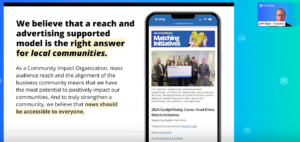
Village Media is the industry’s favorite security blanket. For years, the narrative has been simple: "Look at these guys. They’ve cracked the code on local news by focusing on 'service'—directories, obituaries, and community listings." It sounds wholesome. It sounds sustainable. It is also a slow-motion car crash for the actual craft of journalism.
The industry is obsessed with the idea that "service journalism" is the savior of the local beat. We are told that if we just provide enough utility—tell people where to find the best pizza or when the city council meeting starts—the revenue will follow. I’ve watched newsrooms burn through their remaining runway chasing this "utility" dragon, only to find that being a digital yellow pages doesn't actually fund a newsroom; it just funds a database.
Village Media hasn’t saved local news. They’ve perfected the art of the community bulletin board. There is a massive, structural difference between a platform that hosts information and a news organization that creates accountability. If your business model relies on being "useful" rather than "essential," you aren’t a journalist. You’re a concierge. And the concierge is always the first person fired when the economy dips.
The Utility Trap
The "lazy consensus" among media consultants is that people don't want hard news anymore; they want "news you can use." This is a fundamental misunderstanding of why people pay for information.
Utility is a commodity. Google, Yelp, and Facebook are better at utility than any local news site will ever be. If your value proposition is telling me the weather or the high school football scores, you are competing with trillion-dollar algorithms. You will lose.
Service journalism, as practiced by the darlings of the Canadian media scene, treats the reader as a consumer of services rather than a citizen of a democracy. It prioritizes the "how-to" over the "why-it-happened." This leads to a hollowed-out editorial product where the most clicked stories are about a new Starbucks opening, while the local zoning board quietly approves a development that will bankrupt the school district.
I’ve seen publishers pivot to this model and watch their "engagement" metrics skyrocket. They celebrate the traffic. But when they try to convert that traffic into subscribers or high-value donors, they hit a wall. Why? Because nobody feels a moral or civic obligation to pay for a restaurant recommendation.
The Myth of the Scalable Local
Village Media’s pride is its platform—a white-label solution they can drop into any mid-sized city. They argue that efficiency and centralized tech are the keys to survival.
This is the "McDonaldisation" of the press.
Local news is, by definition, unscalable. The moment you try to standardize the "look and feel" and the editorial process of news across fifty different cities, you lose the very thing that makes local news valuable: its grit. When you walk into a Village Media site, you aren’t entering a community space; you’re entering a template.
The overhead is lower, sure. But the soul is gone. Real journalism requires local intuition, deep-rooted connections, and the freedom to spend three weeks on a story that might only get 500 views but will result in a provincial inquiry. The Village Media model, and its many imitators, creates a treadmill of low-stakes content designed to satisfy advertisers, not to challenge power.
Why Community Lists Aren't Journalism
Let’s talk about the "Business Directory."
The industry line is that these directories "engage the local business community." In reality, they are a desperate attempt to claw back ad dollars that left for Google Ads fifteen years ago.
When a newsroom starts prioritizing its business directory over its investigative desk, it has stopped being a newsroom. It has become a marketing agency with a side hustle in reporting. This creates a dangerous conflict of interest. Are you going to investigate the labor practices of the "Top Rated" contractor who pays for a premium listing in your directory? Probably not. You’ll "service" them instead.
We have confused "community support" with "civic health." A community can be very well-supported with information about garage sales and lost cats while its civic health is in total organ failure.
The Accountability Gap
The biggest lie in the service journalism manual is that it "builds trust."
It doesn't build trust; it builds familiarity. Trust in journalism is earned through the friction of accountability. It’s earned when a publication tells its readers something they didn’t want to hear, or something the local mayor didn't want them to know.
Service journalism avoids friction. It is designed to be frictionless. It is pleasant. It is "nice."
But "nice" doesn’t keep the lights on when a hedge fund decides to buy your building. Only "indispensable" does that. If your local news site disappeared tomorrow, would people miss the coupons, or would they be terrified because there’s no longer anyone watching the people with the guns and the money? If the answer is the former, you aren’t running a news organization.
The Hard Truth About Revenue
Stop looking at Village Media as a blueprint for journalism. Look at them as a blueprint for a local advertising network.
If you want to actually save local news, you have to do the things that don't scale.
- Ditch the "Useful" Content: If a bot can write it, don't publish it.
- Lean Into Conflict: Not for the sake of "both sides," but for the sake of truth. High-friction reporting is the only thing people will eventually pay for.
- Kill the Ad-Tech Obsession: The "scalable platform" is a myth that serves tech providers, not reporters. Your CMS should be invisible, not a straightjacket.
- Accept the Boutique Reality: Local news is a high-cost, low-volume business. It is a luxury good for the civically minded, not a mass-market commodity.
The industry is currently patting itself on the back for "pivoting to service." It feels good. It looks like growth on a chart. But it is a retreat. It is an admission that we have given up on the difficult, expensive, and essential work of investigative reporting in favor of being a digital town crier.
We are replacing watchdogs with golden retrievers. They’re friendlier, they’re easier to manage, and they’re great for "community engagement." But they won't stop the house from being robbed.
Stop trying to be useful. Start being dangerous.