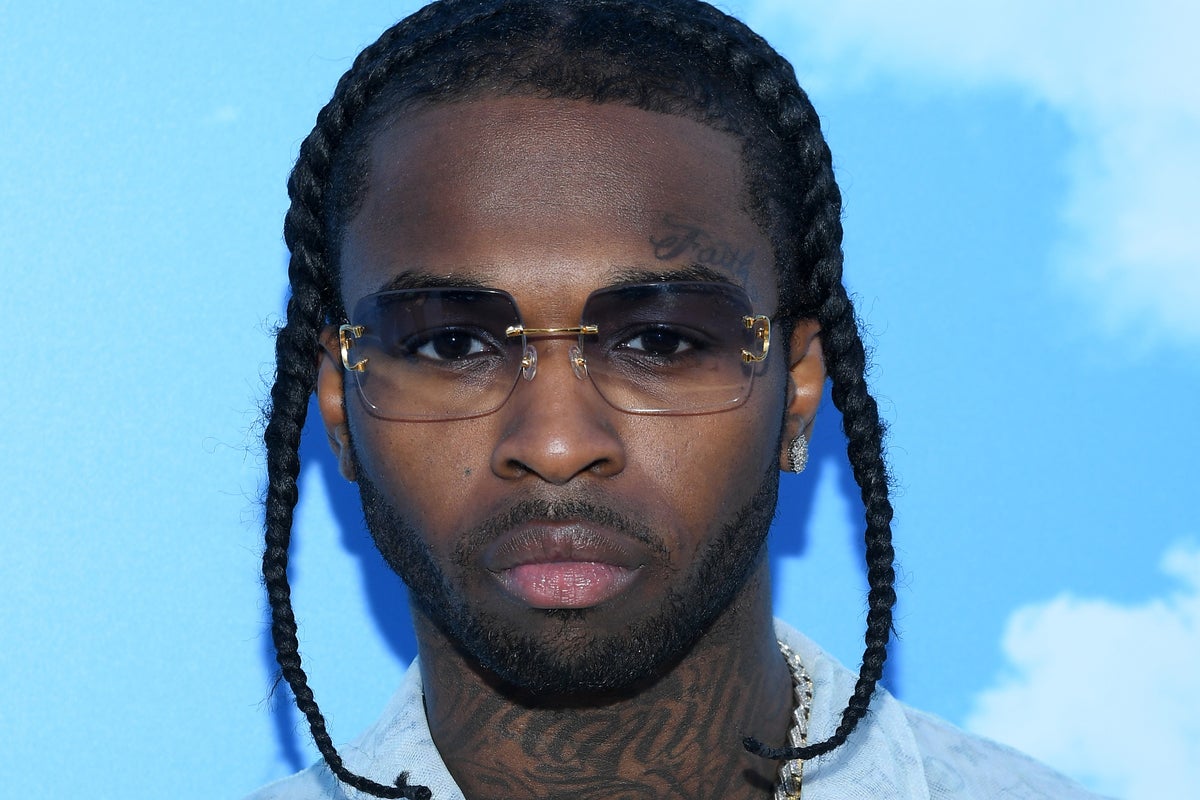
Fame is supposed to grant immortality. When a twenty-year-old rapper from Brooklyn named Bashar Jackson—known to the world as Pop Smoke—was murdered in a Hollywood Hills home in February 2020, the music industry stopped. His voice, a low, gravelly rasp that sounded like it had been dragged across asphalt, was suddenly silenced. The heavy bass of the drill beat he helped popularize rolled away, leaving a vacuum.
For the public, it was a tragedy of wasted potential. A young man with platinum records and an infectious grin cut down just as his life was expanding. But behind the bright lights of the tabloids, the courtrooms, and the streaming charts, a much quieter, more sordid machinery kept turning.
Justice crawled. Arrests were made. Juveniles stood before judges, their faces too young for the gravity of the charges against them. One of those teenagers, the one who pulled the trigger, was sentenced. You would think the story ends there. You would think the system, heavy and bureaucratic, closes its ledger.
It does not.
Instead, the story bleeds outward, leaking into places it should never reach. Concrete boxes. Steel doors. Juvenile detention facilities.
Consider what happens when a boy whose life is already forfeit inside a cell decides to stretch his boundaries. Not toward rehabilitation. Not toward redemption. Toward contraband.
Corey Walker and his co-defendants made headlines when the details of Pop Smoke’s homicide emerged. But the spotlight fades fast. Years pass. The cameras leave the courthouse steps. The reporters go home. Yet the legal consequences ripple across time like stones dropped in dark water. Recently, the person convicted in that fatal robbery found himself facing an additional four years behind bars.
Why? Fentanyl.
Drug smuggling inside a juvenile facility sounds like a Hollywood script. It sounds impossible. How does a synthetic opioid, a drug potent enough to stop a charging bull in its tracks, find its way past guards, metal detectors, and reinforced glass?
Human error. Desperation. Greed.
I have walked the corridors of correctional facilities—not as an inmate, but as an observer watching the slow decay of human potential. I know the smell of stale floor wax, institutional cleaner, and unexpressed panic. It is a suffocating odor. In that environment, contraband is currency. It buys protection. It buys silence. It buys a fleeting, chemical numbness from the inescapable reality of a ruined life.
When you introduce fentanyl into a locked room full of adolescents, you are not just smuggling an illegal substance. You are lighting a fuse in a powder keg. A single grain of that white powder can mean the difference between breathing and waking up dead on a cold linoleum floor.
The courts looked at the new charges and added four years. Four more years tacked onto an already staggering sentence. To a teenager or a young adult, numbers like twenty or thirty years lose all meaning. They become abstract concepts, distant mathematical problems. But four extra years means growing older in a cage. It means watching the world outside evolve while your universe remains confined to a narrow strip of sky visible through reinforced mesh.
We talk about violent crime as if it occurs in a vacuum. We isolate the moment of the gunshot, the flashing police lights, the yellow crime scene tape, and the grieving family standing behind a podium. We treat the crime as a discrete event with a beginning, middle, and end.
It never ends.
The trajectory of violence is a contagion. It spreads from a rented mansion in the Hollywood Hills to the holding cells of a youth detention center, carried by the same reckless disregard for human life that sparked the original tragedy. The boy who participated in a robbery that claimed a rising star's life could not leave the life behind, even behind bars. The habits of the street—the hustle, the contraband, the risk—followed him through the iron gates.
This is the invisible cost of our cultural fascination with high-profile crime. We consume the true crime podcasts, read the court transcripts, and dissect the lyrics of fallen artists, searching for clues or catharsis. Meanwhile, the actual machinery of the justice system grinds forward, revealing a depressing monotony. It is rarely cinematic. It is mostly administrative paperwork, prison yard contraband, and the slow, grinding waste of young lives.
Fentanyl does not care about Billboard charts. It does not care that the person holding it was tied to the murder of a generational talent. It only destroys. The addition of four years to a sentence is a legal punctuation mark, but it fails to address the underlying rot.
When we look at the life of Pop Smoke, we see a snapshot of a cultural movement cut short. When we look at the subsequent drug smuggling charges of his killer, we see the tragic, mundane continuation of that same destructive impulse. There is no grand redemption arc here. There is only the steady hum of a fluorescent light overhead, casting a harsh glare over concrete walls that refuse to let go of the past.