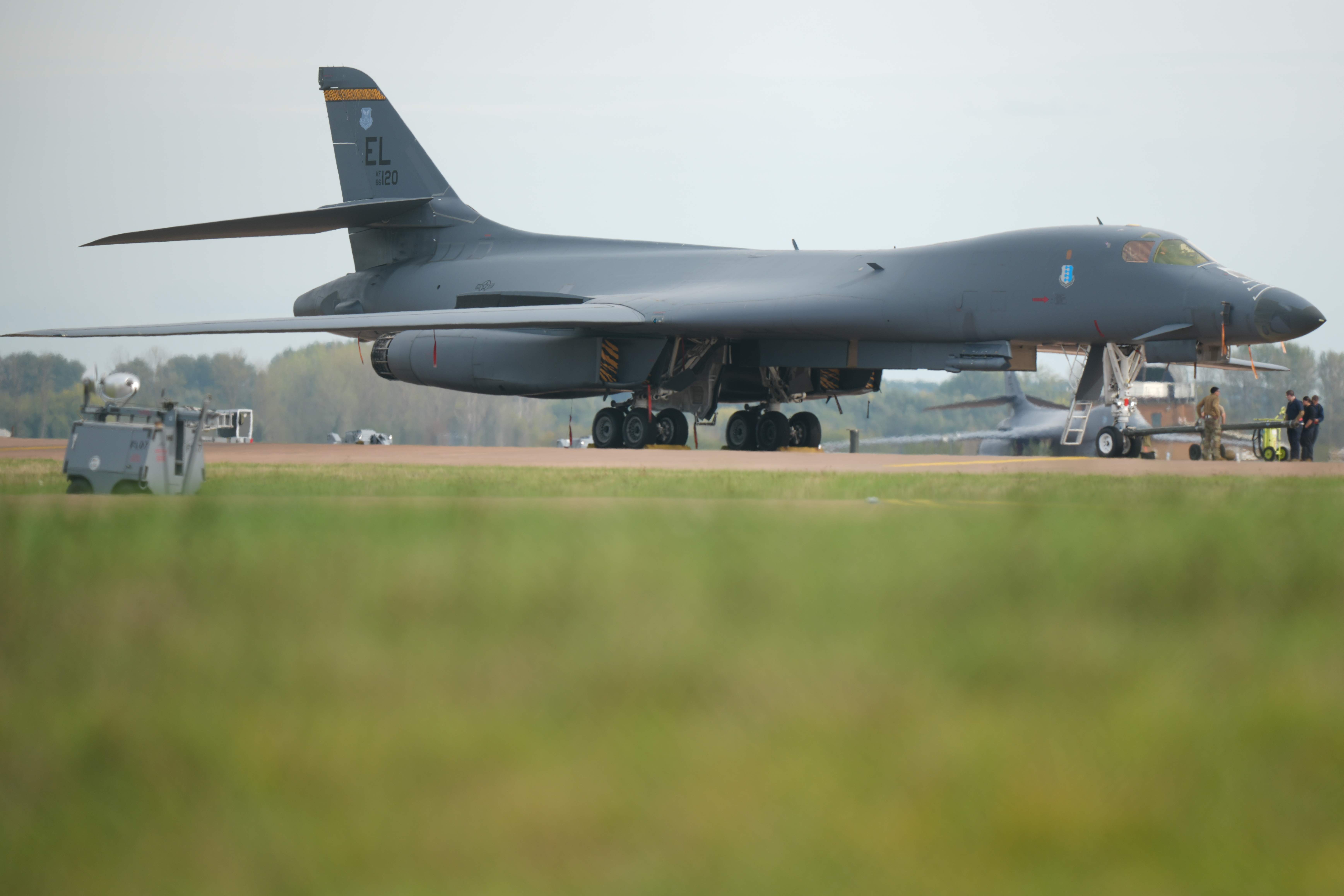
The sheep graze undisturbed on the rolling meadows of Gloucestershire, indifferent to the massive grey silhouettes resting behind reinforced concrete and razor wire. To a casual passerby on the winding country lanes near Fairford, the airfield is simply a fixture of the horizon, a distant hum of heavy jet engines shaking the dew from ancient oak leaves. It looks sleepy. It feels isolated.
It is anything but.
When the British government quietly pointed toward Tehran regarding an unsettling security breach at the Royal Air Force base, the announcement landed with the muffled thud of a classified dossier hitting a mahogany desk. No sirens wailed across the Cotswolds hills. No breaking news banners flashed across televisions in local pubs. Yet, beneath the veneer of pastoral calm, a silent tremor had registered on the global seismograph. A line had been crossed. Distance no longer offered sanctuary, and the quiet English countryside found itself unexpectedly stitched into the frontline of a shadow war stretching thousands of miles away.
Consider what happens next when a major military logistics hub becomes an object of hostile curiosity.
To understand the weight of the incident at Fairford, one must first understand what the base actually represents. RAF Fairford is not merely a collection of hangars and runways. It is a critical nexus of American global power projection, a forward staging post where B-52 strategic bombers can land, refuel, and launch into theaters of operation across the globe. When global tensions flare in the Middle East or Eastern Europe, the heartbeat of strategic deterrence echoes directly off these Gloucestershire tarmac strips.
For decades, the security model protecting such installations was built on a straightforward premise. Physical walls, armed patrols, and geographic isolation were supposed to provide an impenetrable shield. If an adversary wanted to strike or disrupt a military capability of this magnitude, the traditional logic dictated they would need overt escalation, a declared crisis, or direct military confrontation.
That logic has dissolved.
Modern conflict has evolved into a continuous, low-intensity friction where the boundaries between peace and war blur into an unrecognizable gray zone. Adversaries do not need to drop bombs to disrupt operations. They probe. They test perimeters, both physical and digital. They map vulnerabilities, cultivate local intelligence, and measure response times.
When intelligence analysts in London began piecing together the telemetry and forensic evidence surrounding the Fairford breach, the trail of breadcrumbs did not lead to a common criminal or a rogue trespasser looking for an adrenaline rush. It pointed toward statecraft. Specifically, it pointed toward the sprawling intelligence apparatus of the Iranian state and its network of proxies and operatives who specialize in operating in the shadows.
Let us step into a hypothetical scenario to ground this abstract threat in human reality. Imagine a nondescript sedan parked on a gravel layby three miles from the base perimeter late on a damp November evening. Inside sits an operator whose face is illuminated only by the cold blue glow of a tablet screen. They are not wearing a uniform. They bear no insignia. They are receiving encrypted data packets relayed from a small, low-altitude drone hovering silently near the outer fence line—a drone equipped with thermal optics and RF sensors designed to map the patrol schedules of military police and locate the emergency power generators servicing the flight line.
This is not Hollywood fiction. This is the daily reality of modern reconnaissance. Every military installation in the Western world is constantly being scanned, poked, and prodded by actors who understand that information is the most valuable currency in asymmetrical warfare.
Why Fairford? Why would Tehran invest time, risk, and resources into probing an air base in rural England?
The answer lies in the interconnected nature of modern military logistics. An adversary cannot hope to counter American strategic power solely in the Persian Gulf or the Strait of Hormuz. Power projection is a chain, and a chain is only as strong as its logistical and staging nodes thousands of miles from the actual conflict zone. By understanding the vulnerabilities at Fairford—how quickly security forces mobilize, where communication blind spots exist, what electronic signatures leak from the command posts—an adversary gains a psychological and tactical advantage. It is about gathering leverage. It is about knowing where to press when the geopolitical temperature eventually boils over.
Yet, acknowledging this reality creates a profound diplomatic and strategic dilemma for the United Kingdom.
When a state actor is implicated in a hostile act against a critical military installation on British soil, the immediate reflex of the public is to demand a dramatic response. Retaliation. Sanctions. Expulsions. But statecraft is rarely so cinematic. It is a grinding, delicate exercise in calibration.
Intelligence officials must weigh the immediate desire to punish against the broader imperative of protecting sources and methods. To reveal how you know something is to reveal your own listening posts. If MI5 and counter-terrorism police publicly lay out every intercepted communication, every recovered digital footprint, and every identified operative, they risk blinding themselves for the next encounter. They give the adversary a blueprint of their own capabilities.
Therefore, the statements released by British authorities are intentionally measured, cautious, and laced with diplomatic nuance. They hint at attribution without laying bare the entire ledger. They send a private message to Tehran that says: We see you. We know what you are doing. Do not mistake our restraint for ignorance.
Silence can be louder than a megaphone.
But this quiet diplomacy leaves the civilian population in a strange emotional limbo. People living in the picturesque villages surrounding Fairford—Fairford, Lechlade, Marston Meysey—walk their dogs past the same perimeter fences their grandparents walked past during the Cold War. To them, the base is a neighbor, sometimes a noisy one when the massive bombers roar overhead, but ultimately a familiar backdrop to rural life.
The revelation that this peaceful landscape is being scanned by hostile foreign eyes shatters a comforting illusion. It reminds us that globalization has a dark twin. The very interconnectivity that allows goods, ideas, and people to move rapidly across borders also allows malice, espionage, and cybernetic probes to bypass traditional geographic defenses.
We live in an era where the frontline is everywhere.
Consider the security guard standing watch at Gate 3 of RAF Fairford on a freezing, mist-shrouded dawn. His boots crunch on the gravel. His breath billows in the damp air as he shines his heavy-duty flashlight along the base of the chain-link fence. He is focused, vigilant, attuned to the subtle rustle of leaves or the unnatural shadow in the distance. He is the physical embodiment of a barrier that millions of citizens assume is absolute.
Yet, the threat he guards against is not just a person trying to climb a fence. It is an invisible stream of data being harvested by a server thousands of miles away. It is an insider vulnerability waiting to be exploited through a targeted phishing email sent to a contractor's laptop in a nearby town. It is the quiet accumulation of intelligence that turns an impenetrable fortress into a transparent fishbowl.
The realization that Iran may have played a part in this incident forces a reckoning within Western defense circles. It highlights the dangerous complacency that can set in during periods between major wars. For years, counter-terrorism resources were heavily weighted toward non-state actors like extremist networks—groups driven by ideology rather than the methodical, patient statecraft of a sovereign government with a permanent intelligence service.
State-backed espionage is patient. It operates on timelines measured in years, not news cycles. An operative can sit dormant in a European city for a decade, blending seamlessly into the local populace, waiting for a single moment when access to a secure facility or a piece of logistical data becomes available.
When that patience intersects with advanced technological tools like commercial drones, encrypted messaging platforms, and sophisticated cyber intrusion techniques, the challenge multiplies exponentially. Traditional perimeter security is designed to keep people out of physical spaces, but it was never fully optimized to defend against the invisible bleed of data and reconnaissance in an era of total surveillance.
What happens when the line between peacetime espionage and active sabotage blurs entirely?
That is the question haunting defense planners in Whitehall and the Pentagon today. The incident at Fairford is not an isolated anomaly. It is part of a broader, systemic campaign by revisionist powers—ranging from major adversaries to regional actors like Iran—to test the resolve, readiness, and vigilance of the democratic alliance. They are probing the seams of our security architecture, looking for fraying threads where they can pull and watch the fabric unravel.
The British government's willingness to point the finger, even with diplomatic caution, signals a shift in posture. It reflects a growing recognition that opacity no longer serves the public interest. When hostile acts occur on domestic soil, sunlight remains the best disinfectant. Citizens deserve to know that the security landscape has fundamentally changed, not to induce panic, but to foster a realistic understanding of the world as it actually exists.
The mist is rising off the River Coln. The sheep continue to graze near the airfield perimeter, unbothered by the complex machinery of global geopolitics humming just beyond the wire.
Inside the control rooms and intelligence offices, however, the lights remain on. The screens continue to flicker with incoming telemetry, encrypted reports, and threat assessments. The quiet Cotswolds countryside remains picturesque, beautiful, and deeply deceptive. Above it all, the invisible architecture of modern defense stands alert, bracing for the next shadow that dares to test the fence.