The scent of lemongrass and roasting meat drifts across the night market in Denpasar, thick enough to mask the salt air coming off the coast. To the untrained eye, it is just another evening in Bali. Tourists snap photos of golden satay skewers sizzling over coconut husks, while locals crowd around wooden benches, talking over the hum of motorbikes.
But if you look closer, past the neon signs and the postcard-perfect beaches, a quiet desperation has gripped the Island of the Gods.
The emergency rooms tell a story that the tourism brochures omit. Children clutching torn skin. Parents with hollow eyes, waiting for test results that feel like a death sentence. Bali is currently locked in a brutal, escalating battle against rabies. It is an ancient virus, a shape-shifter that turns man’s best friend into a vector of absolute terror.
For years, public health officials pointed to the usual suspects: stray dog populations, a lack of vaccines, and porous borders between islands. But a darker, more complex variable has entered the equation. It is an industry that operates in the twilight, largely hidden from the average vacationer but deeply woven into specific local subcultures.
The trade of dog meat.
To understand how a dinner plate can become a biological hazard, you have to understand the virus itself. Rabies does not behave like a normal infection. It is a neurological sniper. Once clinical symptoms appear, the mortality rate is not just high; it is effectively one hundred percent.
Imagine a microscopic keysmith. The rabies virus is shaped like a bullet, and its sole mission is to find the highway of the nervous system. It binds to acetylcholine receptors at the site of a bite, slowly creeping up the spinal cord at a agonizingly predictable rate of a few millimeters to a few centimeters per day. Once it reaches the brain, it triggers a catastrophic swelling. The infected individual suffers from severe agitation, hallucinations, and hydrophobia—a terrifying phenomenon where the throat spasms violently at the mere sight of water.
Historically, the primary mode of transmission has been a bite or a deep scratch from an infected animal’s saliva. This is where standard medical advice stops. But the reality on the ground in Bali forces us to look deeper into the supply chain.
Consider a hypothetical vendor named Made. He does not run a glamorous restaurant in Seminyak; he operates a small warung on the outskirts of a rural village. To keep prices low and cater to a specific local demand for rw—a traditional dish made with heavily spiced dog meat—Made relies on unregulated suppliers. These suppliers do not source their animals from clean, monitored farms. They catch them.
They use wire nooses to snag stray dogs from the streets or snatch pets from backyard gardens in communities where rabies is already circulating.
The danger of this practice is not necessarily in the eating. The heat of a rolling boil or a blazing grill generally destroys the virus, which is fragile when exposed to high temperatures. The real peril lies in the shadow economy that brings the meat to the table.
It is the slaughterhouse floor.
When an infected dog is captured, it is terrified. A stressed, rabid animal is a ticking time bomb of viral shedding. During the capture, transport, and slaughter process, the risk of transmission skyrockets. The butchers work quickly, often without protective gear, using heavy knives in cramped, poorly lit spaces.
Think of the virus as a highly contagious, invisible ink coating the animal's saliva, nervous tissue, and brain matter. During butchery, the skull is often cracked open to harvest the brain, which is considered a delicacy or used in traditional preparations. This act aerosolizes fluids and exposes the butcher’s hands—often covered in minor cuts and scrapes from daily manual labor—directly to the highest concentration of the virus.
Medical data from across Southeast Asia confirms that individuals involved in the culling, transporting, and butchering of dogs face a disproportionately high risk of contracting rabies, even if they have never been bitten by a live animal. The virus finds a backdoor through the broken skin of a worker's knuckle or the mucous membranes of their eyes during the frantic chaos of the slaughter.
The problem multiplies when we look at how the virus spreads geographically. Left to their own devices, dogs are territorial. A rabid dog will wander, but usually only as far as its failing neurological system allows before it succumbs.
The dog meat trade gives the virus wheels.
Traders stack dozens of dogs into the backs of trucks, driving them across regencies, bypassing quarantine checkpoints under the cover of night. An infected dog caught in Karangasem might be driven hours away to a kitchen in Denpasar or Badung. Along the way, these dogs fight, bite each other in close confinement, and urinate, creating a rolling incubator of disease that traverses the entire island.
This human-driven movement breaks every rule of epidemiological containment. It creates random, unpredictable hot spots that blindside local health authorities who are trying to manage vaccine distribution.
The tragedy of Bali’s rabies surge is that it is entirely preventable. The island successfully eradicated the disease from its historical narrative for centuries until a single infected dog was brought over by fishermen in 2008. Since then, it has been a game of whack-a-mole.
Public health campaigns often focus heavily on dog vaccination drives, which are vital. If seventy percent of the dog population is vaccinated, herd immunity forms a protective shield around the human population. But the dog meat trade actively dismantles this shield. It removes vaccinated animals from communities and replaces them with an influx of untested, high-risk animals brought in from the fringes.
The solution cannot merely be a matter of passing laws that go unenforced. The dog meat trade exists because of a complex intersection of poverty, cultural tradition among certain migrant communities, and a lack of awareness about the biological mechanisms of viral transmission.
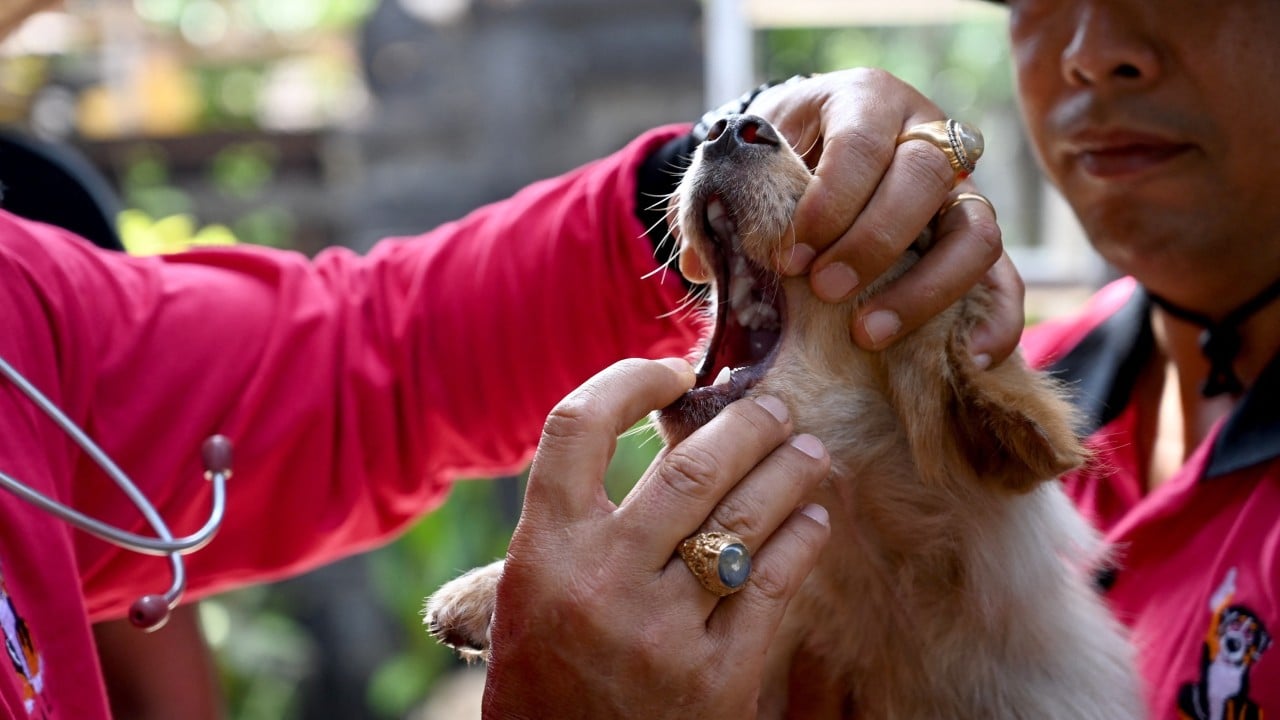
Walk through the quiet villages of Bali’s interior, away from the infinity pools and luxury resorts, and you will see the true cost of this crisis. You will see elders who remember a time when dogs were simply guardians of the family compound, not potential harbingers of agonizing death. You will see local volunteers risking their own safety to vaccinate strays in the pouring rain, trying to outrun a supply chain that moves faster than their needles.
The sun sets over the Indian Ocean, painting the sky in brilliant hues of crimson and violet. On the beach, tourists toast to another day in paradise. A mile inland, a stray dog barks into the gathering dark, its voice echoed by another down the road, while a truck engine starts up in the shadows, loaded with cages, heading toward the markets.
,webp/025/102/772/1280x720.17252177.jpg)


.jpeg?width=1200&auto=webp&trim=0%2C86%2C0%2C85)